✘ Malaga, Spain • December 31, 2025
⌖ Inland Crossing to Córdoba
Tour Route: Málaga → Córdoba → Mezquita-Catedral → Judería → Lunch → Málaga
We departed Málaga by coach at sunrise, leaving the Mediterranean coast and heading inland toward Córdoba. The route followed primary highways north through Andalusia, gradually replacing dense urban development with open countryside and agricultural land.
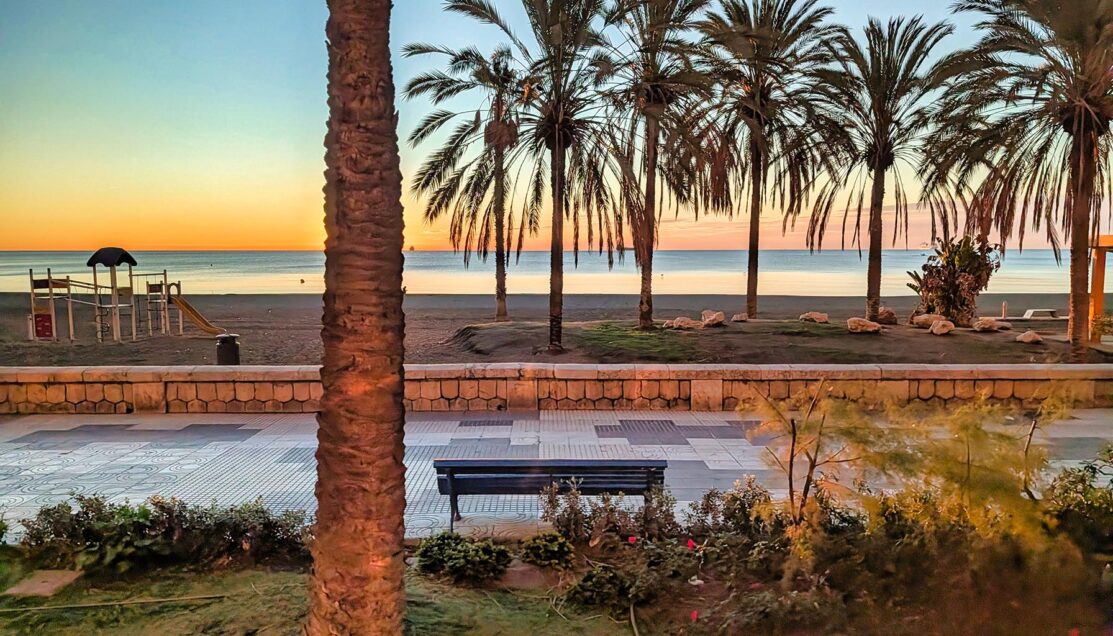
The palm-lined promenade along Málaga’s coast marks the starting point of the inland transfer toward Córdoba.
The journey covered roughly 90–100 miles and required just over an hour and a half, under light holiday traffic. The early departure was necessary to align with timed entry at the Mezquita-Catedral and to allow for a full walking circuit and scheduled lunch before returning to the ship. No stops were made en route.
As we approached Córdoba, low winter fog softened the skyline along the Guadalquivir River. The coach parked near the edge of the historic center, where we disembarked and transitioned from highway travel to on-foot exploration.
① Roman Bridge of Córdoba
⚲ Roman Bridge → Old Town Entry Plaza, Córdoba, Spain
⧗ ~20 minutes
We began walking toward the Roman Bridge along the riverfront path, where the historic skyline gradually emerged through the morning fog. From this approach, the bridge formed a long stone passage leading directly toward the walled city beyond.
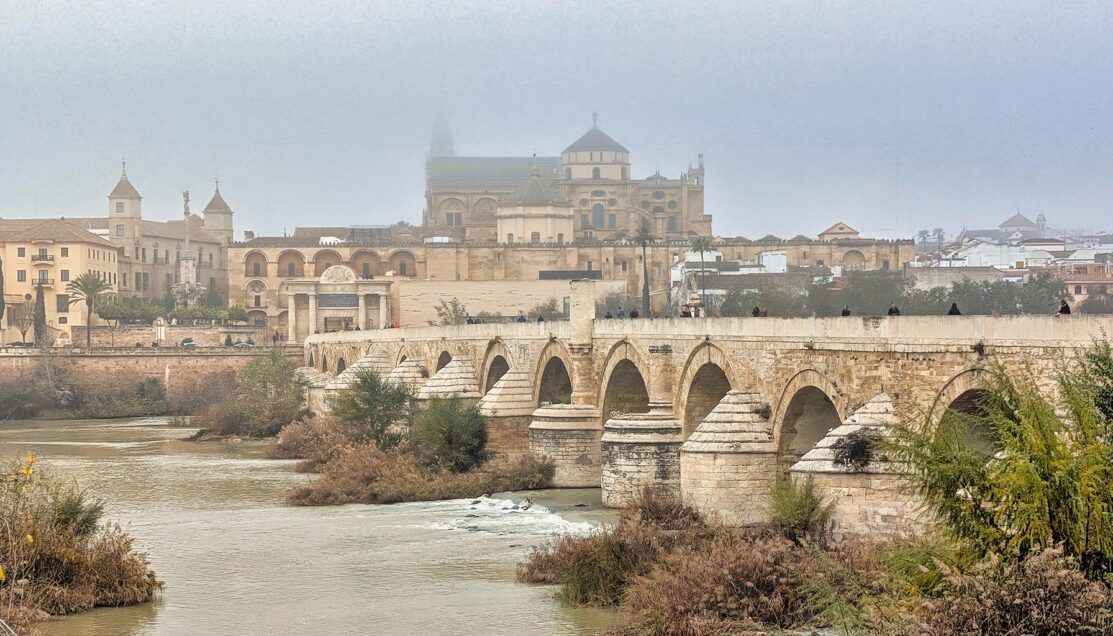
The Roman Bridge spans the Guadalquivir River with the Mezquita-Catedral rising beyond it, marking Córdoba’s historic western approach into the city.
Broad stone slabs and gently sloped paving guided us onto the bridge deck. The surface was level and easy to navigate, though slightly damp from overnight moisture. Low parapet walls bordered both sides, opening wide views along the Guadalquivir and emphasizing the bridge’s narrow, linear form.
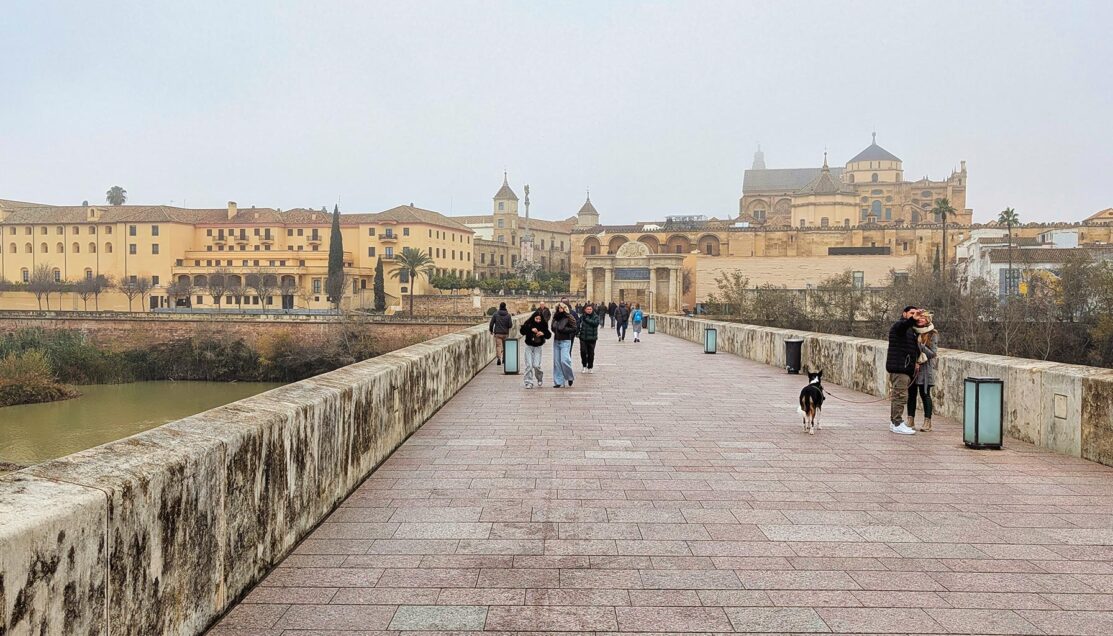
Visitors cross the Roman Bridge toward Córdoba’s historic center along its original west-to-east approach.
From the center span, the defensive outline of Córdoba became more defined. Rooftops clustered behind the perimeter walls, and the rising mass of the Mezquita-Catedral aligned almost perfectly with the bridge axis. The alignment of the bridge, walls, and cathedral drew attention forward toward the old city.
Here, the guide paused the group and explained that this had served as Córdoba’s principal western entrance since Roman times. Later Islamic and Christian rulers preserved and reinforced the route rather than replacing it, recognizing its strategic value in controlling trade, taxation, and access.
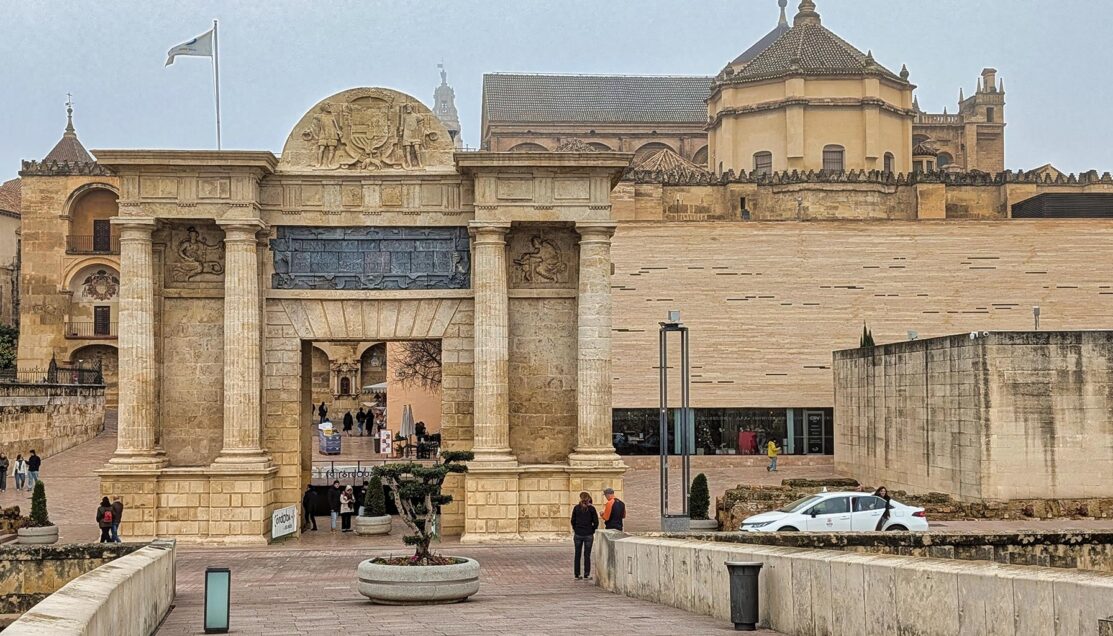
The Bridge Gate frames the approach from the Roman Bridge into Córdoba’s historic center.
At the north end, we stepped into a broad stone-paved plaza just inside the historic walls. Orange trees lined sections of the square, and the surrounding towers and masonry made the defensive layout immediately apparent.
We gathered in a loose semicircle while the guide reviewed Córdoba’s Roman, Islamic, Jewish, and Christian periods, using nearby buildings and streets as reference points. Standing there, it was easy to see how each era had left its mark on the layout and construction around us.
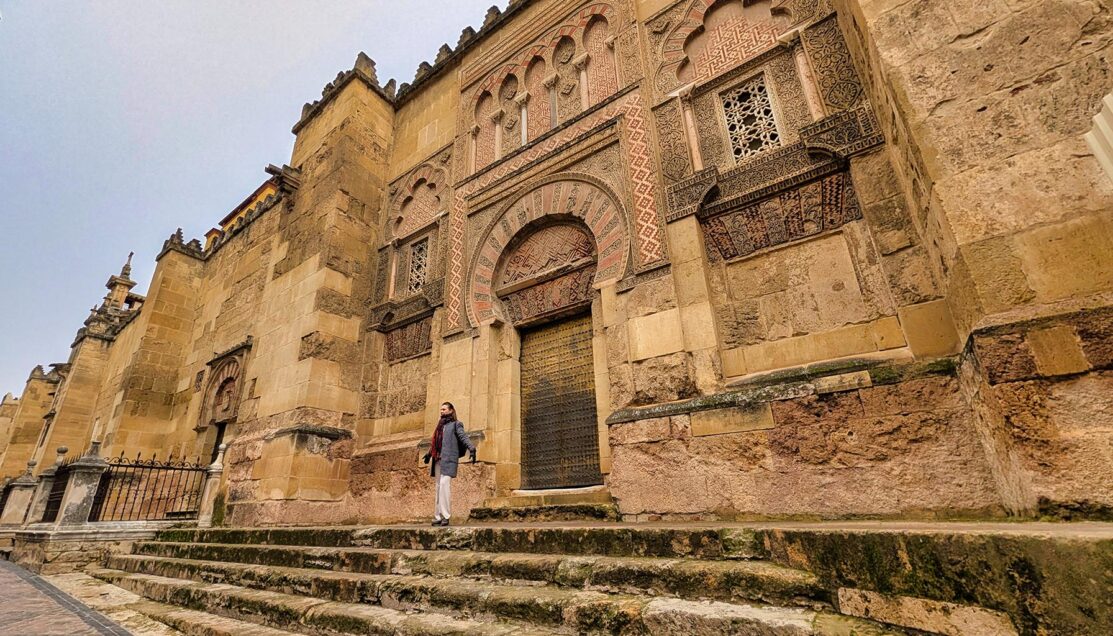
The Gate of Forgiveness displays layered Islamic and Christian stonework marking the principal street entrance to the complex.
After the orientation, she redirected us into the narrow streets leading toward the Mezquita-Catedral. Leaving the open river threshold behind, we entered the tighter street network that defines Córdoba’s medieval district and followed it directly to the main entry gate.
② Mezquita-Catedral Interior Visit
⚲ Mezquita-Catedral de Córdoba, Córdoba, Spain
⧗ ~1 hour
At the entry gate, we paused while tickets were processed and the group was reassembled. Visitor controls limited how many people could enter at once, so we moved inside in stages. Crossing the threshold, street noise dropped away, replaced by cooler air and muted acoustics.
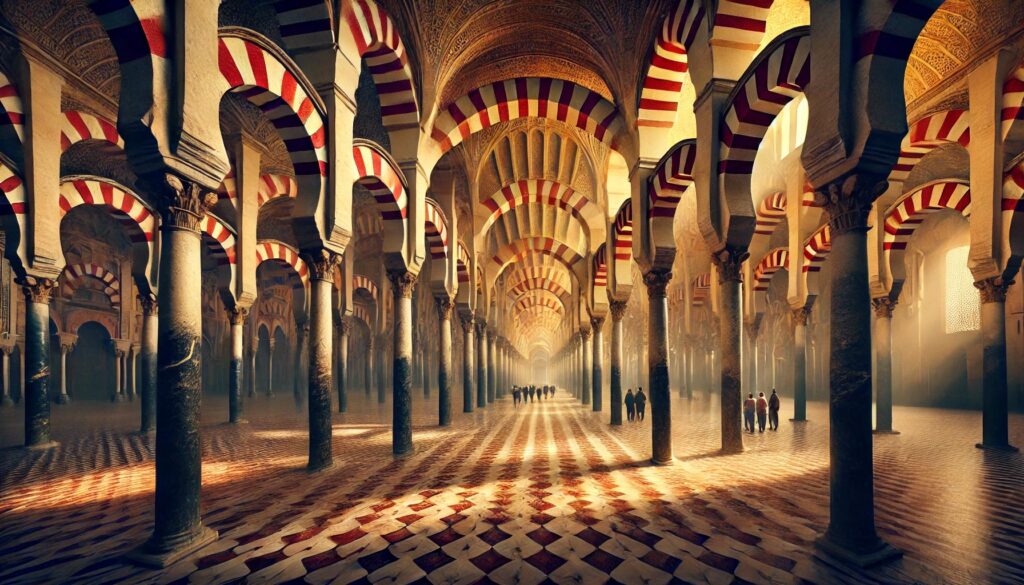
Our first view was into the former mosque’s hypostyle hall. Rows of closely spaced columns supported layered red-and-white arches that extended in every direction. From this initial standing position, the repeating geometry created long visual corridors with no clear center, making orientation difficult and emphasizing the scale of the space.
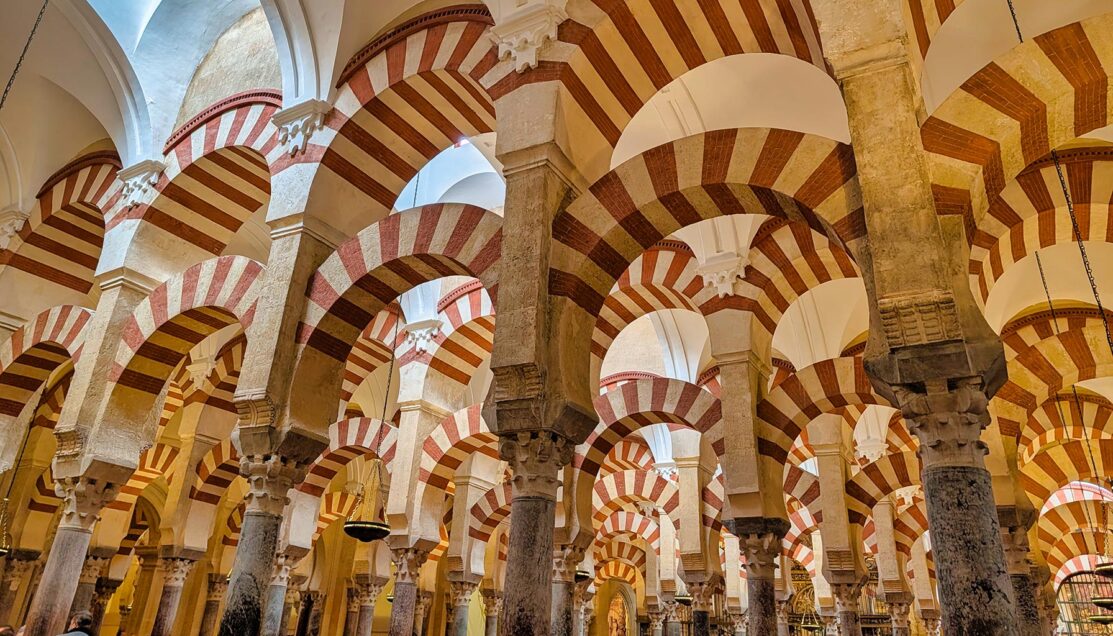
Double-tiered red-and-white arches rise from tightly spaced columns in the former mosque hall.
Positioning us near a main interior aisle, the guide explained that the mosque had been expanded repeatedly during the Islamic period. Rather than rebuilding, successive rulers extended the structure outward, adding new rows of columns and arches. She pointed out subtle differences in materials and spacing that marked these construction phases.
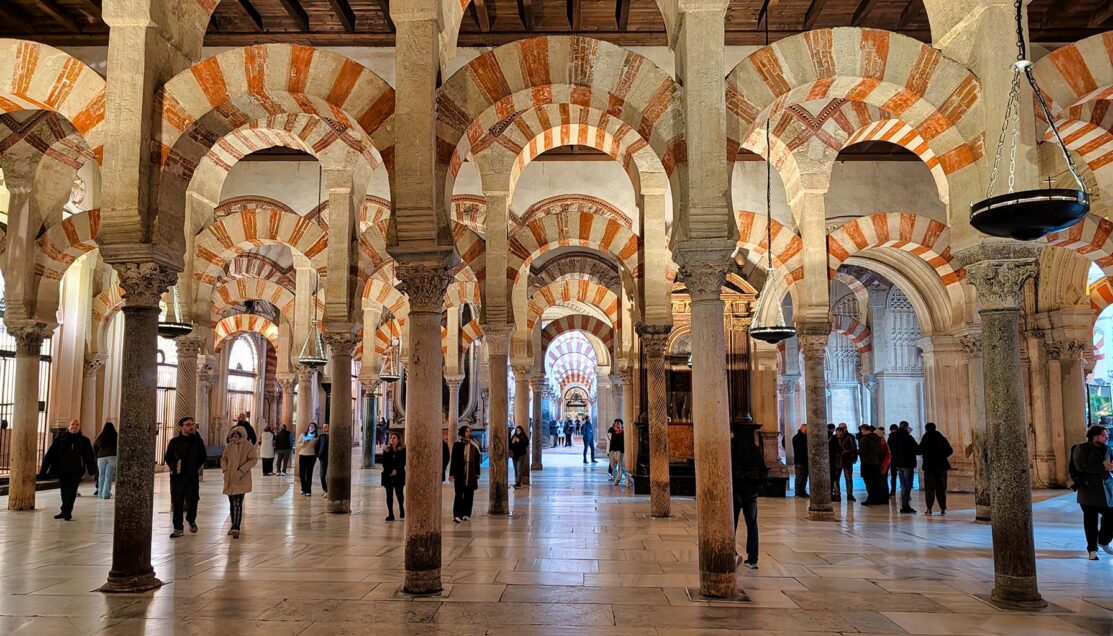
Repeating red-and-white arches supported by closely spaced stone columns form long visual corridors inside the Mezquita-Catedral’s former mosque hall.
As we moved forward, crowd density dictated a loose single-file pattern. The polished stone floor was smooth and level, allowing steady walking, though frequent stops were necessary as the guide regrouped us at key points.
At one section of the floor, she directed our attention to protected panels revealing earlier structural elements preserved beneath the present surface. These remains illustrated how later renovations had been layered directly over earlier foundations.
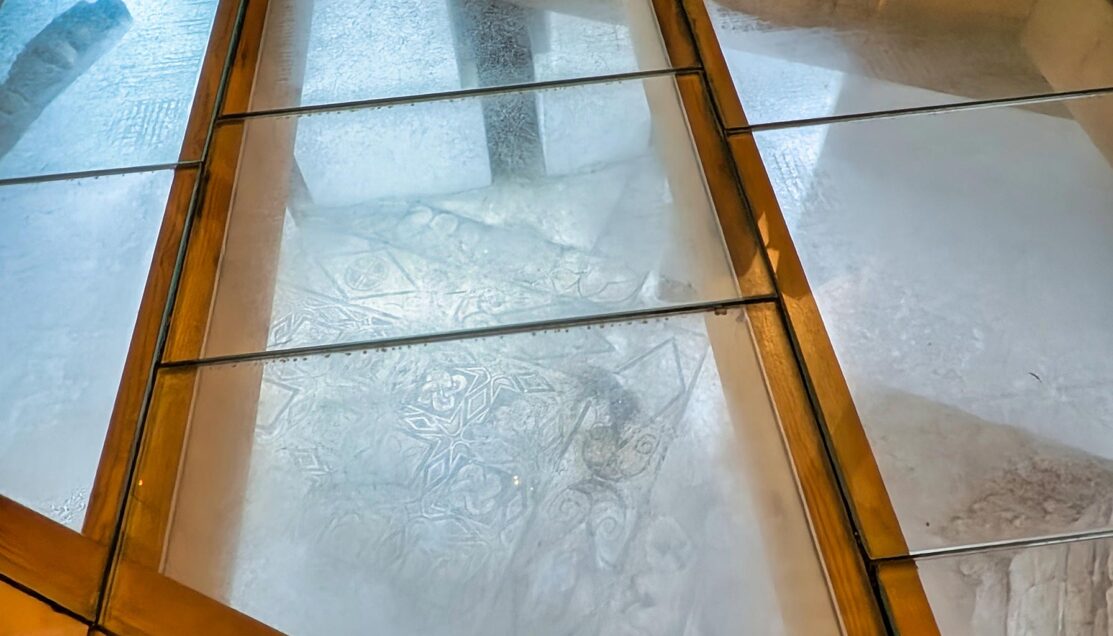
Glass panels expose preserved foundations from earlier construction phases beneath the present floor.
The Mihrab and Royal Maqsura
As we advanced toward the southern end of the mosque hall, the rhythm of arches gradually compressed into a more concentrated architectural focus. Ahead, behind a locked barrier, stood the mihrab — the most elaborately decorated surviving element of the 10th-century Great Mosque.
Unlike a shallow directional niche, the mihrab here forms a small chamber framed by gold Byzantine mosaics and dense Quranic inscriptions commissioned under Caliph al-Hakam II. The shimmering tesserae and carved stone surfaces marked a deliberate assertion of Umayyad authority at the height of Córdoba’s political and cultural influence.
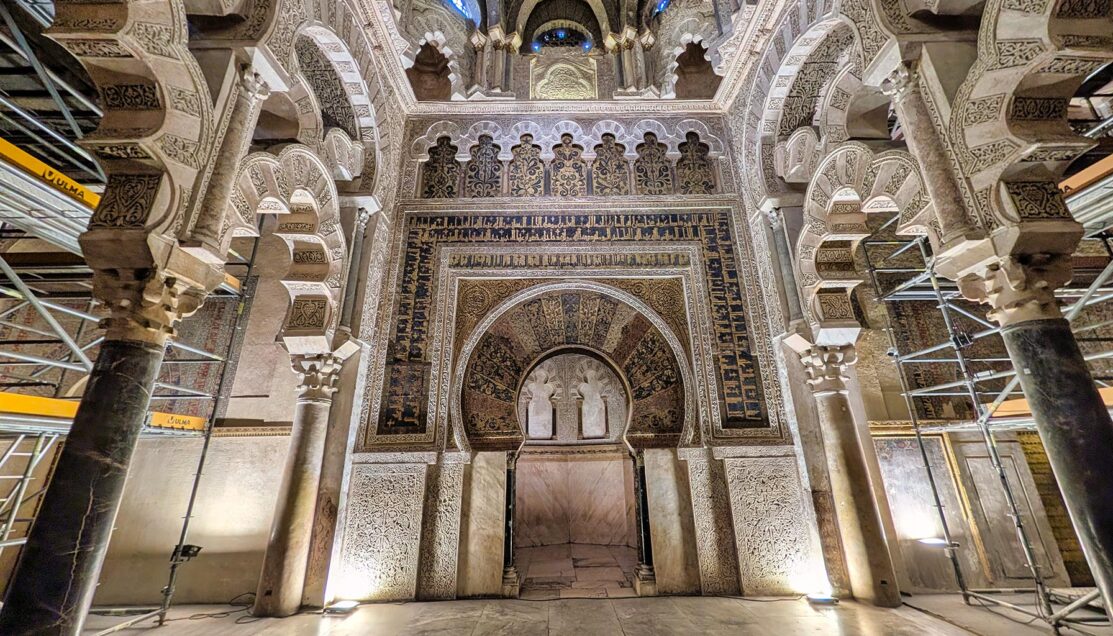
The horseshoe-arched mihrab, encased in gold Byzantine mosaics and Quranic inscriptions.
Surrounding it, a network of interlaced lobed arches forms the maqsura, a restricted royal enclosure where the caliph once prayed under protection. The intricate carving creates a layered screen effect, visually separating this sacred core from the broader hall.
Above, a ribbed dome crowned the space with geometric precision. The intersecting ribs do not function structurally in the Gothic sense but instead organize ornament into a star-like composition, concentrating attention downward toward the mihrab.
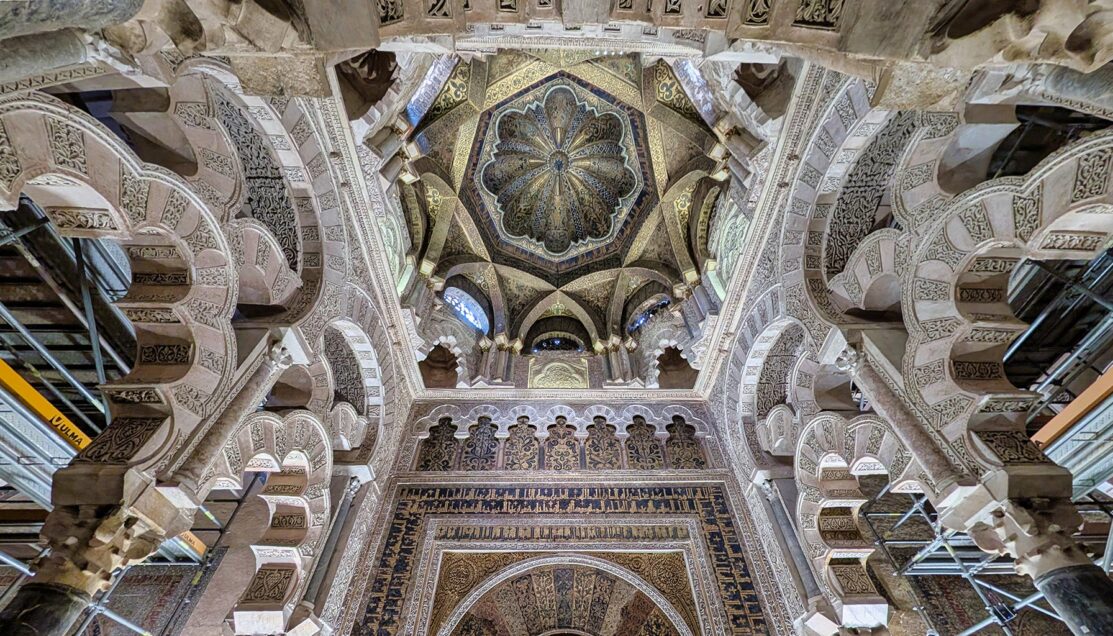
The intersecting ribbed dome crowning the 10th-century mihrab zone.
This area was densely crowded. Visitors compressed toward the barrier, phones raised, as the intricacy of detail demands close inspection but allows little room to disperse. After the lateral openness of the hypostyle hall, the visual intensity here felt contained and ceremonial — a final architectural crescendo of the Islamic phase before the later Christian interventions beyond.
Christmas Nativity Display Within the Arches
Near the transition toward the cathedral section, we encountered a large Christmas nativity display arranged directly beneath the striped arches. The scene was built up with miniature hills, olive trees, stone structures, shepherds, animals, and processional figures, spreading across a raised platform surrounded by low barriers.
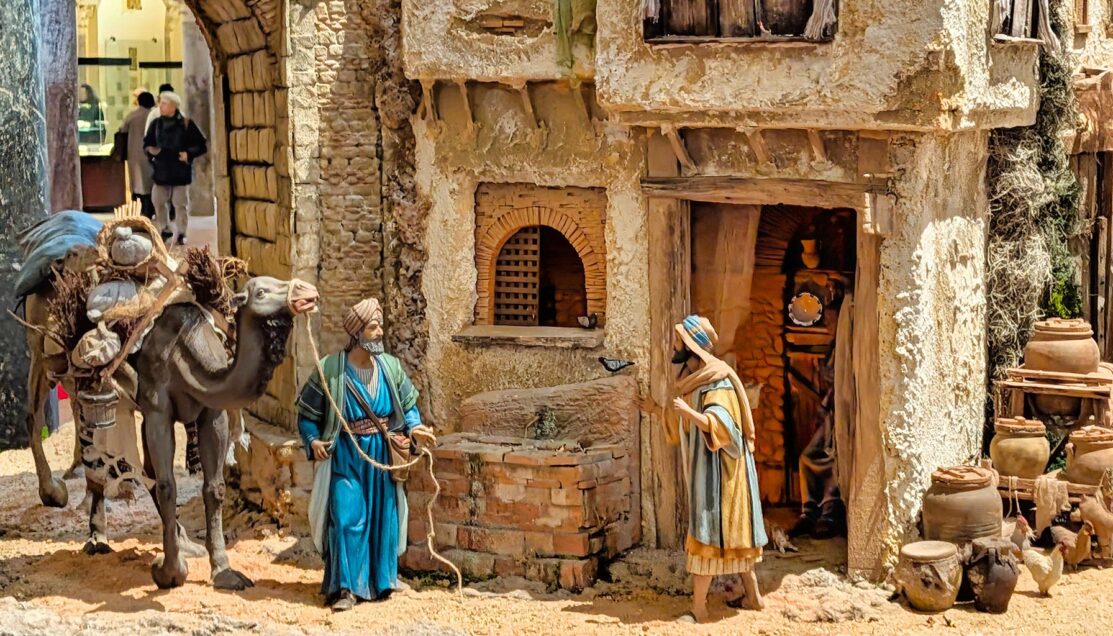
A seasonal nativity display depicting a camel caravan and village storefronts sits beneath the Mezquita-Catedral’s arches.
Set within the repeating columns, the display blended unexpectedly into the surrounding architecture. Biblical figures and miniature landscapes sat beneath arches originally designed for Islamic prayer, creating a seasonal overlay that reflected how the building continues to absorb new layers of use without removing the old ones.
Historic Clock Mechanism Display
Just beyond the nativity display, and before entering the choir area, we paused beside a glass-enclosed exhibit housing a preserved mechanical clock mechanism. The exposed wooden frame, iron gear trains, vertical shafts, and weight channels demonstrated how liturgical timekeeping once operated through gravity-driven systems within the cathedral complex.
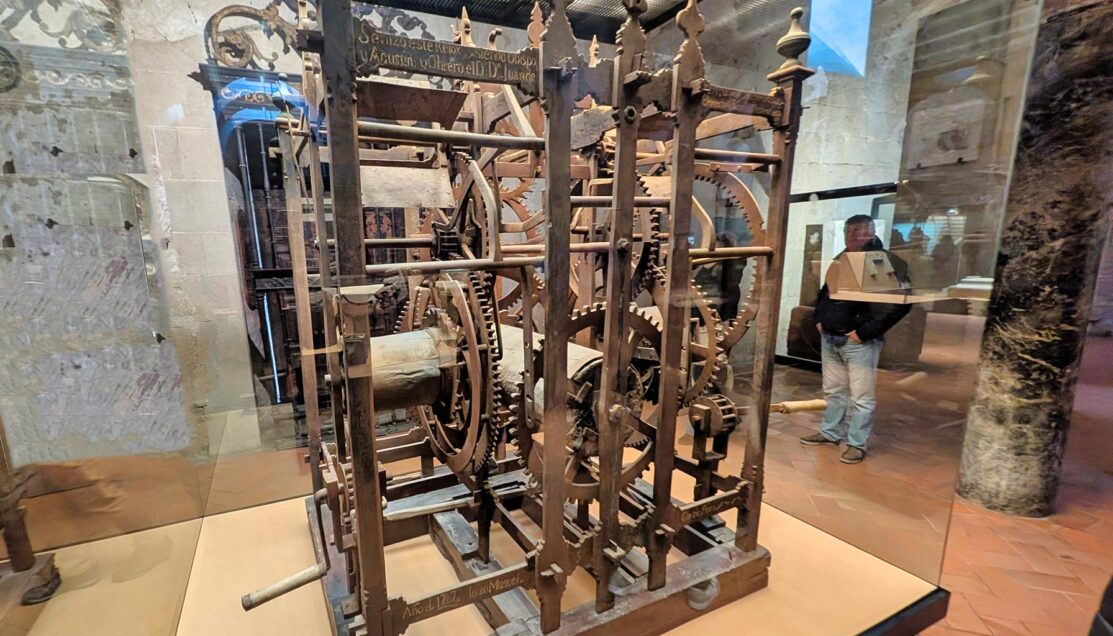
A preserved iron-and-wood clock mechanism reveals the gravity-driven gear system that once regulated canonical hours.
Installed during the Christian cathedral period rather than the earlier mosque phase, the guide explained that this apparatus would have regulated services and canonical hours before later mechanical and electrical systems replaced it.
Transition Into the Cathedral Choir
Continuing inward, we entered the central Christian cathedral insertion. The visual character changed abruptly. Low horizontal horseshoe arches gave way to a soaring vaulted nave, densely carved stonework, and a monumental altar rising beneath a richly ornamented barrel ceiling.
The guide explained that the cathedral had been built directly into the mosque’s interior beginning in the 16th century rather than replacing it entirely. From certain angles, the red-and-white Islamic arches still framed the Christian altar, making the architectural layering unmistakable.
At the far end stood the main altar and towering retablo, constructed during the Renaissance cathedral phase. Framed by columns and flanked by large religious paintings, the vertical composition draws the eye upward toward sculptural figures and gilded detail. Unlike the evenly lit horizontal prayer hall of the mosque, this space is organized around a clear focal point — the altar — emphasizing sacramental ritual and ecclesiastical hierarchy.
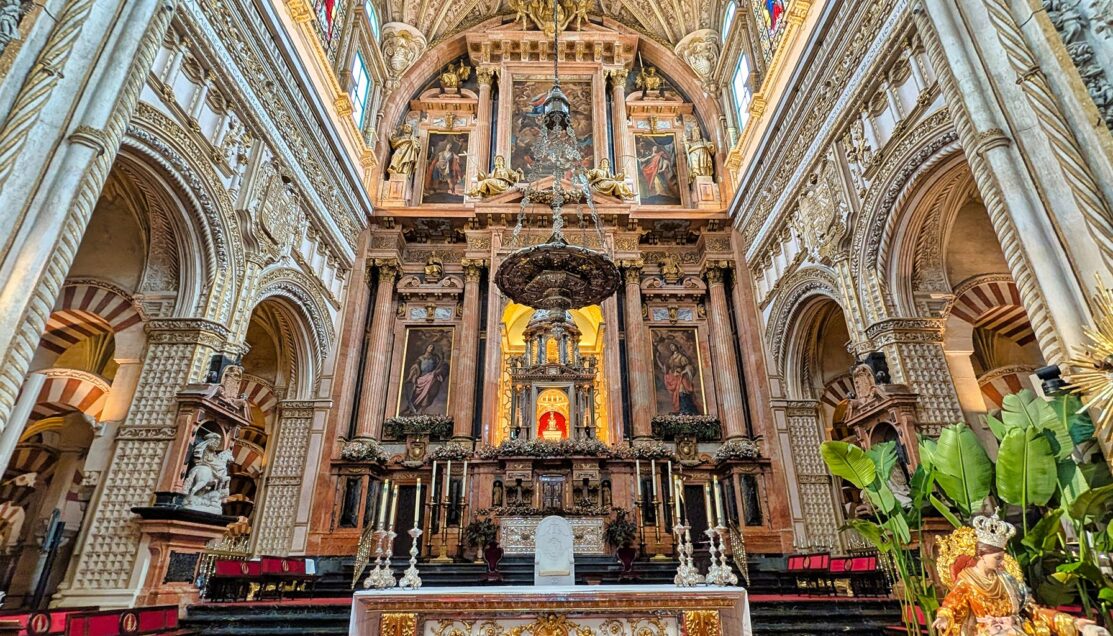
The Renaissance high altar and towering retablo rise within the 16th-century cathedral insertion.
At the crossing stood the enclosed choir, formed by massive dark wooden stalls carved in the 16th and 17th centuries. Their sculpted panels, folding seats, and misericords were created for the cathedral chapter, whose clergy gathered here daily to chant the Divine Office. The carving is dense and highly articulated, executed in the Spanish Renaissance tradition, and the enclosure forms a solid block within what had originally been an open forest of columns.
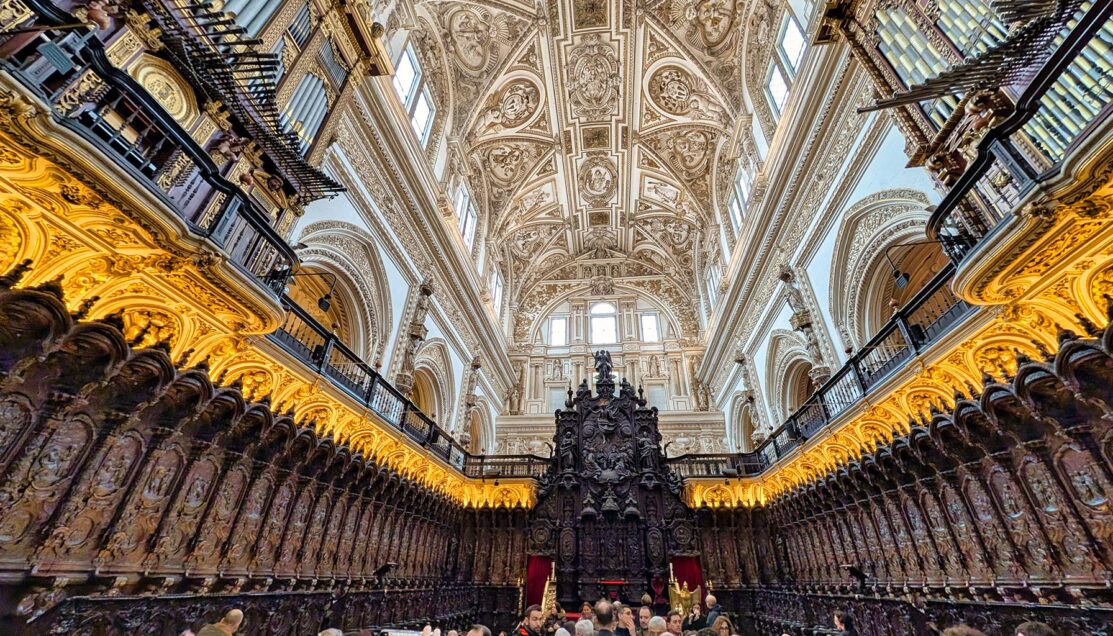
The Renaissance cathedral choir rises vertically within the former mosque, crowned by an ornate barrel-vaulted ceiling.
Movement slowed noticeably as we entered the choir. Circulation narrowed between the stall backs and the elevated central screen, and visitor traffic compressed into tighter aisles. Above, clerestory windows and the decorated vault introduced vertical light into a space originally designed for low, diffuse illumination. The contrast between Islamic horizontality and Christian verticality was no longer abstract — it was visible in the architecture itself.
The Side Chapels
Before exiting, our guide gathered us near several of the side chapels that line the former mosque’s perimeter. Unlike the open repetition of columns in the prayer hall, these spaces were enclosed, personalized, and visually dense — each sponsored by a bishop, noble family, or religious order after the Christian conquest.
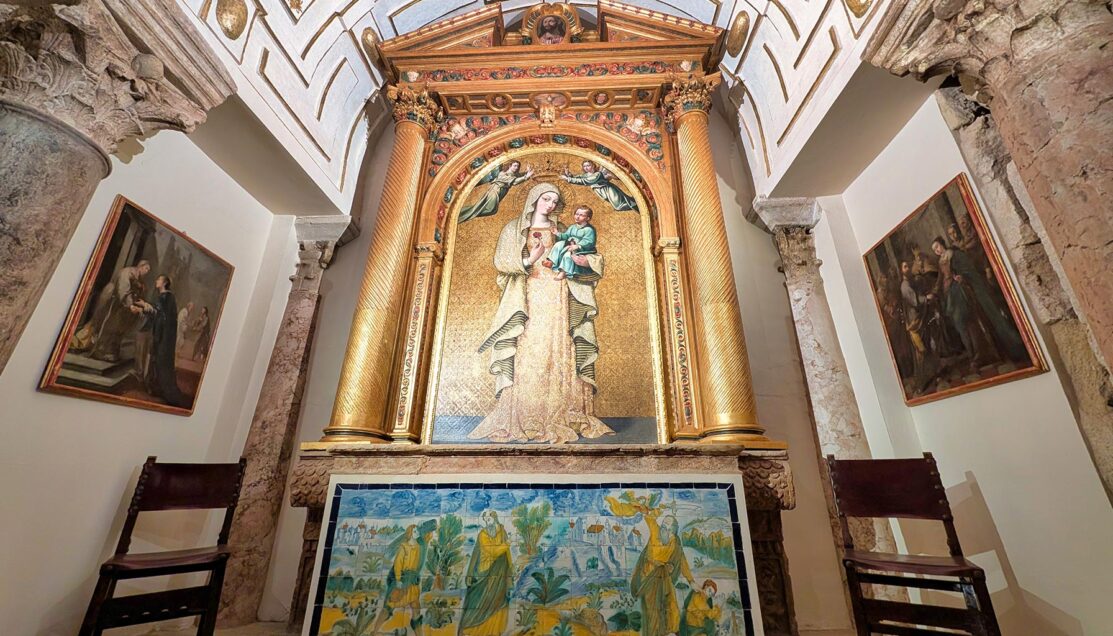
A gilded Marian retablo rises within one of the cathedral’s side chapels.
Gilded retablos rose toward the ceiling, Marian and saintly figures filled layered frames, and blue-and-white tile panels lined the lower walls, all set between the original stone columns of the mosque. Over the centuries, the once-unified Islamic interior had been gradually subdivided into private devotional spaces, each asserting a different identity within the same structure.
After roughly an hour inside, we were guided toward an exit leading back into the surrounding streets. Looking upward from the courtyard, the cathedral’s bell tower — built around the former mosque’s minaret — rose above the walls, its bronze bells suspended within the stone openings.
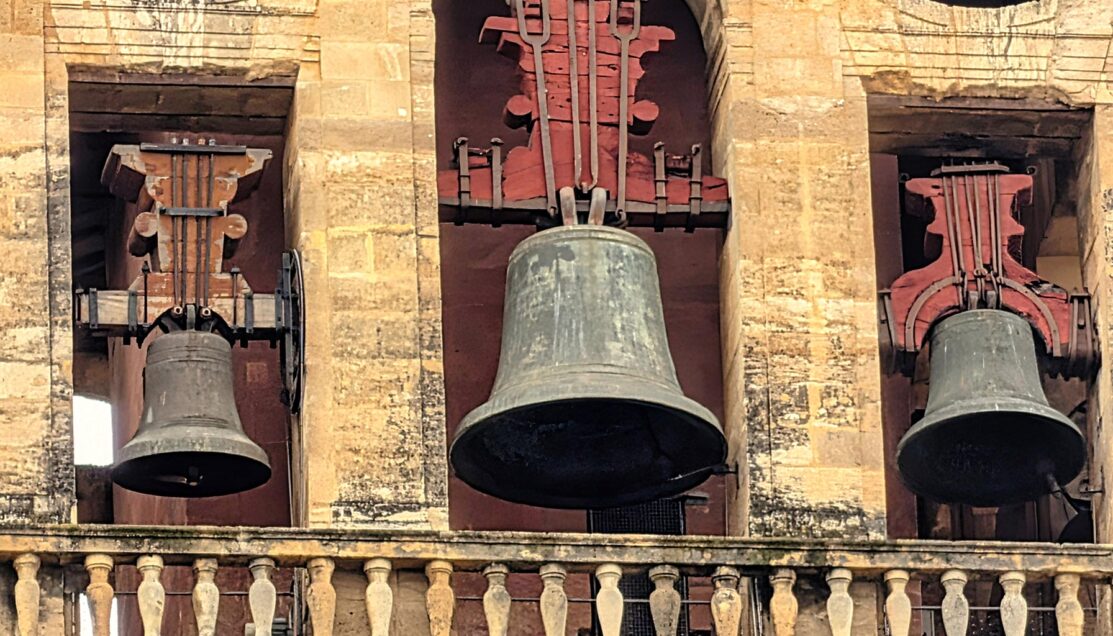
Three large bronze bells hang within the Renaissance tower of the Mezquita-Catedral de Córdoba.
③ Jewish Quarter & Historic Center Walk
⚲ La Judería (Jewish Quarter), Córdoba, Spain
⧗ ~1 hour, 15 minutes
From the cathedral exit, we moved directly into the tight network of lanes that define Córdoba’s older districts. Inside, the scale had been monumental; outside, movement narrowed into cobblestone streets framed by whitewashed walls, iron-barred windows, and closely spaced doorways.
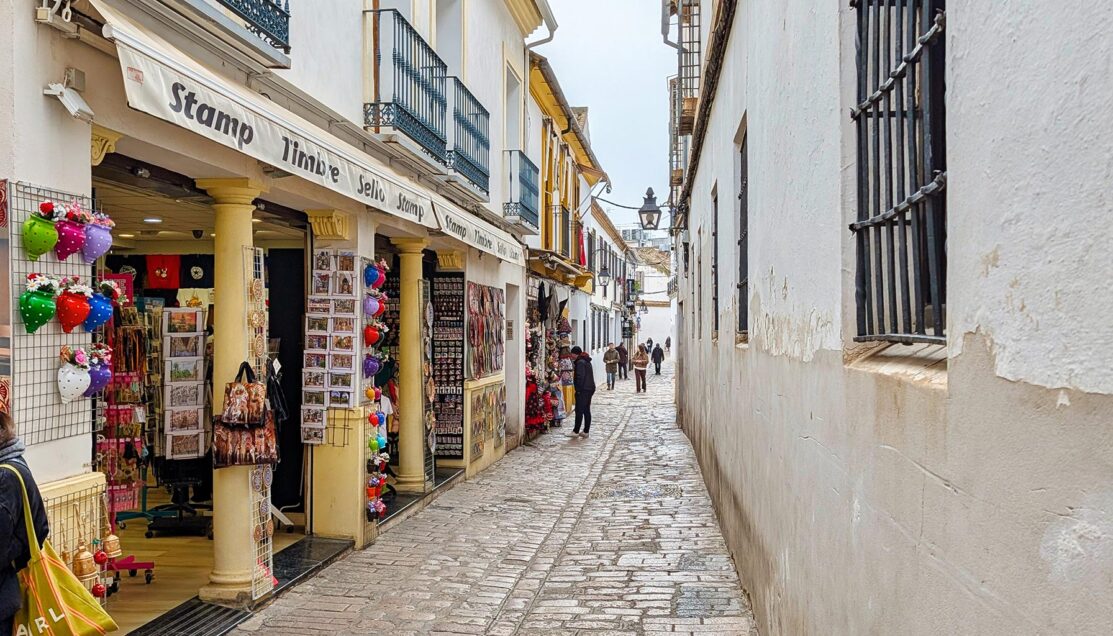
Whitewashed façades and small storefronts line Calle Judíos in Córdoba’s Judería along its narrow cobbled lane.
Our guide led us toward the Sinagoga de Córdoba, pausing near signage marking the Enclave Monumental that identifies the preserved medieval synagogue and surrounding historic structures. Standing along the narrow lane, she outlined how Muslim, Jewish, and later Christian communities had developed within the same confined street layout. The streets around us reflected that density — designed for shade, privacy, and climate control rather than openness.
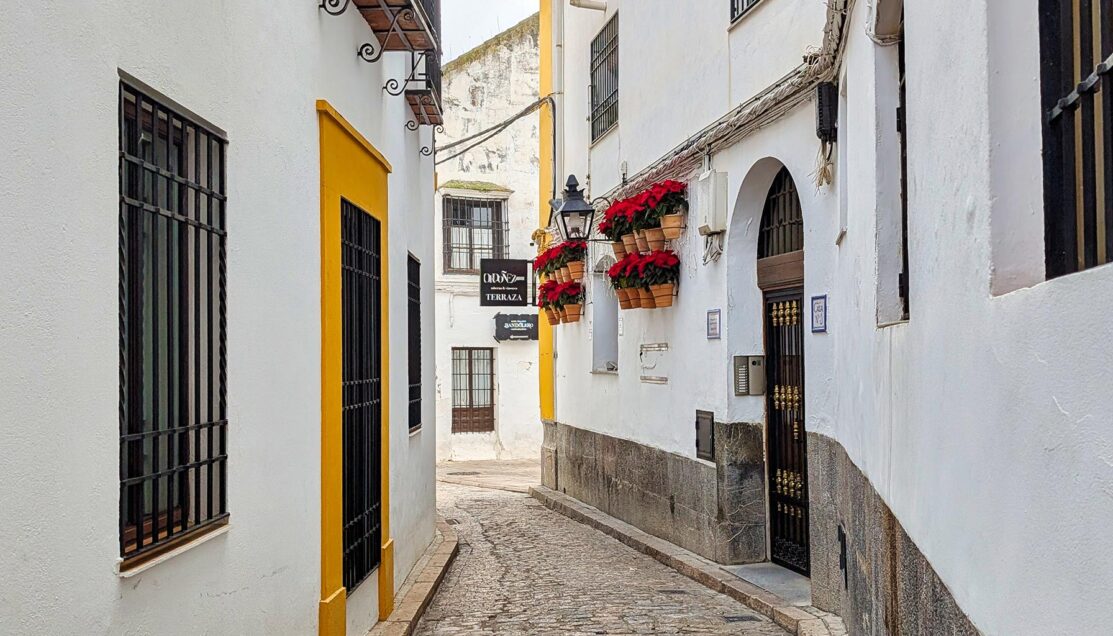
A narrow cobbled lane illustrates the inward-facing residential character designed for shade, privacy, and climate control.
Along the route, we passed Iglesia de San Bartolomé, whose Mudéjar brickwork and decorative detailing reflect the architectural layering that defines the quarter. Its presence illustrated how religious and civic structures sit within immediate walking distance of one another, embedded in residential streets rather than isolated in formal plazas.
From there, we crossed into Plaza Maimónides, a small cobbled square named for the medieval Jewish philosopher and physician born in Córdoba. The open space allowed the group to regroup briefly before continuing. From the edges of the square, narrow passages branched off in several directions, reinforcing how movement through the quarter remains channeled and deliberate.
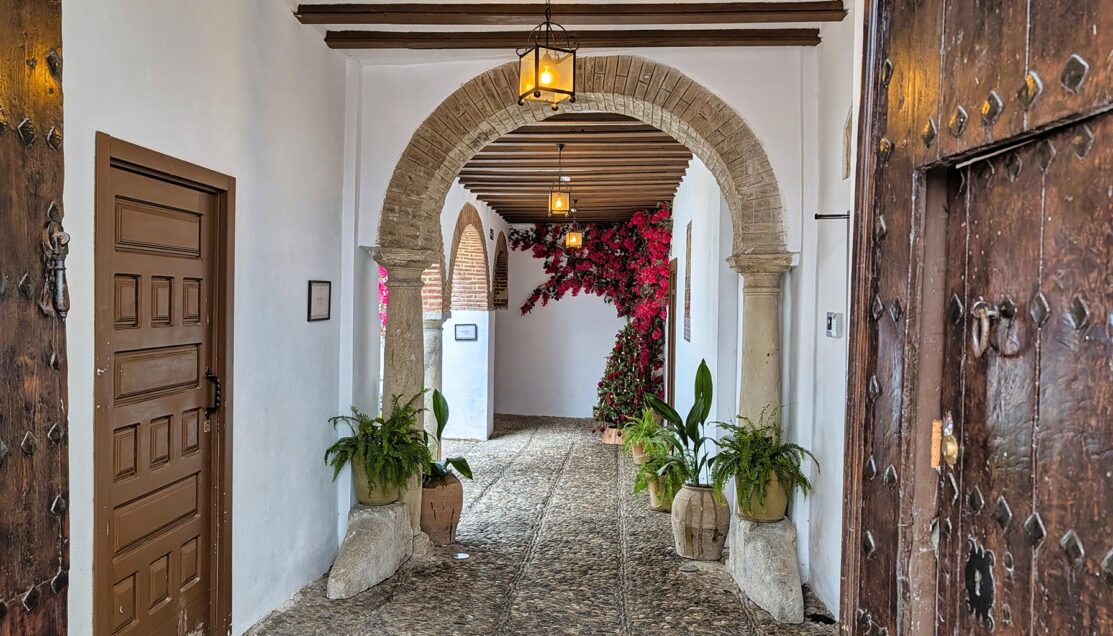
A rounded stone arch and heavy wooden doors frame the entrance to a traditional patio in La Judería.
We continued along Calle Judíos and adjacent lanes, where foot traffic increased as independent visitors and other tour groups converged. Souvenir shops, balconies, and small decorative details lined the route, many easy to overlook without slowing down. The paving stones were uneven in places but manageable, and the route remained mostly flat, shaped more by turns than by changes in elevation.
At several points, the guide referenced features linked to Córdoba’s historic water systems, describing how hidden channels and courtyard cisterns once supported daily life in this dense neighborhood.
We passed a traditional patio entrance framed by a rounded arch and heavy wooden doors. Through the opening, interior plantings and tiled walls hinted at the courtyard culture that remains central to residential life in the city, concealed behind otherwise plain façades.
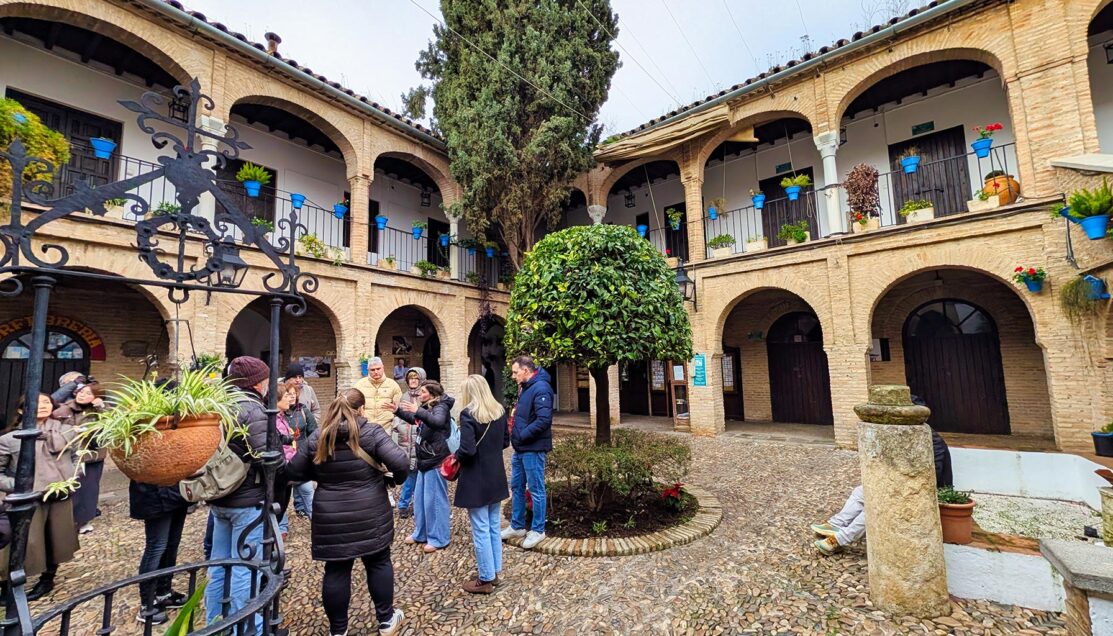
A two-level arcaded courtyard in La Judería centers around shared communal space.
As the walk continued, the streets widened and daylight increased. Near Puerta de Almodóvar, thick stone walls and square-topped towers came into view, marking the former defensive boundary of the city. From this vantage point, the contrast between enclosed residential lanes and fortified perimeter space was immediately visible.
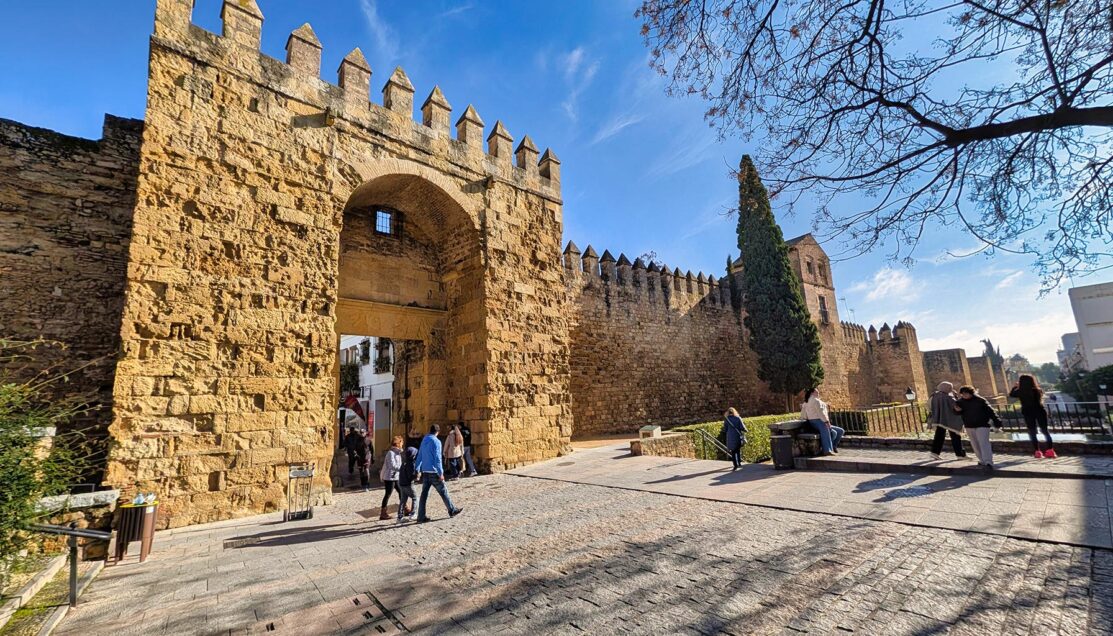
The fortified Almodóvar Gate and adjoining walls mark the western boundary of Córdoba’s historic center.
This segment of the tour focused less on individual monuments and more on understanding how residential streets, religious quarters, courtyards, and fortifications were arranged within close proximity, shaping daily movement through the city.
After regrouping, we retraced our path toward the cathedral complex, emerging once again near the orange trees of the Patio de los Naranjos where the walk had begun. The guide allowed approximately twenty to twenty-five minutes of free time before departure, giving participants an opportunity to revisit nearby lanes or pause along the courtyard edges before boarding the coach for the short transfer to lunch.
④ Lunch at Soho Boutique Córdoba
⚲ Soho Boutique Córdoba, Córdoba, Spain
⧗ ~1 hour
The restaurant was located outside the monument district in a more contemporary part of Córdoba, marking a clear shift from medieval lanes to modern streets and hotel façades.
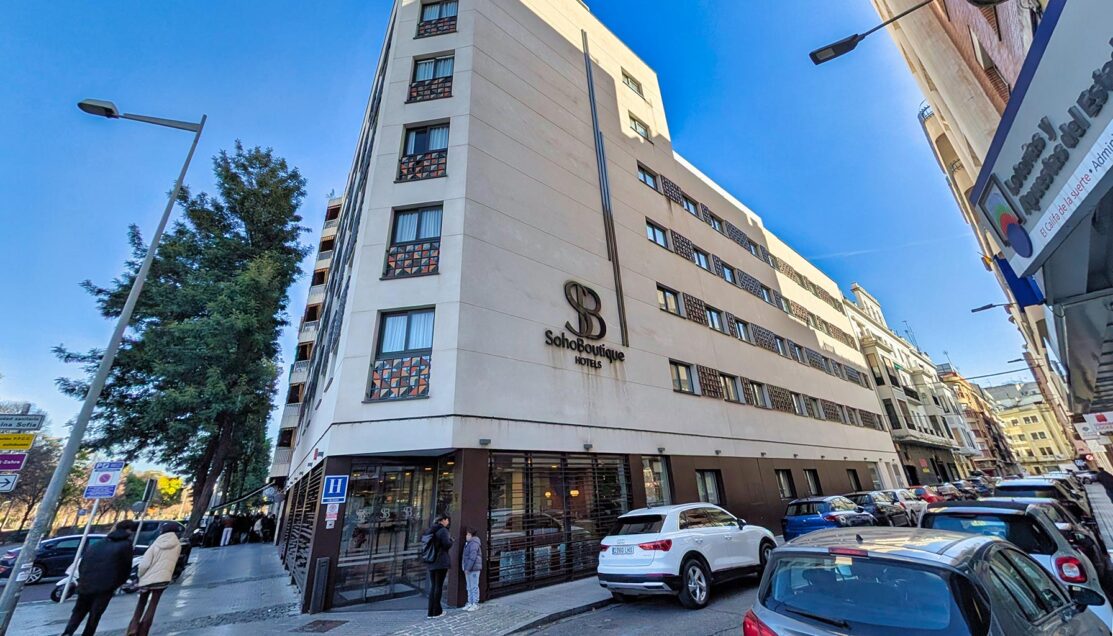
Upscale hotel located in Córdoba, a short walk from Cordoba Mosque.
Inside, the dining room was arranged in individual tables. Courses were delivered individually by staff rather than placed communally. Seating was organized in larger groupings, allowing the full tour to be served simultaneously. The space was bright and neutral, designed for efficiency rather than ornamentation.
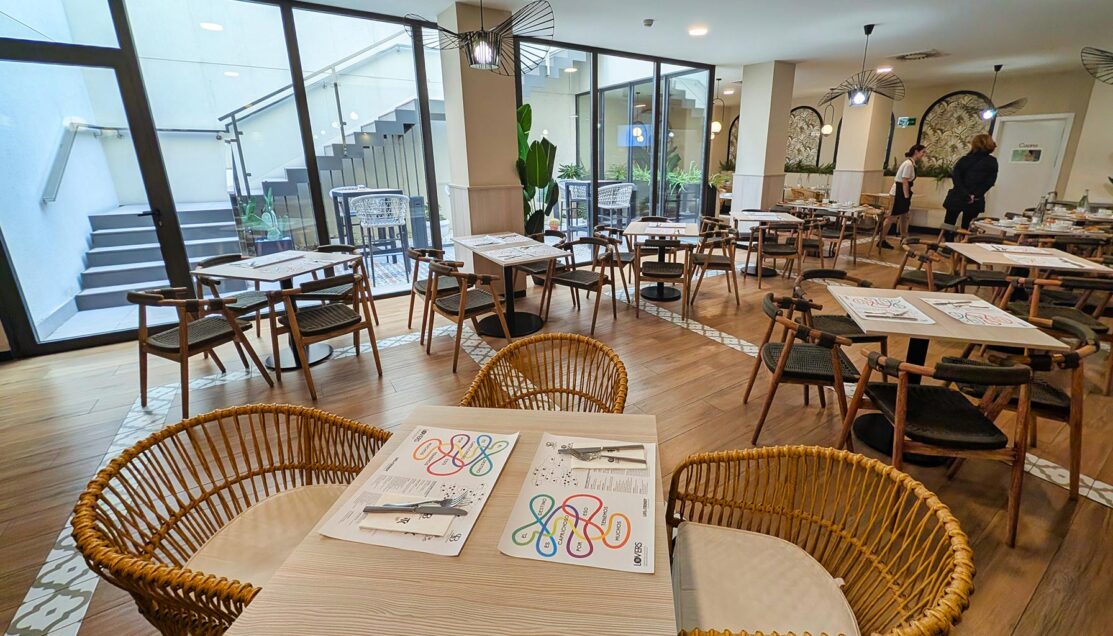
The venue was simple but well attended with helpful staff and accomodations.
⌖ The Meal
Bottled water was placed at each table, and several guests ordered Victoria Málaga lager.
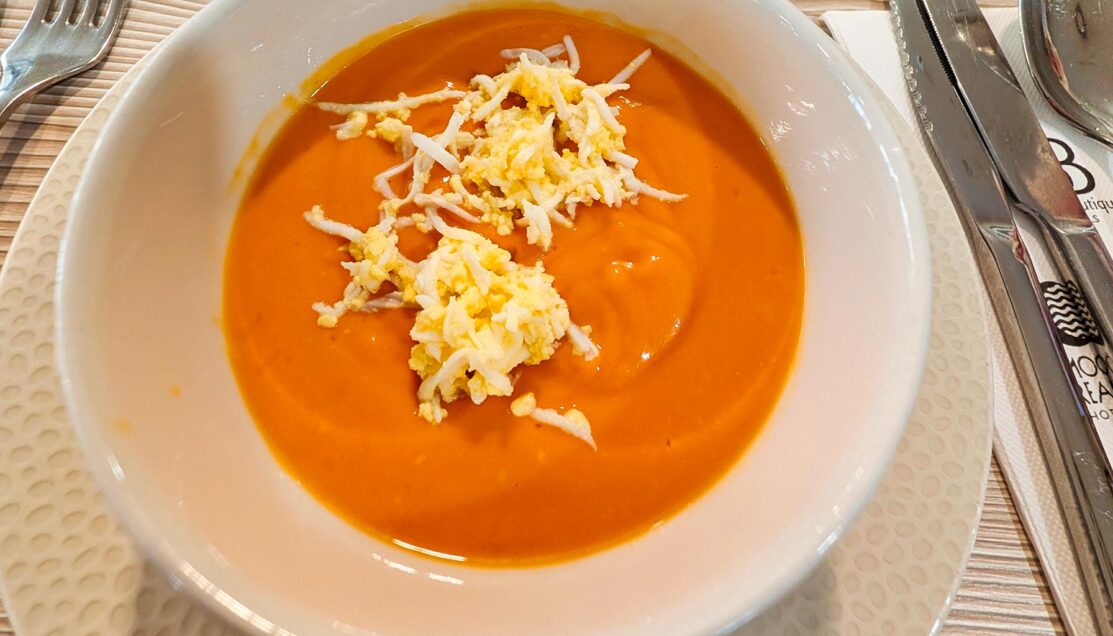
The meal opened with individual bowls of salmorejo, a dense chilled tomato purée topped with finely grated hard-boiled egg. The texture was smooth and thick, closer to a purée than a traditional soup. Bread was served alongside the soup, consistent with its everyday role in Córdoba cuisine.
Plates were cleared fully before the main course arrived.
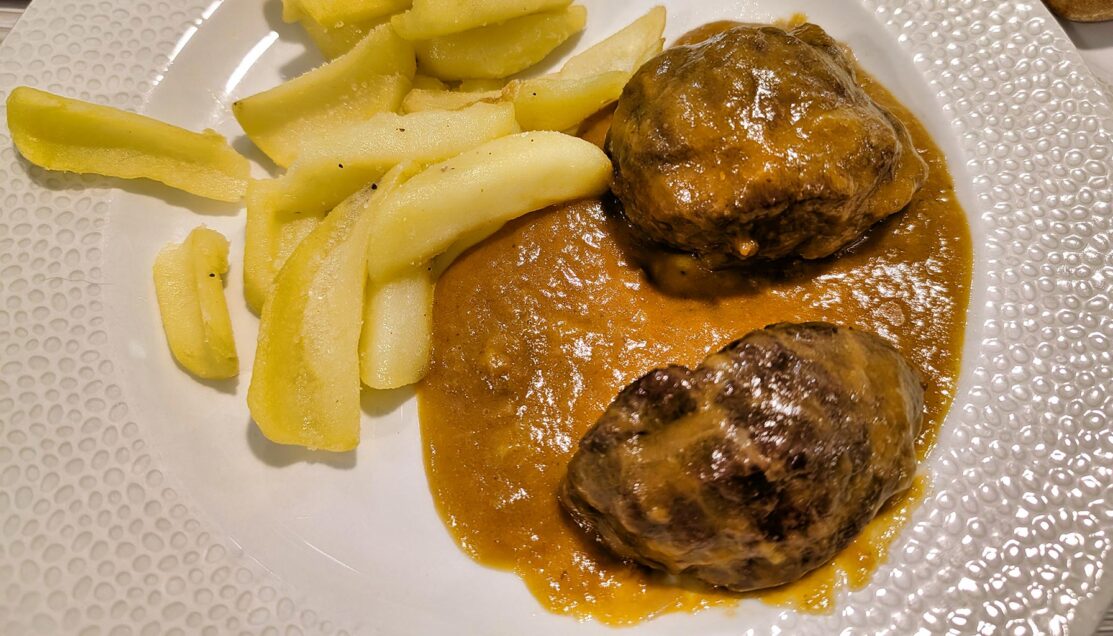
The main course consisted of two braised beef medallions served in a brown onion-based sauce. The meat was tender and heavily coated, indicating a slow-cooked preparation suitable for group service. Thick-cut fried potatoes accompanied the beef, lightly seasoned and portioned generously.
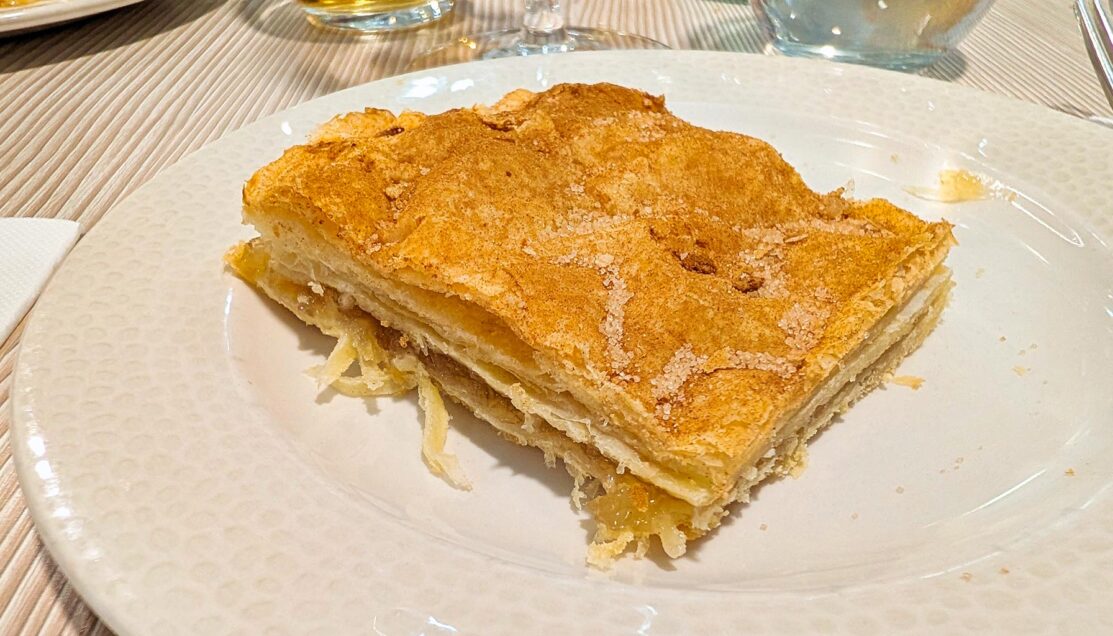
Dessert followed as a rectangular slice of layered apple pastry dusted lightly with sugar. Thin pastry sheets enclosed a soft apple filling, creating a crisp exterior and tender interior. The sweetness was moderate and straightforward.
Coffee was available upon request, though time allowed only a brief window before departure.
As plates were cleared, guests gathered coats and bags, and conversation tapered off as the guide signaled the return schedule. We exited the dining room together, boarded the coach, and began the afternoon drive back toward Málaga.
Return to Port — Back Across Andalusia
Leaving Córdoba, the route followed major highways south toward the coast. Tight urban streets gave way to open agricultural land and olive groves, then gradually shifted again toward suburban development as traffic and signage increased.
Inside the coach, conversation softened and movement slowed. Some guests reviewed photos or rested, while the guide offered brief closing reminders before allowing the remainder of the drive to pass quietly. By mid-afternoon, port security fencing, terminal buildings, and our docked ship reappeared as we entered the cruise complex.
☑ Who Is This Tour Best For?
- History-focused travelers — Visitors interested in seeing how Roman, Islamic, Jewish, and Christian periods coexist within a single urban landscape, especially through direct observation inside the Mezquita-Catedral and surrounding streets.
- First-time visitors to inland Andalusia — Travelers who want an efficient introduction to Córdoba without independent planning, including transportation, timed entry, and a structured lunch.
- Architecture and urban-layout observers — Those who enjoy reading cities through street patterns, walls, bridges, and building transitions rather than museum-heavy interpretation.
- Cruise passengers with limited port time — Guests seeking a comprehensive inland excursion that fits within a single port call and includes transportation, guided access, and return logistics.
⊞ Tour Summary
- Tour Name: Discover Córdoba
- Port: Málaga, Spain
- Ship: Celebrity Infinity
- Total Duration: ~8 hours
- Primary Focus: Historic Córdoba and Mezquita-Catedral
- Main Stops: Roman Bridge approach, Mezquita-Catedral interior, Jewish Quarter walk, group lunch
- Meal Included: Yes (group lunch at Soho Boutique Córdoba)
- Drive-By Highlights: Málaga city center, Guadalmedina River corridor, coastal suburbs, inland agricultural landscape

▣ Activity Summary
- Walking Distance: Moderate (spread across bridge crossing, interior monument visit, and historic district walk)
- Terrain: Stone paving, polished interior floors, narrow cobbled streets; generally level with occasional slick surfaces
- Accessibility: Challenging for guests with limited mobility due to walking duration, crowd density, and uneven surfaces
- Pacing: Structured, guide-controlled, with limited free time
- Group Size: Large coach group (multiple tour groups present at major sites)
- Restrooms: Available at lunch venue and select monument facilities
- Meals Included: Group lunch (starter, main, dessert, beverages)
- Return Drive to Port Area: Approximately 2 hours, dependent on traffic conditions
Related Mediterranean Travel: Explore more Mediterranean cruise ports and shore excursions in our complete regional guide.
→ Mediterranean Cruises & Shore Excursions Guide
© OceansAfoot