✘ Casablanca, Morocco • December 29, 2025
⌖ Royal Monuments, Medina Life, and Morocco’s Political Capital
Tour Route: Casablanca Cruise Terminal → Royal Palace of Rabat → Hassan Tower & Mausoleum of Mohammed V → Bab El Had & Medina Walk → Dar Rbatia (Lunch) → Kasbah of the Udayas & Andalusian Gardens (Café Maure) → Casablanca Cruise Terminal
We met our guide and boarded the coach at the Casablanca Cruise Terminal early in the morning, beginning the roughly 55-mile drive north to Rabat, Morocco’s political capital. With an early evening all-aboard time, the day was planned around a long round-trip drive combined with several extended walking stops in dense urban areas.
Once underway, the route followed the Atlantic corridor out of Casablanca. Industrial zones, container yards, and expanding suburbs lined the first stretch of highway before gradually giving way to greener areas and lower-density development. During the drive, our guide outlined Rabat’s role as both an imperial city and a modern administrative center, explaining how it differs politically and culturally from Casablanca.
By late morning, the skyline had shifted. Minarets, fortified walls, and palace precincts replaced high-rises and logistics hubs, signaling our arrival in a city shaped by centuries of dynastic rule and modern nation-building. As the coach slowed near the royal district, we prepared to begin the walking portion of the tour—starting at Morocco’s seat of royal authority.
① Royal Palace District & Mosque Ahl Fes
⚲ Mosque Ahl Fes & Royal Palace District (Mechouar), Rabat, Morocco
⧗ ~30 minutes
Our first stop in Rabat brought us to the Mechouar district, the ceremonial zone surrounding the Royal Palace. The coach parked beside Mosque Ahl Fes, whose arcaded façade and square minaret anchor the royal quarter visually and architecturally.
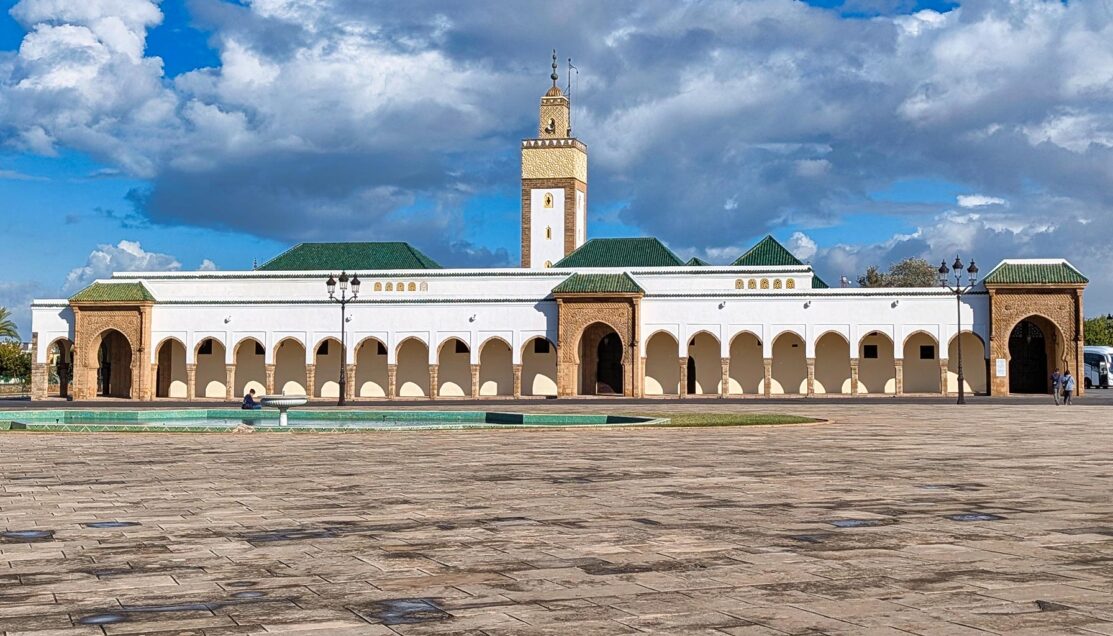
The arcaded façade and square minaret establish the formal architectural rhythm of the royal quarter, with green-tiled roofs and long colonnades emphasizing symmetry and order.
From the mosque, we walked across a wide ceremonial square toward the palace walls. The open expanse serves as a buffer between public space and royal authority, emphasizing distance and scale. The surface was level and paved, but the distance made it feel like a formal approach rather than a casual stroll.
Ahead, ochre-colored ramparts, green-roofed towers, and massive carved gates defined the entrance. Royal guards stood beneath small canopies in full ceremonial dress, some mounted on horseback. Movement was regulated, and visitors remained within designated boundaries.
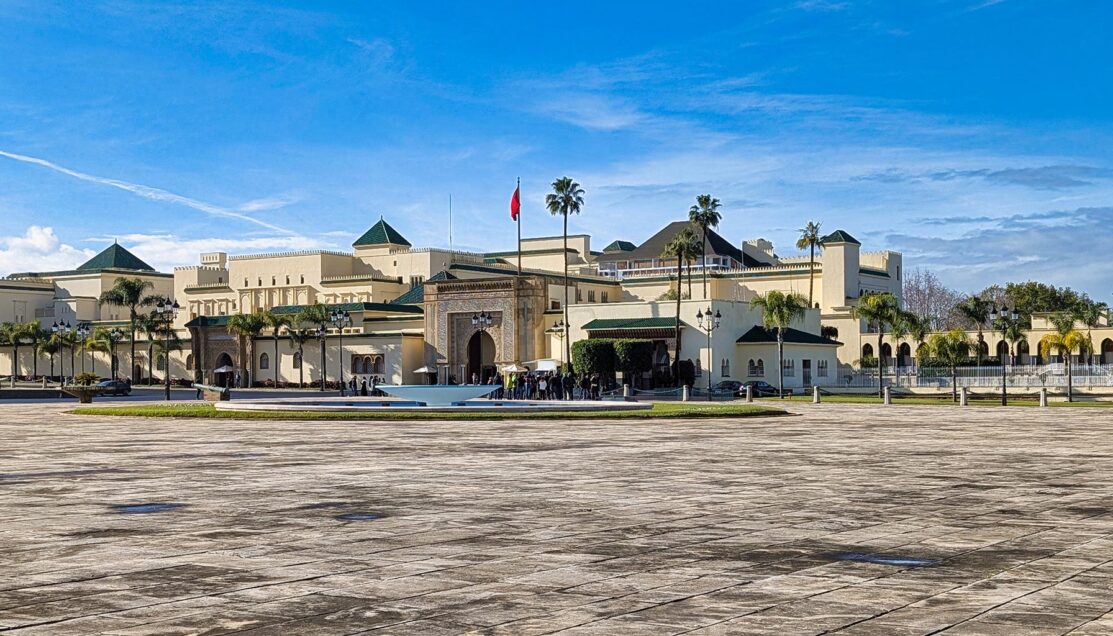
Layered palace buildings and fortified walls rise behind a controlled viewing zone, illustrating the physical separation between public space and royal authority.
While entry into the palace grounds is restricted, the viewing area provided a clear look at the principal gate and surrounding towers. Our guide explained Rabat’s role as Morocco’s administrative capital and described the king’s dual position as head of state and Commander of the Faithful — a link between political and religious authority that shapes the monarchy’s role.
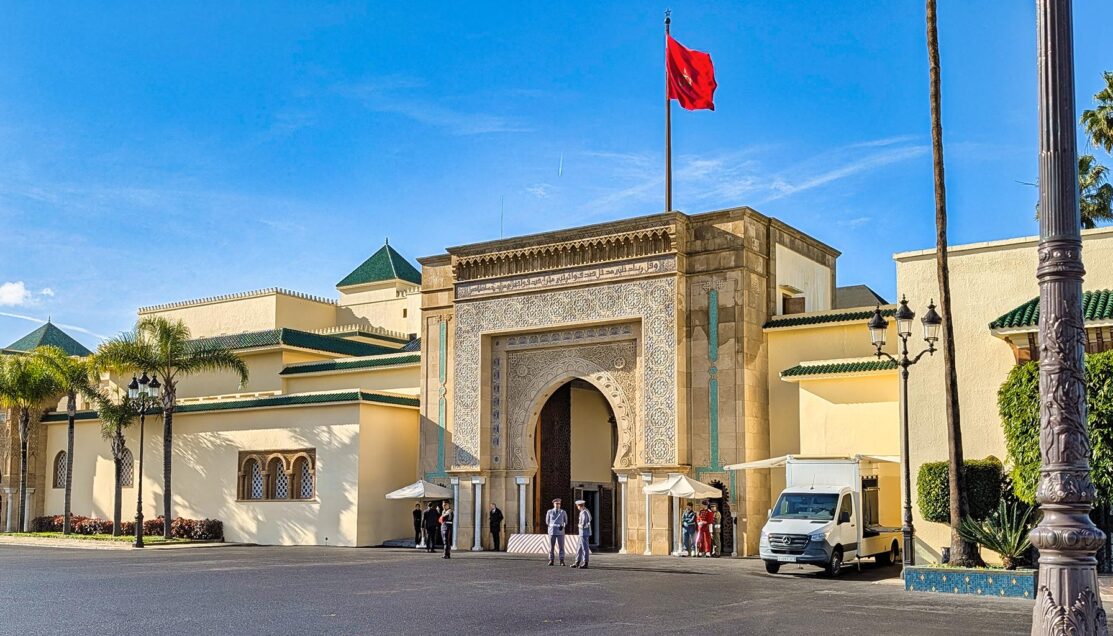
Intricate stone carving and tiled panels frame the main entrance, where uniformed guards regulate access beneath the Moroccan flag, reinforcing the site’s ceremonial role.
After time for photographs, we retraced our route across the square, with the mosque now framing the palace walls behind us. Within minutes, we were back aboard the coach, leaving the royal quarter for Rabat’s next historic landmark.
② Hassan Tower & Mausoleum of Mohammed V
⚲ Hassan Tower & Mausoleum of Mohammed V Complex, Rabat, Morocco
⧗ ~30 minutes
From the Royal Palace district, we boarded the coach again and drove a short distance to the open esplanade surrounding Hassan Tower and the Mausoleum of Mohammed V, one of Rabat’s most important ceremonial spaces.
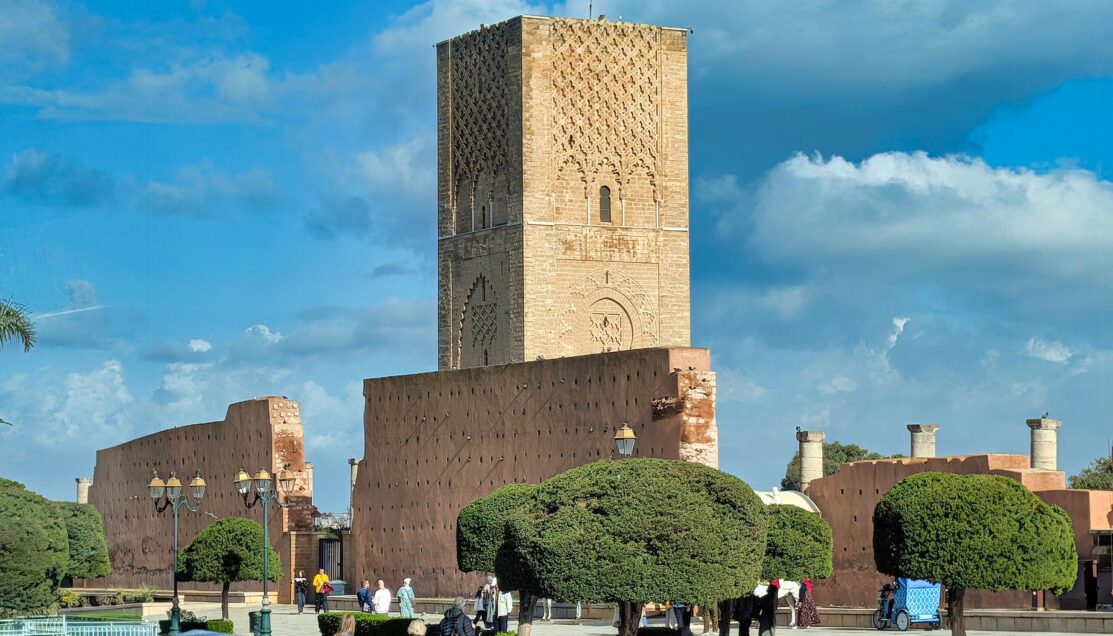
Hassan Tower rises above the esplanade in Rabat as the unfinished minaret of a 12th-century mosque project halted after the death of Abu Yusuf Yaqub al-Mansur.
The change in atmosphere was immediate. The enclosed palace zone gave way to a broad, elevated plaza overlooking the mouth of the Bou Regreg River where it meets the Atlantic. From the terrace, Salé was again visible across the estuary. After stepping off the bus, we gathered near the entrance and began walking toward the main complex.
We entered through the primary approach, passing between rows of red-uniformed guards positioned along the perimeter. Their presence made it clear that this was still an active royal memorial rather than a static historical site.
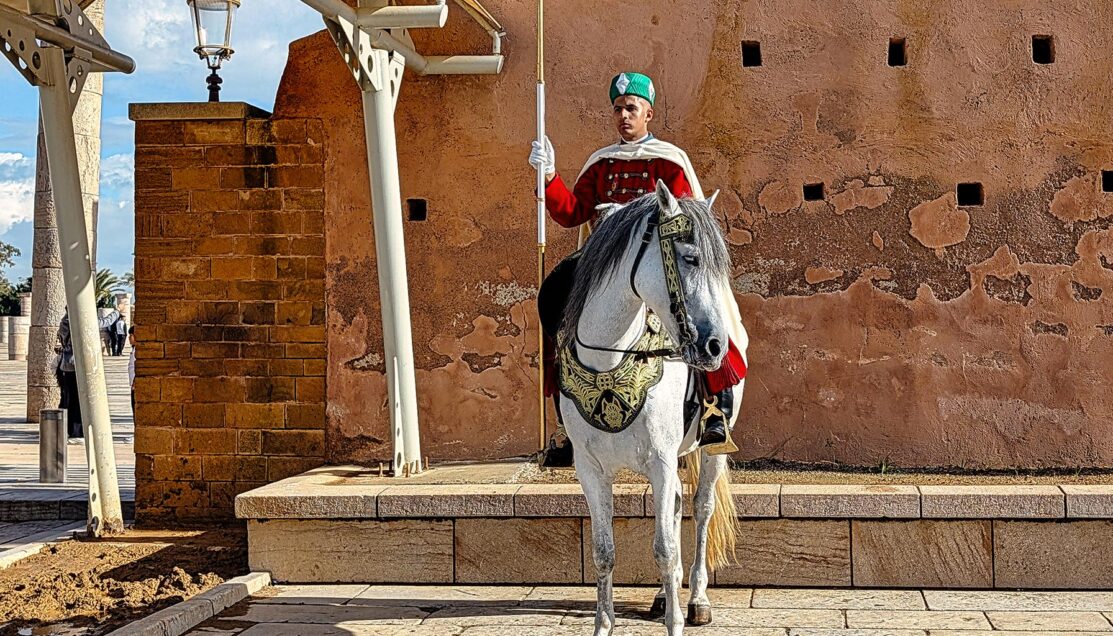
A mounted royal guard stands along the perimeter of the complex, reinforcing that the mausoleum remains an active ceremonial space rather than a static monument.
Ahead of us, Hassan Tower rose alone above the plaza, its reddish sandstone surface standing out against the open sky. Our guide explained that it dates to the late 12th century and was commissioned by the Almohad ruler Abu Yusuf Yaqub al-Mansur as part of a planned mosque that was never completed. Construction ended after his death, leaving the tower unfinished.
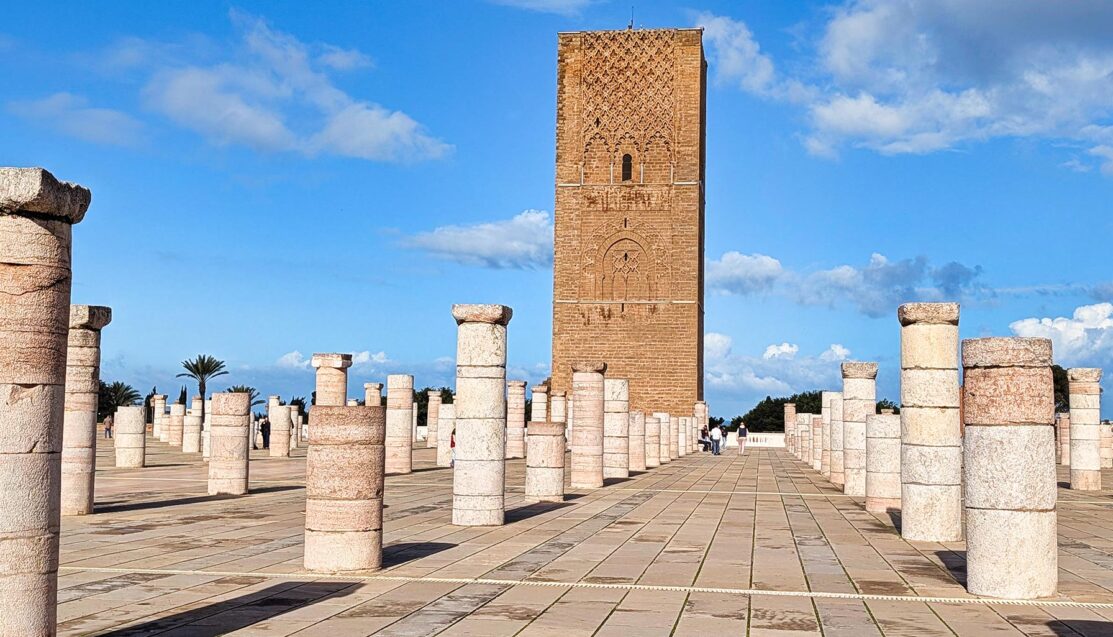
Rows of stone columns mark the intended footprint of a vast prayer hall that was never completed, making the scale legible through absence.
In front of the tower, hundreds of stone columns were scattered across the grounds. We walked among them while the guide explained that they marked the planned footprint of an unfinished prayer hall. Moving through the field of columns made the original scale of the project easier to understand than any diagram or photograph.
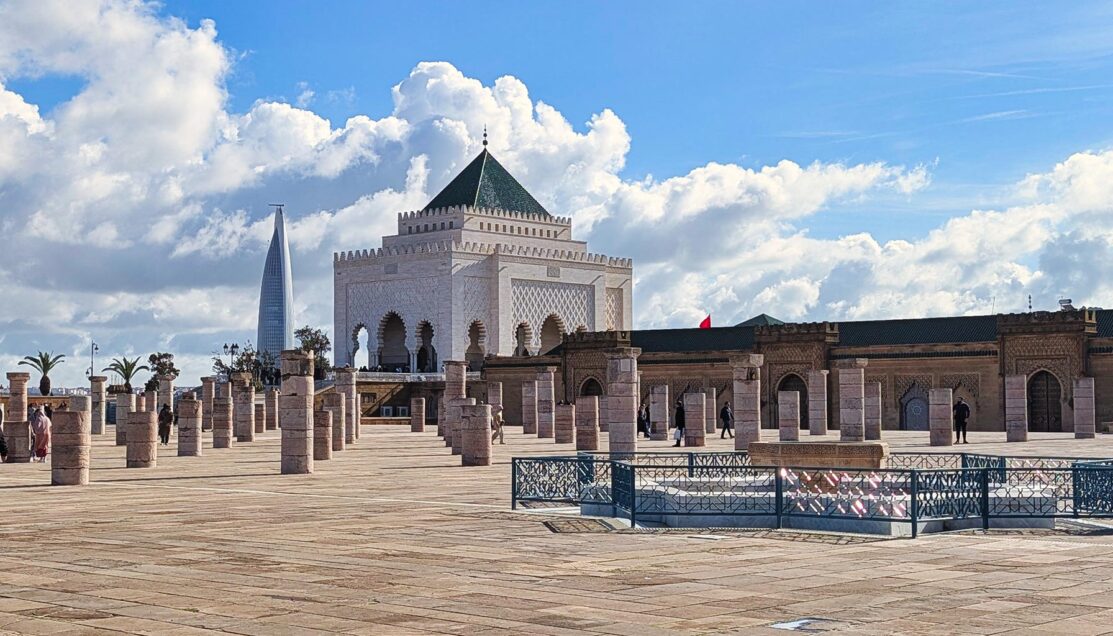
The marble arcade and horseshoe arches frame the mausoleum’s ceremonial approach, combining traditional Moroccan design with the formal layout of a modern royal memorial.
From there, we walked south toward the Mausoleum of Mohammed V, marked by white marble walls, a green-tiled roof, and bronze doors. Built between 1967 and 1971 by King Hassan II, it honors his father, who led Morocco to independence in 1956.
Inside, we stepped onto polished marble floors beneath a cedarwood ceiling decorated with gilded plasterwork and geometric patterns. Three tombs rest in the lower chamber: Mohammed V at the center, alongside Prince Moulay Abdallah and King Hassan II. Uniformed royal guards stood ceremonially at each corner, maintaining the formal atmosphere as visitors moved quietly around the upper gallery.
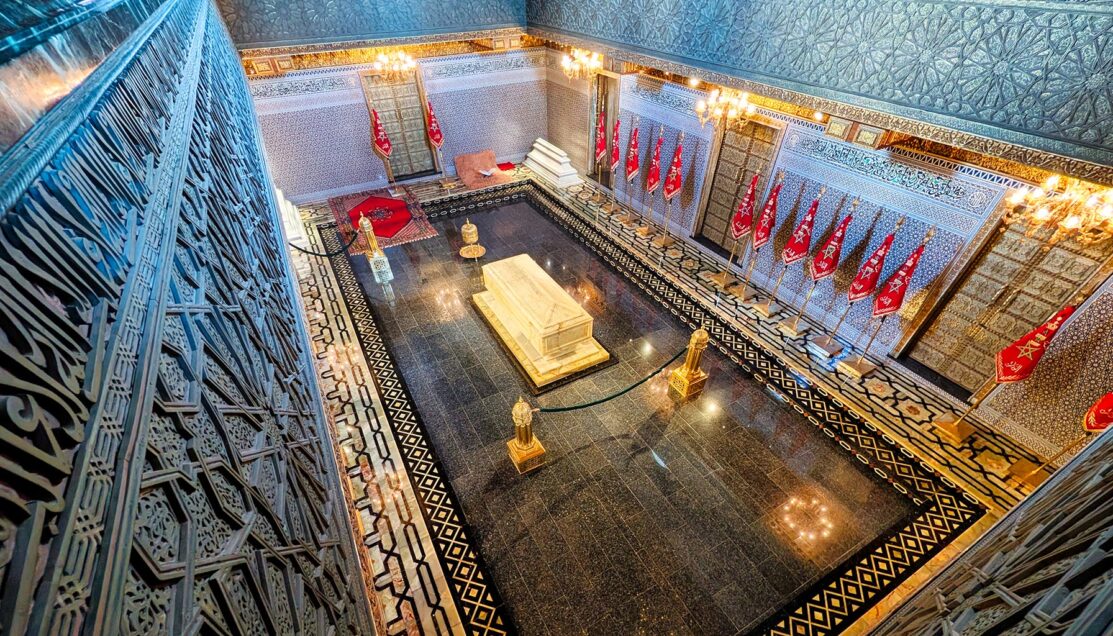
The central marble sarcophagus rests beneath carved cedar ceilings and tiled walls, with royal flags and ceremonial guards reinforcing the space’s continuing symbolic role.
As we exited, our guide pointed out the materials used in construction — marble, travertine, cedarwood, and bronze — explaining how traditional craftsmanship was combined with international resources to create a national monument.
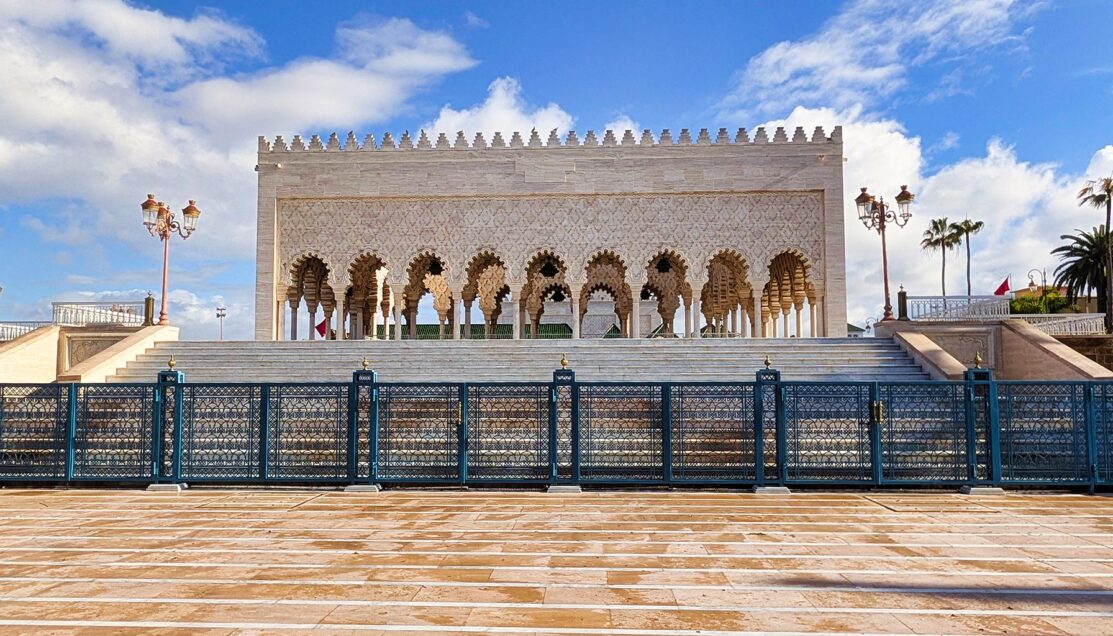
Carved horseshoe arches and marble steps frame the formal approach to the royal mausoleum, reinforcing that the site functions as an active ceremonial memorial rather than a static monument.
We then had time to circulate through the surrounding plaza, stopping at several vantage points to photograph the tower, mausoleum, river, and skyline together. From here, the long-standing connection between Rabat and Salé was clearly visible across the water.
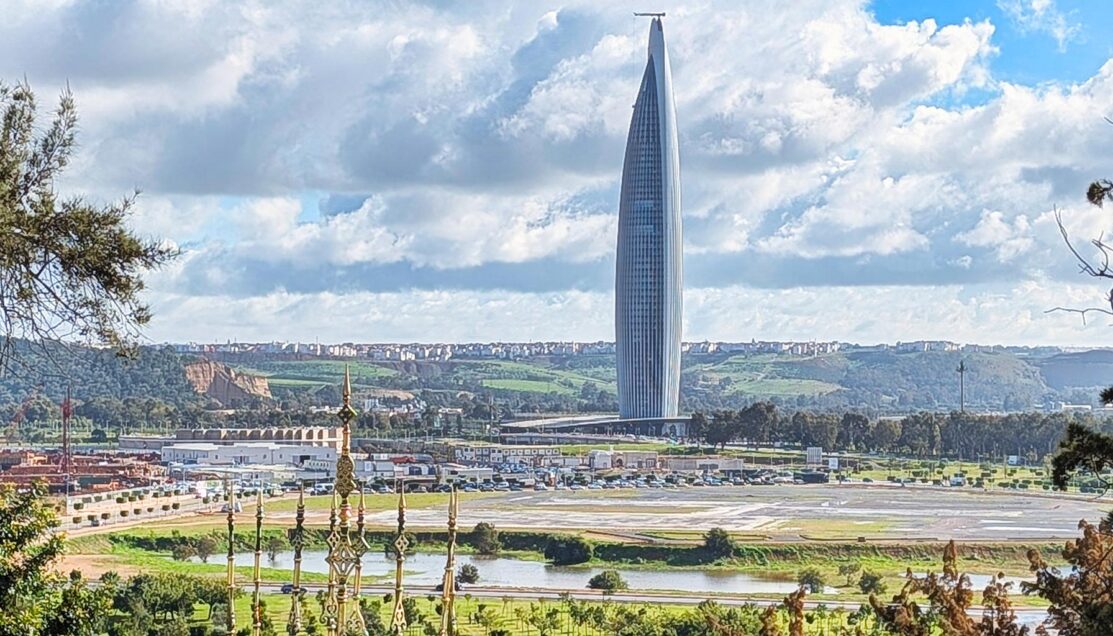
Rising above the Bou Regreg valley, Morocco’s tallest skyscraper marks the country’s modern financial district, contrasting sharply with the historic monuments of central Rabat.
After regrouping near the entrance, we returned to the coach and departed the complex, leaving Rabat’s monumental core behind as we headed toward the medina for the next phase of the tour.
Medina Walk: Marché Central to Bab El Had (Transitional Segment)
⚲ Marché Central de Rabat → Bab El Had
⧗ ~30–45 minutes
After leaving the ceremonial grounds near Hassan Tower, our coach dropped us in the open plaza outside Bab El Had. We stepped down into a broad paved square framed by fortress walls, palm trees, and fountains — a space that felt transitional rather than enclosed.
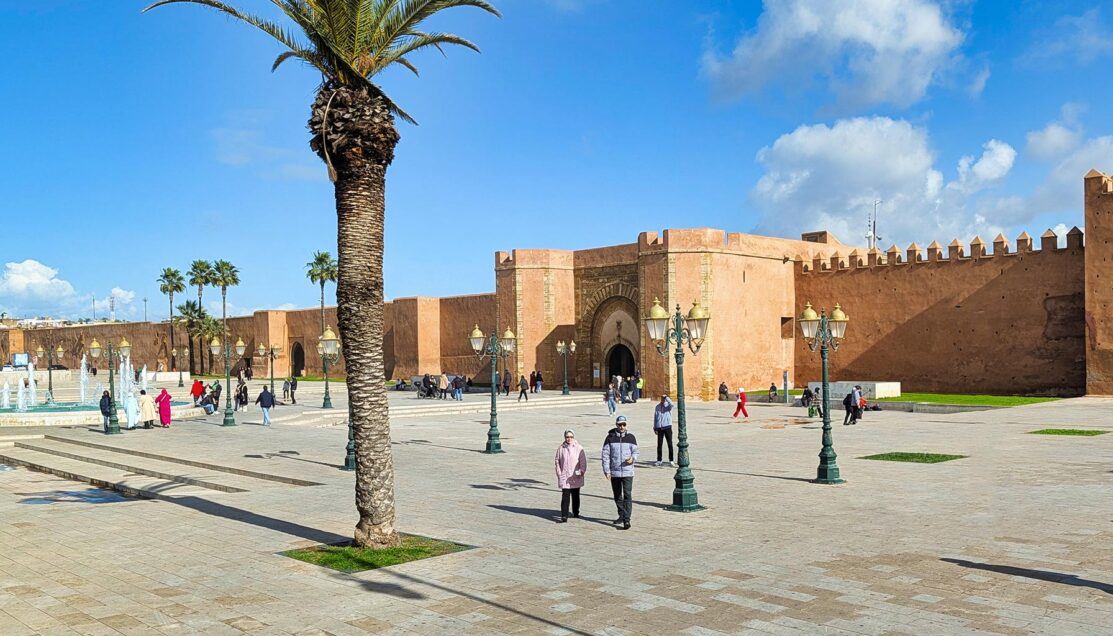
The broad paved square outside Bab El Had forms a transitional space between Rabat’s monumental districts and the enclosed streets of the medina.
The massive wooden doors of the gate stood ahead, set within thick stone walls dating back to the Almohad period. Before entering, we paused briefly near the historical marker mounted on the exterior wall, where our guide outlined the gate’s origins and later restorations.
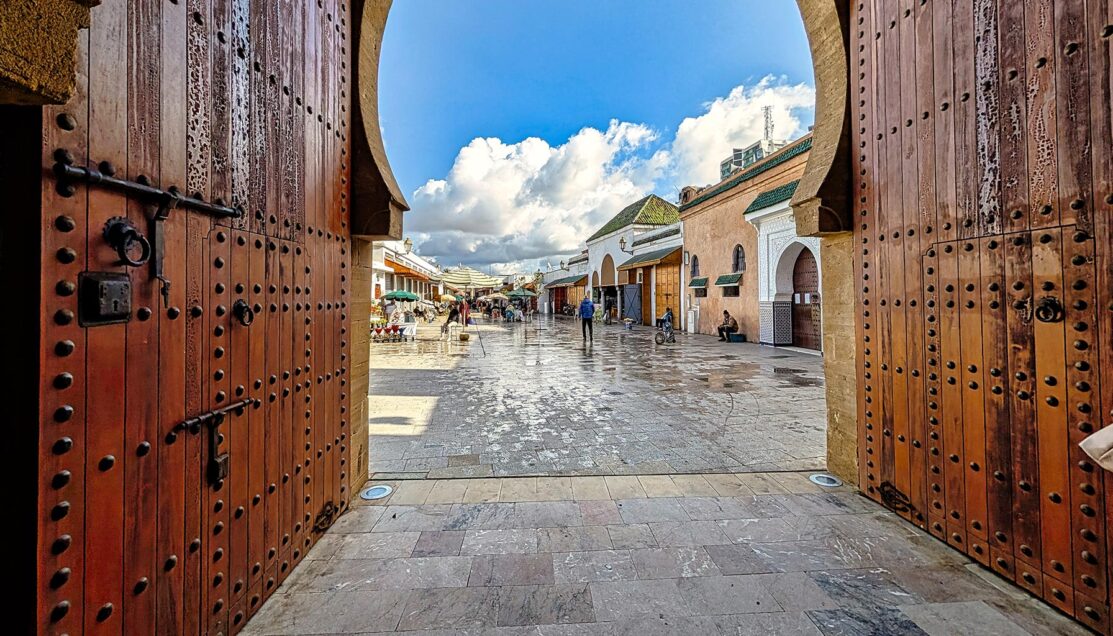
Passing through the massive wooden doors and arched stone opening marks the physical and psychological shift from open civic space into the historic market quarter.
Passing beneath the arched opening marked a clear physical shift. The heavy wooden doors and curved stone threshold created a literal frame between two urban environments.
We emerged directly into the edge of the Central Market district. Flower stalls lined the entrance, their bright colors spilling into the walkway. Produce vendors arranged citrus, herbs, and vegetables in neat pyramids along the street. The soundscape tightened — voices, bargaining, carts, and footsteps replacing the open echo of the plaza behind us.
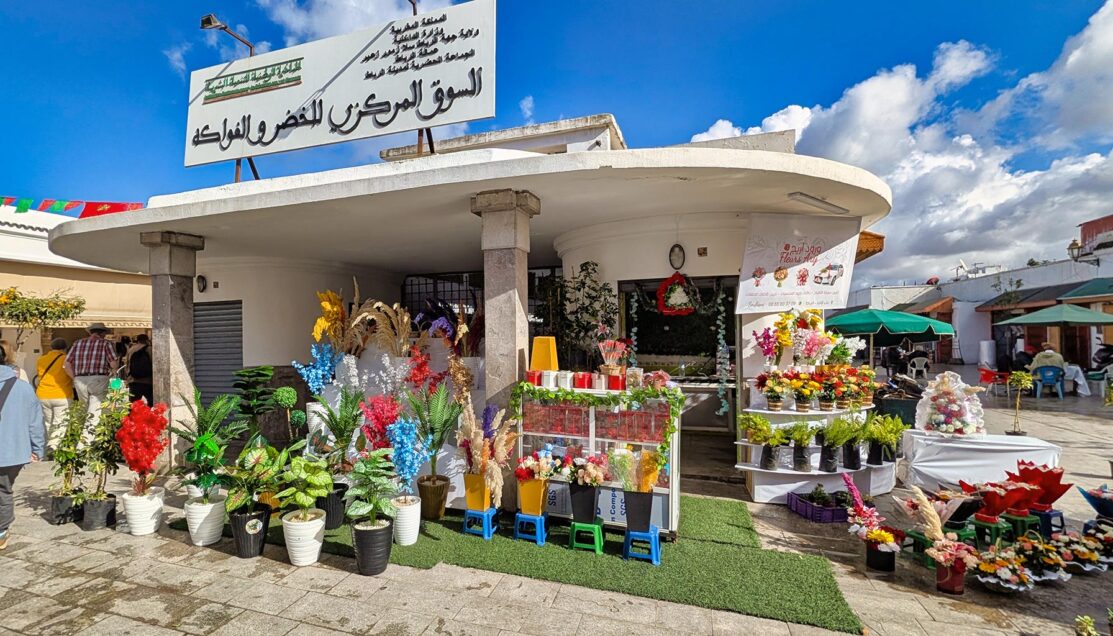
Bright floral displays cluster near the gate entrance, signaling the transition from monumental plaza to the dense commercial core of the medina.
From here, we continued on foot along the market’s perimeter before gradually turning deeper into the medina proper. Shopfronts narrowed. Side lanes branched unpredictably. Tailors, bakers, barbers, hardware sellers, and phone repair kiosks operated side by side with little separation between storefront and street.
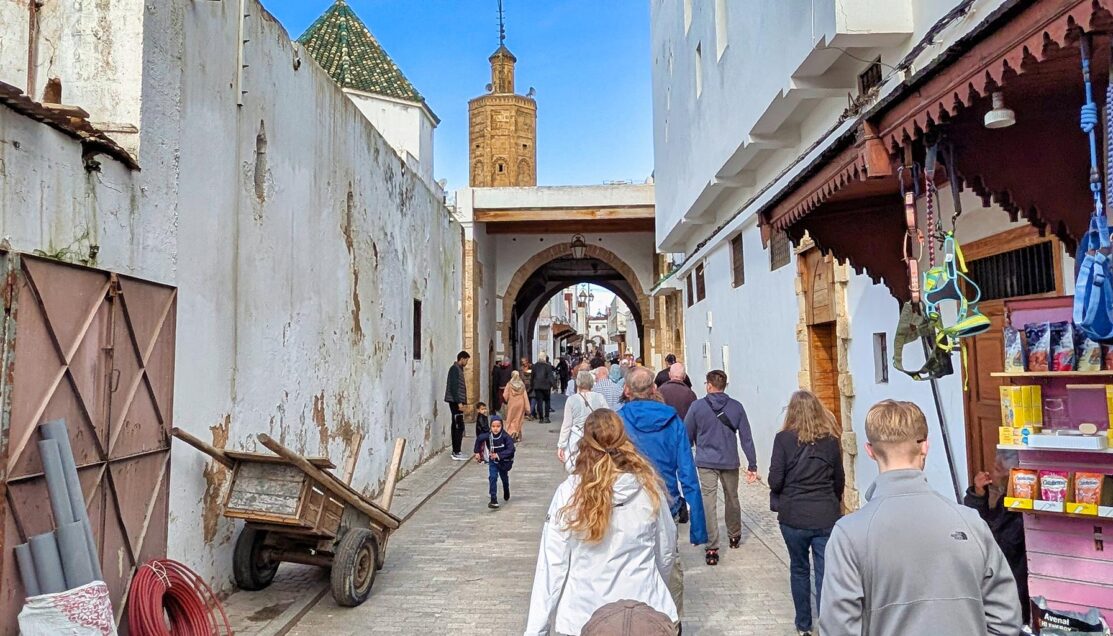
Crowds funnel through narrow lanes lined with small shops and delivery carts, illustrating how movement, commerce, and daily life overlap inside the medina.
Underfoot, surfaces shifted between worn stone and patched pavement. At times the passage narrowed enough to require single-file movement as porters maneuvered crates through gaps in the crowd.
The market functioned not only as a commercial hub but as a social space — neighbors stopping to talk, shoppers negotiating prices, delivery workers weaving steadily through foot traffic.
By the time we left the most concentrated market area behind, the sensory intensity of the walk made the upcoming lunch stop feel well timed.
③ Lunch at Dar Rbatia
⚲ Dar Rbatia, Rabat Medina, Morocco
⧗ ~1 hour, 15 minutes
Stepping through the entrance immediately changed the atmosphere. Street noise dropped away, and the interior opened into a high-ceilinged central atrium built in the traditional riad style. What would once have been an open courtyard had been enclosed with a glass roof, allowing daylight to filter down over the dining area.
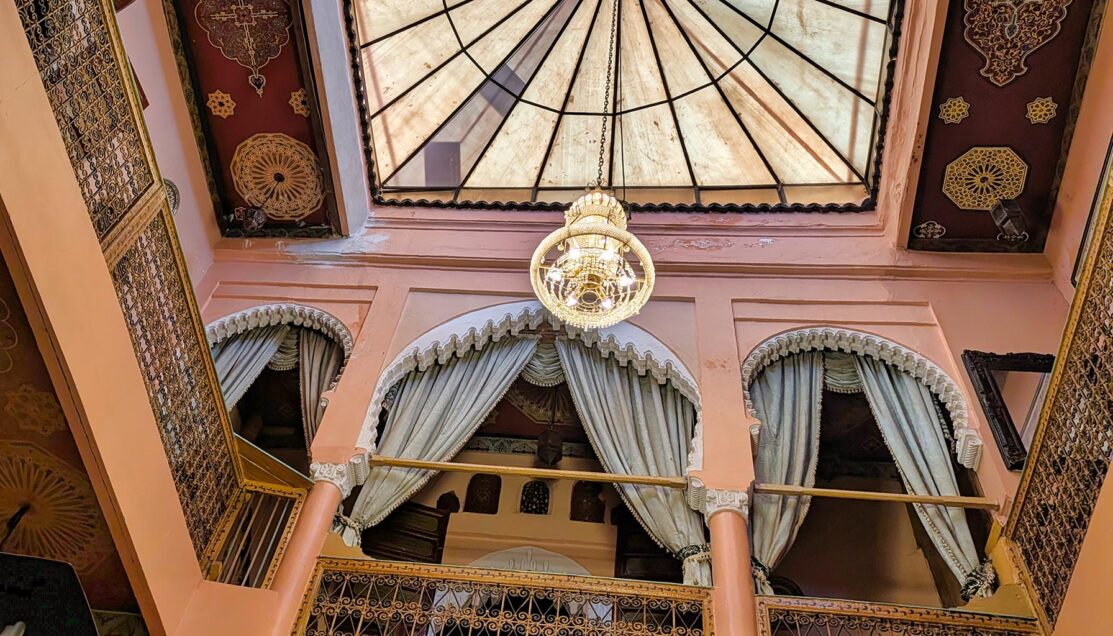
A glass roof and central chandelier draw the eye upward, highlighting the restaurant’s inward-facing courtyard design.
Moorish arches framed the surrounding walls, painted wooden doors lined the perimeter, and patterned tile floors reflected the light from above. A large chandelier hung beneath the skylight, emphasizing the vertical scale of the space and drawing attention to the building’s inward-facing design.
Tables were arranged around the edges of the atrium, with upholstered bench seating running beneath the arches. Soft pink plaster, geometric wall motifs, carved cedarwood elements, and detailed zellige tilework gave the interior the character of a preserved private home rather than a conventional restaurant.
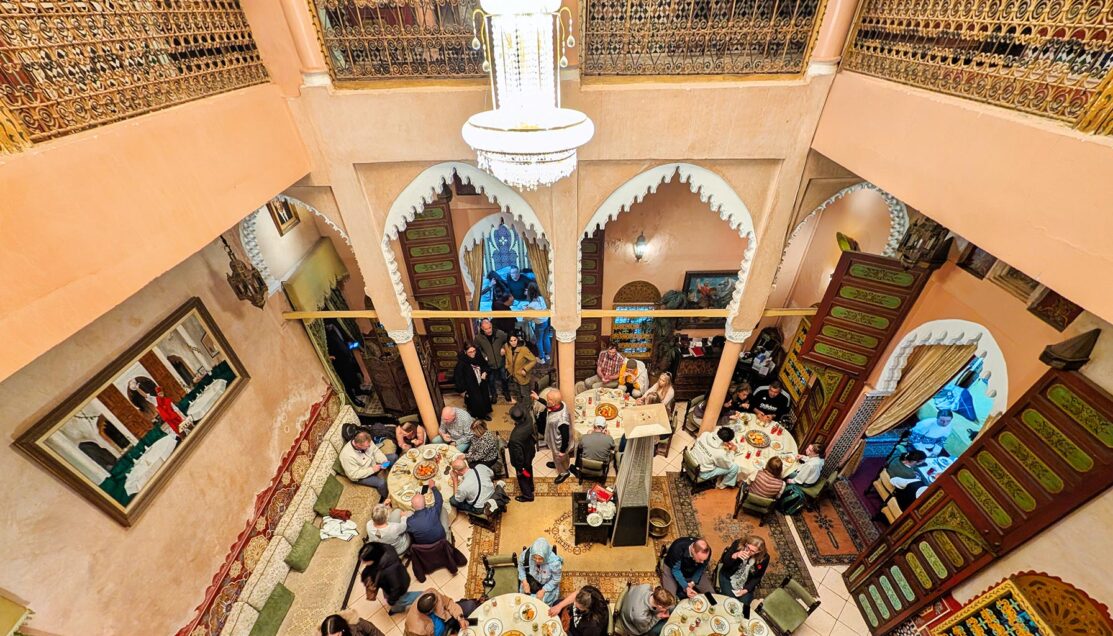
Viewed from the upper level, the tables and arches read as a converted residential riad adapted for group dining.
Upper-level galleries overlooked the dining area, reinforcing the sense that the restaurant occupied a former residential riad adapted for group dining.
⌖ The Meal
Lunch began simply, with warm Moroccan bread presented in ornate silver trays and placed at each table. The bread was pre-cut into manageable portions and served communally, reflecting its traditional role as both accompaniment and utensil.
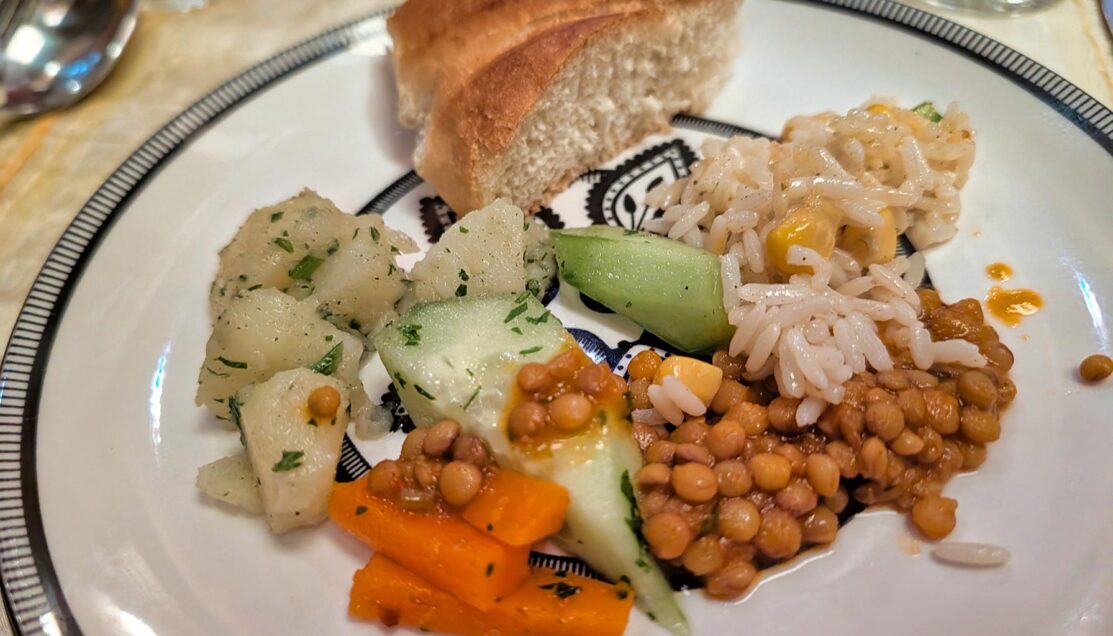
Before the main dishes arrived, individual plates were set with a small assortment of starters. These included herb-dressed potatoes, cucumber and carrot salad, lentils in a light sauce, and rice mixed with corn and tomato. The portions were modest but varied in texture and flavor, providing a light introduction before the heavier courses.
Soft drinks and bottled water were available throughout the meal, with several guests opting for Coca-Cola alongside the traditional dishes.
The main courses were then served family-style at the center of each table.
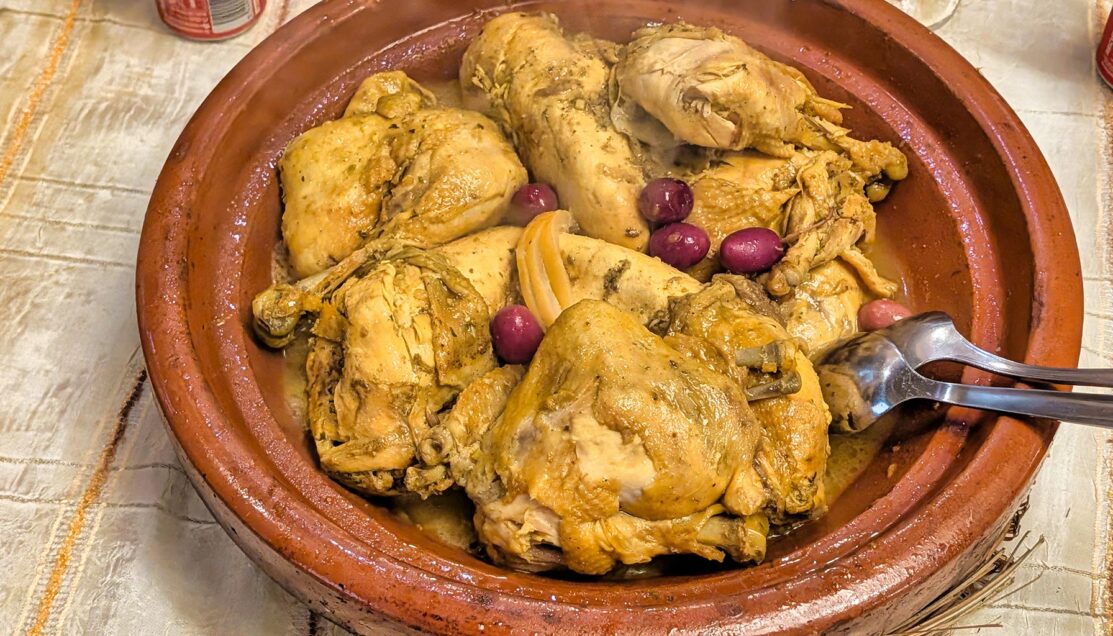
Chicken Tagine with Preserved Lemon and Olives
The first dish arrived in traditional clay tagine vessels, already uncovered. Several pieces of tender chicken rested in a lightly thickened sauce, flavored with saffron, herbs, preserved lemon, and olives. The citrus notes and briny accents created one of Morocco’s most recognizable combinations.
Beef with Couscous
Next came slow-braised beef served over couscous, accompanied by carrots and potatoes. The grains absorbed the surrounding broth, producing a softer, savory profile that contrasted with the brighter flavors of the tagine. This pairing reflected couscous’s central role in both everyday and ceremonial meals.
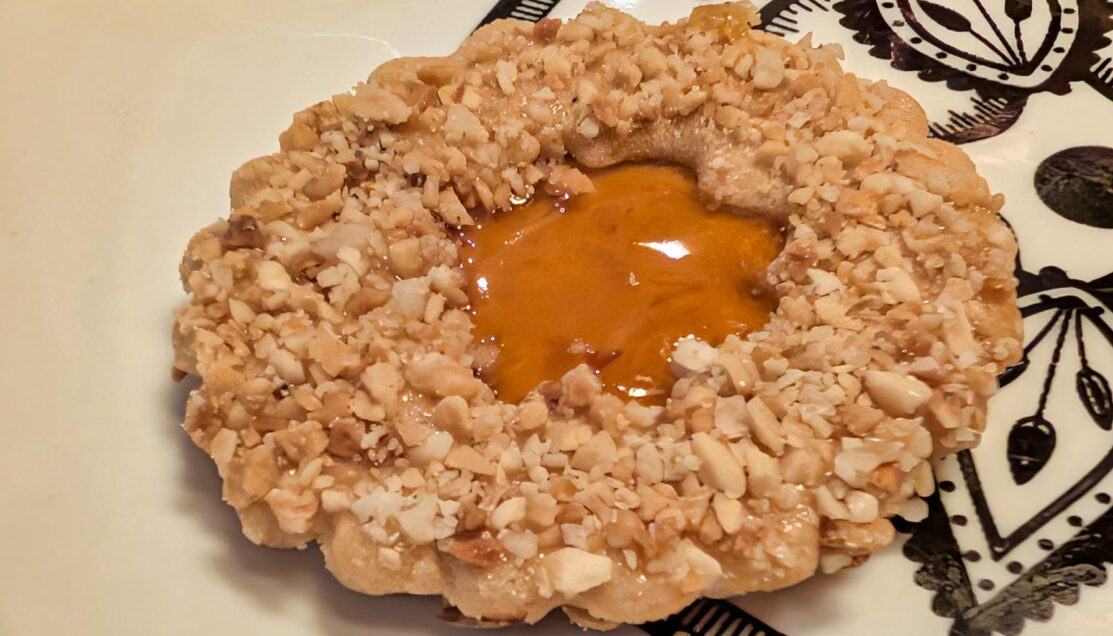
Almond Pastry with Honey
Dessert followed in the form of a ring-shaped pastry coated in honey and chopped almonds. Dense and intensely sweet, it represented Morocco’s long tradition of syrup-based confections flavored with nuts and spices.
Fresh Fruit
The meal concluded with a shared platter of bananas, oranges, strawberries, and pears, providing a lighter finish after the rich main courses and dessert.
As plates were cleared, the group gradually gathered near the entrance. Stepping back outside, the return of voices, movement, and narrow passageways was immediate, reinforcing how sharply the restaurant was insulated from its surroundings.
From here, we continued on foot toward the Kasbah of the Udayas and the Andalusian Gardens for the final segment of the tour.
④ Andalusian Gardens at the Kasbah of the Udayas
⚲ Andalusian Gardens & Kasbah of the Udayas, Rabat, Morocco
⧗ ~75–90 minutes
After lunch, we continued on foot through the medina, the lanes gradually rising as we approached the Kasbah of the Udayas. The streets narrowed again, bordered by whitewashed walls, wooden shutters, and small balconies. Compared with the commercial density near Marché Central, this stretch felt more residential and less congested.
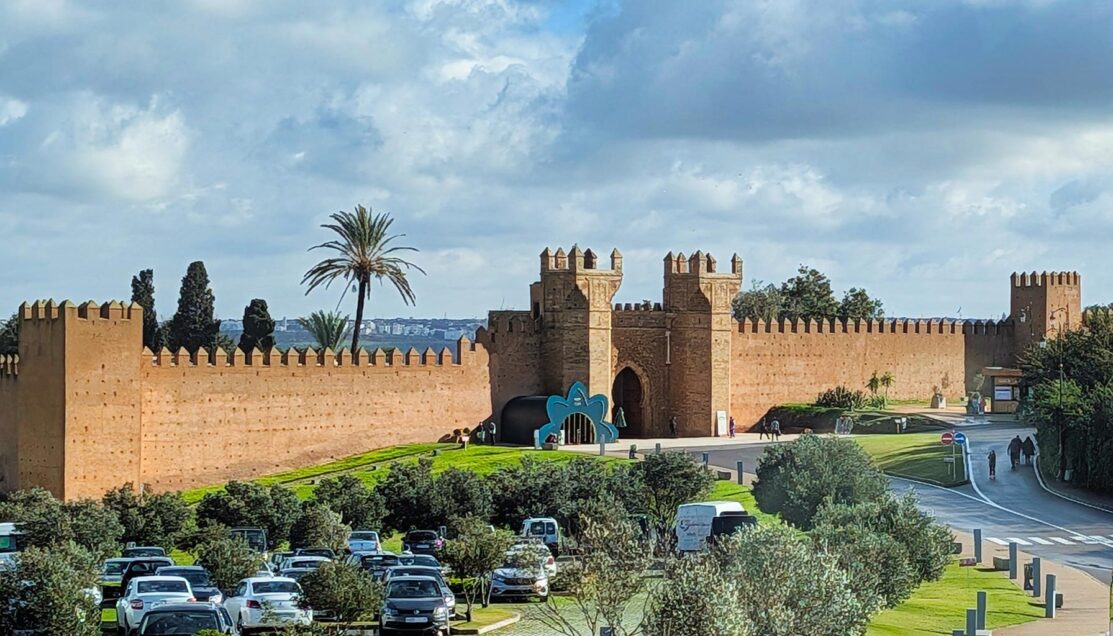
Thick Almohad-era ramparts and crenellated towers define the fortified edge between the historic kasbah and the modern city below.
The path soon opened onto a wide staircase leading up to the kasbah’s main gate. The massive stone entrance—constructed in the late 12th century during the Almohad period—stood framed by thick fortress walls and a carved horseshoe arch. Visitors paused at the base for photos before climbing. After the compressed geometry of the medina, the open approach emphasized the scale of the fortifications.
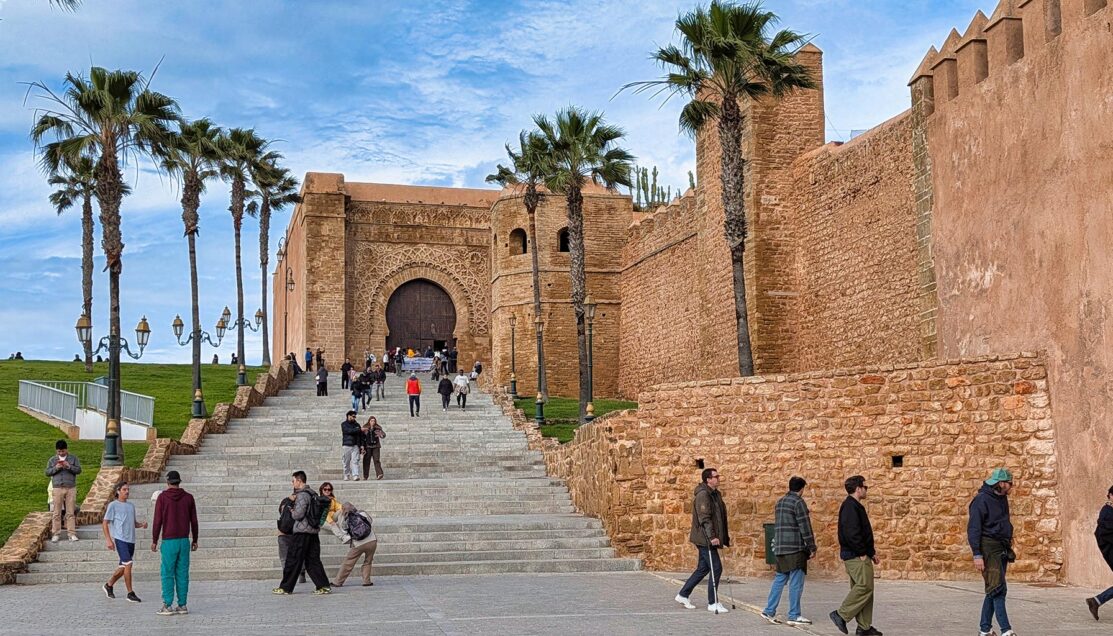
The monumental Almohad-era entrance controls access into the kasbah, using scale, elevation, and fortified masonry to signal the transition from open city streets to enclosed defensive space.
Passing through the gate, we entered the Andalusian Gardens. Redesigned during the French Protectorate in the early 20th century, the gardens follow a formal layout influenced by Spanish-Andalusian design traditions. Pebble-set walkways traced geometric lines between planted beds edged in stone. Citrus trees, palms, cypress, and dense shrubs created layered shade throughout the grounds.
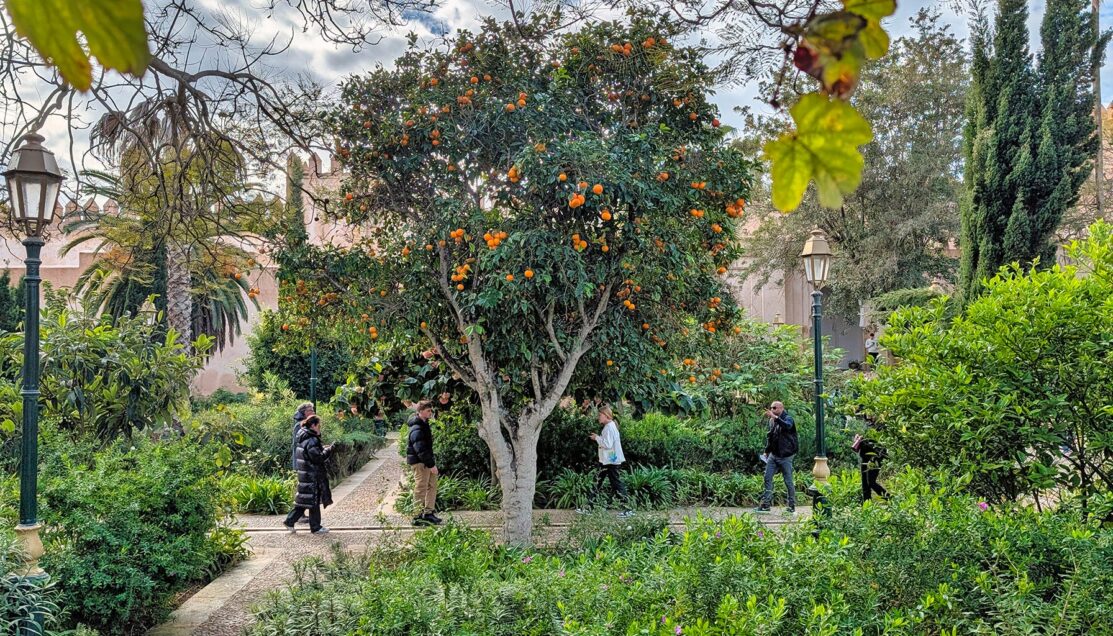
Pebble-set paths and formal planting beds reflect the early 20th-century French-era redesign that imposed Andalusian symmetry onto an originally military enclosure.
Iron lampposts and benches lined the paths, reinforcing that this was a carefully managed public garden rather than a natural landscape. Pink-toned stucco walls and arched structures echoed the architectural vocabulary of the surrounding kasbah.
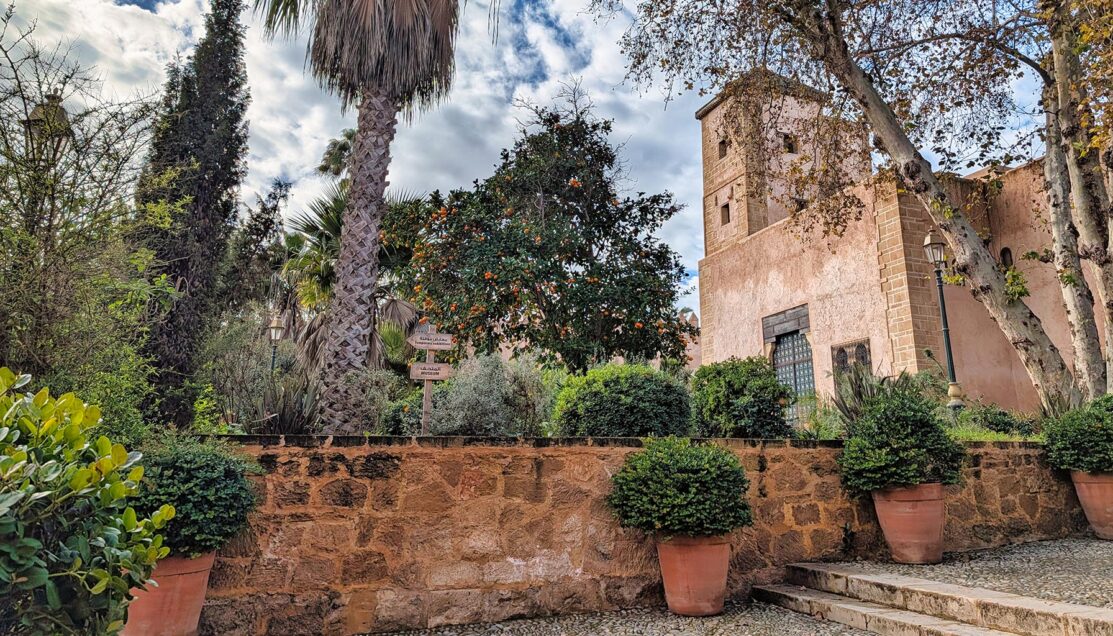
Pebble-set walkways, trimmed shrubs, and a square watchtower frame the controlled landscape within the kasbah walls.
In practice, however, our time in the Andalusian Gardens was limited. The group moved briskly along the main paths under schedule pressure, leaving little opportunity for exploration. The gardens offered only passing glimpses of their design and planting, making the visit feel more transitional than immersive.
Exiting the gardens through a side archway, we emerged at Café Maure along the kasbah’s edge, overlooking the Bou Regreg River with Salé visible across the water.
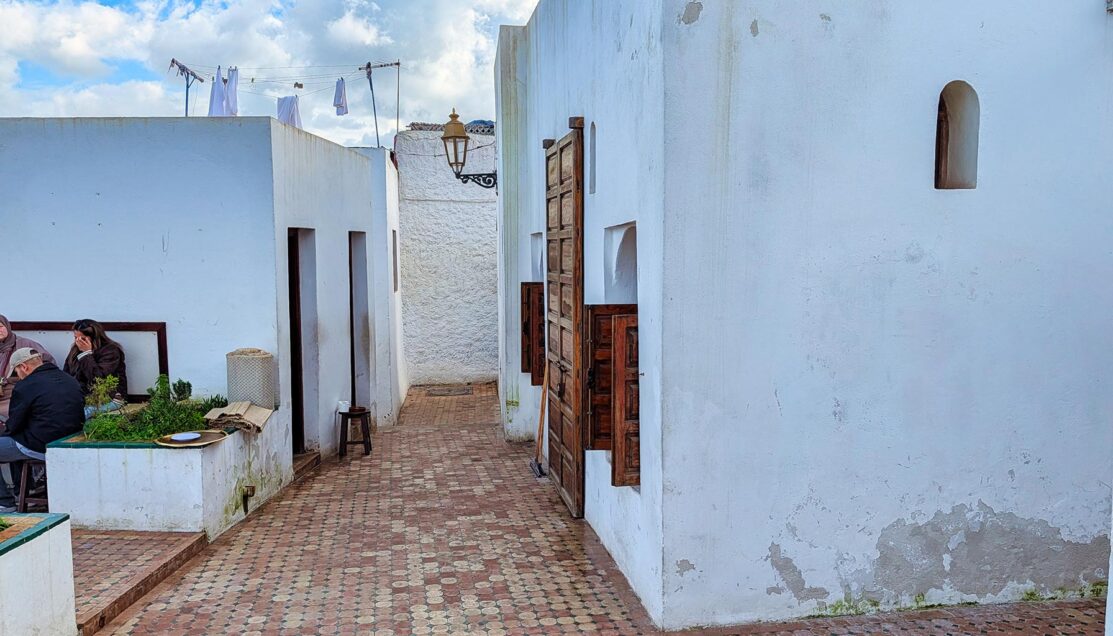
Simple courtyard tables and surrounding walls create a sheltered setting for traditional tea service within the kasbah’s outer defensive perimeter.
Our guide explained that we would be stopping for mint tea and pastries, a plan that initially felt ironic so soon after a full multi-course lunch. In practice, however, the pause reflected a common Moroccan custom: mint tea and small sweets function less as dessert than as a social interlude—an opportunity to slow the pace, sit together, and mark the transition between parts of the day.
Seating was informal. Servers circulated with trays of pastries while mint tea was ordered at the counter and carried back to the tables. The assortment included almond-filled gazelle horns, honey-glazed briouats, powdered-sugar ghriba cookies, ring biscuits, and coconut-based sweets. Guests selected items directly from the trays before settling into conversation overlooking the water.
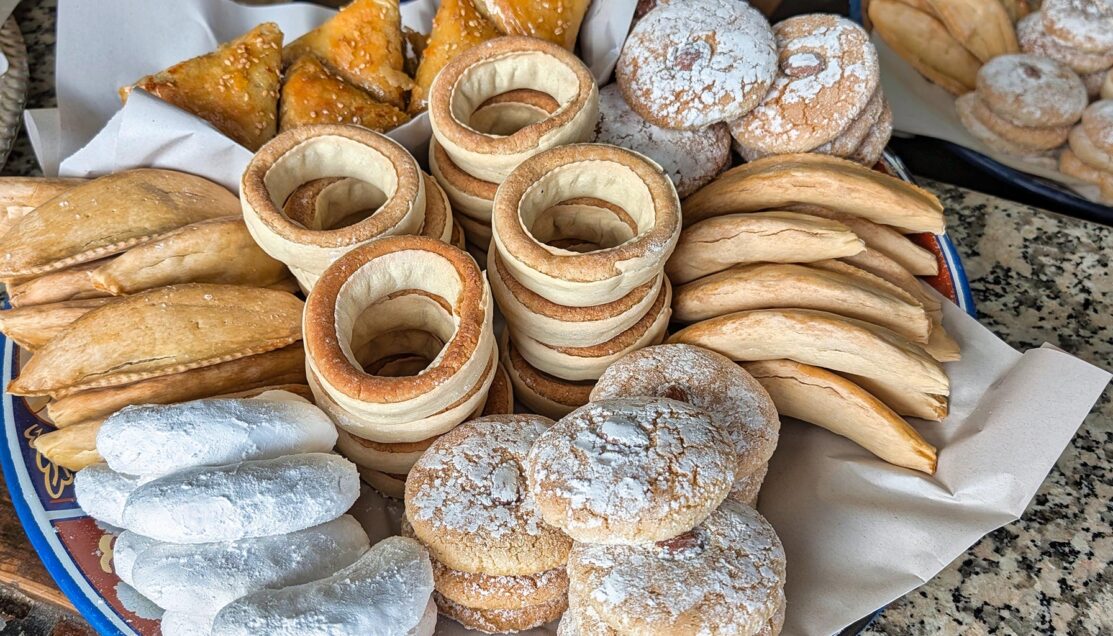
Assorted ghriba, briouats, gazelle horns, and ring biscuits are presented for informal selection, reflecting the social rather than ceremonial role of Moroccan tea service.
After tea, we walked through the kasbah’s small artisan lanes, where ceramics, painted woodwork, textiles, and clothing were displayed in compact storefronts integrated into the neighborhood walls. Several in our group browsed briefly before the guide gathered us for the return walk.
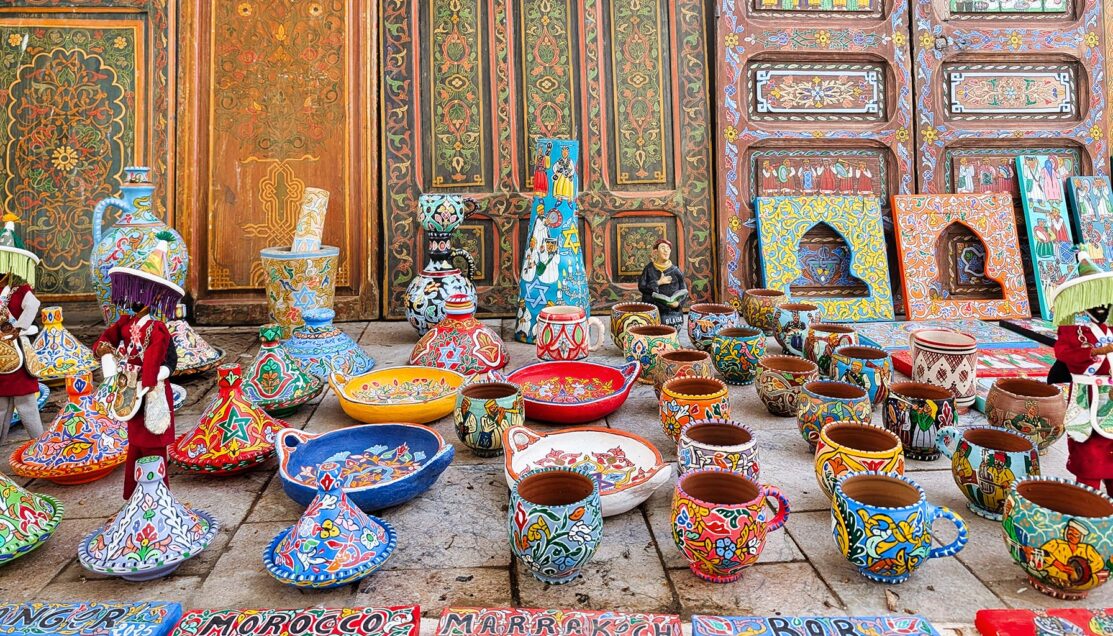
Hand-painted tagines, mugs, and decorative panels are displayed directly along pedestrian routes, integrating small-scale retail into the kasbah’s residential fabric.
From there, we exited the kasbah and made our way to the bus pickup point, concluding the final Rabat segment of the day.
Return to Port — Casablanca’s Final Impressions
As we reentered Casablanca on the return drive, the city came back into view in brief, shifting segments. Along the coastal boulevard, the minaret of the Hassan II Mosque rose above the shoreline, serving as a familiar visual marker of our approach to the port.
Farther along the Atlantic frontage, the stone ramparts of Fort El Hank stood above the surf, while inland neighborhoods revealed smaller mosques, apartment blocks, and commercial strips that reflected everyday life beyond the major landmarks.
We also passed the sweeping white curves of the Casablanca Grand Theatre, its modern design contrasting sharply with the historic sites we had visited earlier in the day.
As traffic narrowed toward the harbor, the skyline gave way to port infrastructure and security checkpoints. After a full day centered in Rabat, Casablanca functioned primarily as our departure and return point—seen from the coach window rather than experienced on foot.
☑ Who Is This Tour Best For?
- History-forward travelers — those who want imperial monuments, dynastic context, and landmark sites (Royal Palace district, Hassan Tower, Mohammed V Mausoleum) in one day.
- Walkers who like urban exploration — the medina walk plus the kasbah lanes involve sustained time on foot, with uneven surfaces and occasional stair climbs.
- Travelers who enjoy “city layers” over a single attraction — this tour works well if you like seeing how ceremonial Rabat, everyday medina life, and the kasbah’s quieter spaces connect.
- Food-curious cruisers — lunch in a riad-style setting plus mint tea and pastries at Café Maure add a strong cultural and sensory anchor to the day.
- Anyone comfortable with a long transit day — Rabat is the focus, but it’s a full coach journey from Casablanca and back, so patience with drive time is part of the experience.
⊞ Tour Summary
- Tour Name: Rabat – The Capital of the Kingdom
- Port of Call: Casablanca, Morocco
- Total Duration: ~9 hours
- Main Stops: Royal Palace District → Hassan Tower & Mausoleum → Medina Walk → Dar Rbatia → Kasbah of the Udayas & Café Maure
- Drive-By Highlights: Atlantic coastline, Fort El Hank, Casablanca Grand Theatre

▣ Activity Summary
- Terrain: Paved plazas, uneven medina streets, pebble garden paths, moderate stair climbing
- Walking Distance: ~2–2.5 miles total
- Accessibility: Moderate — extended walking and uneven surfaces
- Meals Included: Yes — lunch at Dar Rbatia
- Facilities: Restrooms at major sites and lunch stop
Related Mediterranean Travel: Explore more Mediterranean cruise ports and shore excursions in our complete regional guide.
→ Mediterranean Cruises & Shore Excursions Guide
© OceansAfoot