✘ Barcelona, Spain • December 20 (rainy winter day)
⌖ Medieval Towns and Volcanic Landscapes of Rural Catalonia
Tour Route: Barcelona → Vic → Santa Pau → Castellfollit de la Roca → Besalú → Barcelona
We woke to steady rain and met our In-Out Barcelona guide, Xavi, at 8:50am outside the Hard Rock at Plaça Catalunya, an easy three-minute walk from Royal Hotel Ramblas. Our transport was a small minivan (seating for eight), but there were only six of us, which set the tone for the day: flexible pacing, easy questions, and plenty of room to breathe.
As we rolled out of Barcelona, Xavi warmed up the group with light architectural commentary—especially the idea that Barcelona isn’t a one-architect city. He rattled off names beyond Gaudí (Domènech i Montaner, Puig i Cadafalch, and others), pointed out landmarks tied to them, and even shared a quirky detail about old heated benches—street seats with small metal doors where hot coals could be placed for warmth, paid for with a coin.
Soon we were on the C-33 heading northeast, then onto secondary routes as the city thinned into wet winter countryside. Xavi previewed the flow of the day in plain terms: Vic first, then Santa Pau for lunch, a quick photo stop at Castellfollit de la Roca, and finally Besalú—the one he clearly expected to steal the show.
① Vic — Where a Thousand Years Share the Same Street
⚲ Plaça Major, Vic 08500, Catalonia, Spain
⧗ 1.5–2 hours
We arrived in Vic at 10:13am, umbrellas open, stepping directly into a working market day. Rain had darkened the cobblestones to near-black and given the arcaded buildings a soft sheen, making the medieval square feel less like a tourist site and more like a town that simply happened to be a thousand years old.
Xavi framed the visit with a simple idea: Vic is not a museum of separate eras, but a place where centuries stack on top of one another. Roman foundations, Romanesque walls, Gothic additions, Baroque decoration, and 19th-century restorations all coexist in the same buildings. You don’t move from period to period — you see them layered in front of you.
Plaça Major — The Market That Never Moved
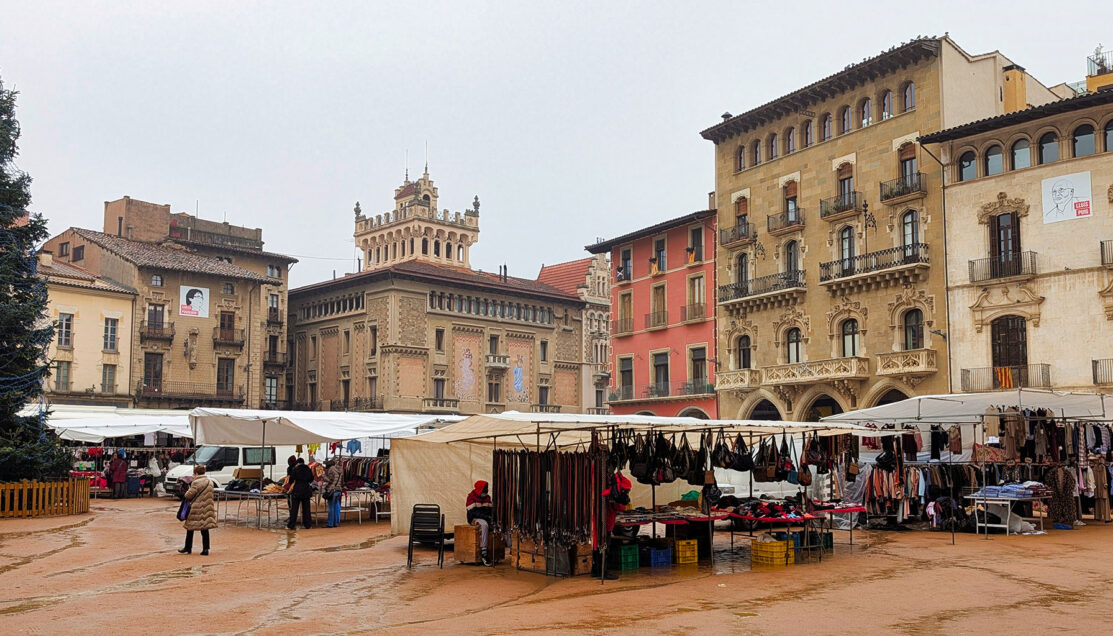
Vic’s Plaça Major has hosted markets for centuries, and even in the rain it was doing exactly what it has always done: feeding the region. Locals moved confidently between stalls selling meat, produce, and everyday goods, using the same arcades that medieval traders once sheltered beneath. The square still functions as Vic’s living room — civic, commercial, and social all at once.
It was here that Xavi began showing us how to read the city.
Reading Vic’s Architecture
Standing in the square, he introduced what he called the city’s “style ladder” — the three major architectural eras layered throughout Vic:
- Romanesque (thick walls, small openings)
- Gothic (taller, lighter, more vertical)
- Baroque (ornament, color, movement)
The transitions, he explained, happened every few hundred years as new ideas replaced old ones — much like upgrading technology. His analogy was simple: old phone to new phone. It worked.
He even gave us a way to date decorative carvings. Classical sculptors used grapes, apples, and oranges — but bananas didn’t arrive in Europe until after the Americas were discovered. So, if you ever see bananas carved into stone, you are looking at something from the 17th century or later.
Then he pointed out something uniquely Vic: many building owners deliberately remove small patches of plaster to expose the medieval stone beneath — not because the structures are neglected, but because age itself has become a mark of distinction. In Vic, history is something you show off.
The Town Hall and Vic’s Civic Identity
A block from the square we paused at the Ajuntament (Town Hall), where large display windows held Vic’s Christmas giants — crowned royal figures flanked by animals. These gegants are traditional Catalan ceremonial figures used in festivals and parades to represent a town’s historic founders and nobility.
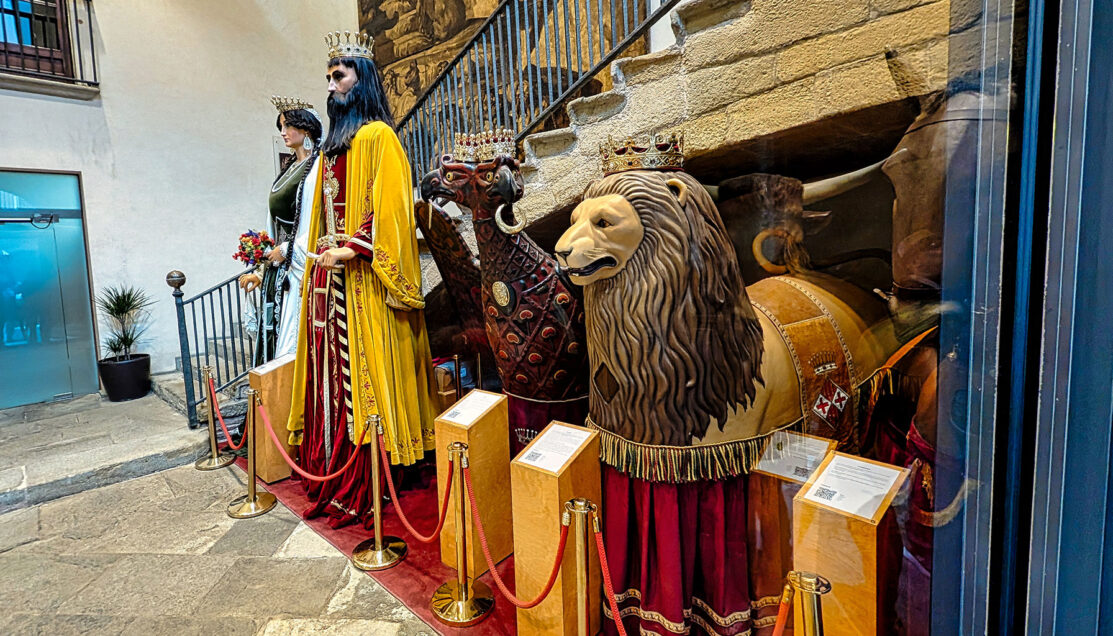
Set inside the modern town hall, they quietly tied Vic’s present-day civic life to its medieval identity — another example of how the city layers its past into everyday life rather than separating it from it.
The Bishop’s Quarter — Santa Maria la Pietat
Leaving Plaça Major behind, we entered the Episcopal Quarter, where the noise of the market dissolved into echoing footsteps and rain on stone. The streets narrowed, the buildings grew more austere, and the civic energy of the square gave way to a district shaped for centuries by the church.
Our stop here was Santa Maria la Pietat, a compact Baroque chapel attached to the Bisbat de Vic, the bishop’s administrative complex. The church was closed, but through a locked gate in the vestibule we could see its brilliantly gilded altar glowing beneath a deep blue ceiling scattered with gold stars.
This was where Xavi offered one of the most revealing explanations of the morning.
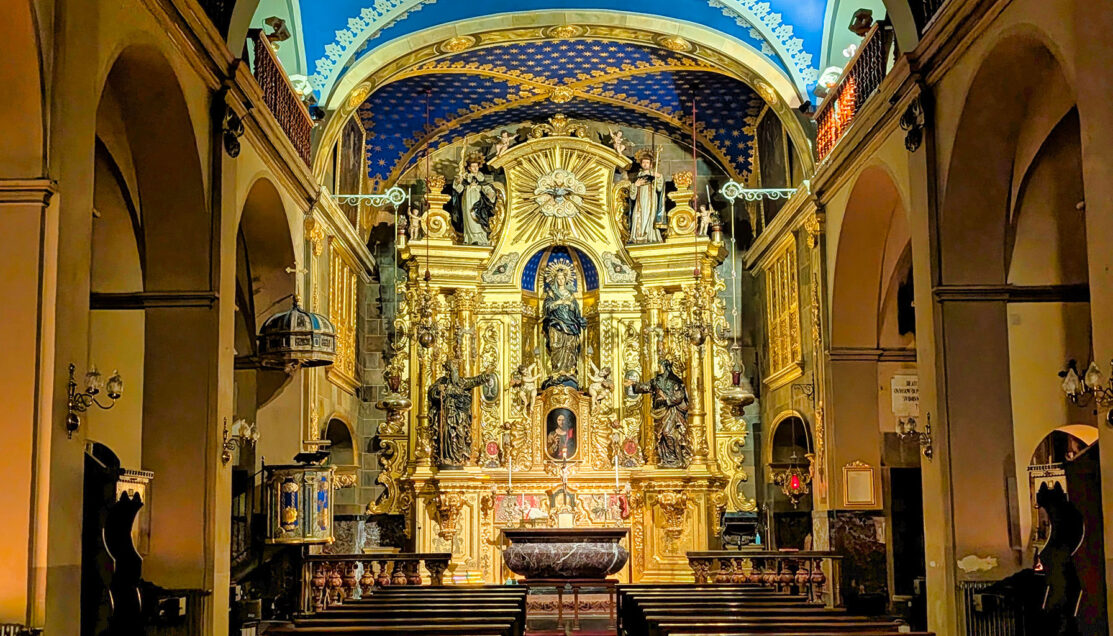
The altar’s design is highly unusual. Instead of focusing only on Christ, it places Mary at the center, with God above, Jesus below, and Mary’s parents — Saint Anne and Saint Joachim — standing on either side. In most Catholic churches, Mary’s parents appear only in side chapels or not at all. Here, they occupy the main altar itself.
Xavi explained that this arrangement reflects something deeply Catalan. Before Catalonia was ever a political identity, it was a Marian Christian culture. Devotion to Mary lies at the heart of its religious life, older than the language, older than the borders. In Vic, faith did not grow outward from kings or institutions — it grew inward, around Mary.
Approaching Vic Cathedral
From the Episcopal Quarter we crossed a small, open square flanked by stone buildings and dominated by Vic’s Romanesque bell tower. A modern metal sculpture of Abbot Oliba—the 11th-century bishop who helped shape medieval Catalonia—stood watch over the space. The pairing was deliberate: a contemporary figure cast in steel facing a thousand-year-old tower of stone, again reinforcing Vic’s habit of letting eras stand side by side rather than replacing one another.
This square marks the threshold between Vic’s medieval fabric and the cathedral complex. From here, the scale of the religious precinct becomes clear: thick masonry walls, narrow windows, and the vertical rhythm of the bell tower rising above everything else.
Vic Cathedral — Monumental and Modern
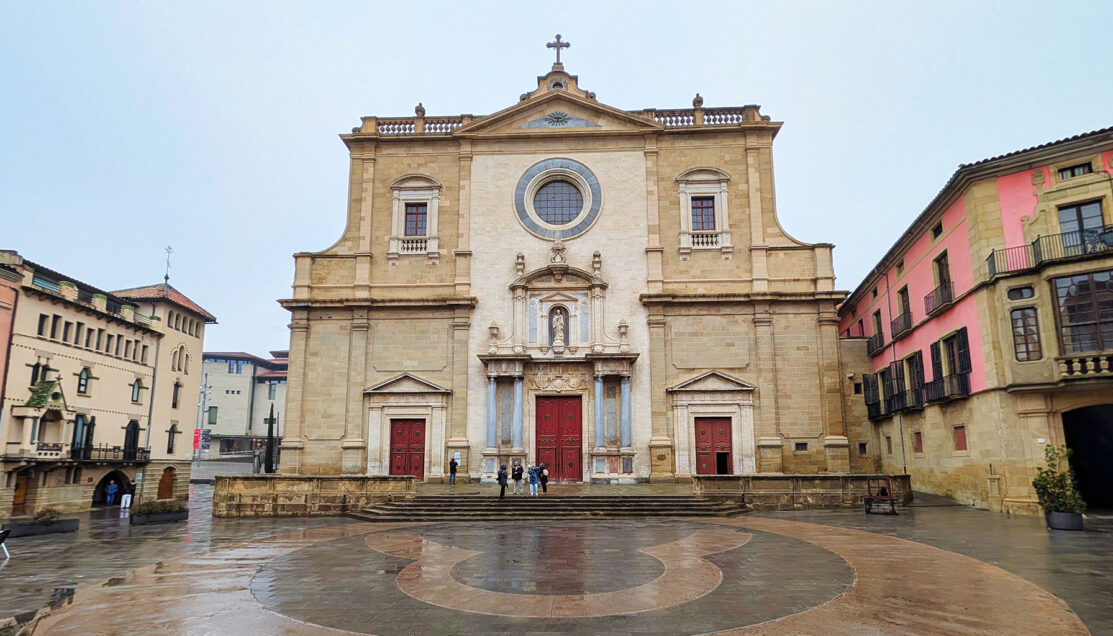
The Cathedral of Sant Pere de Vic faces a broad open plaza, its neoclassical façade deliberately set apart from the dense medieval streets behind it. Unlike the layered buildings of the old town, the cathedral reflects an 18th-century architectural vision, modeled after Roman basilicas and designed to project symmetry, authority, and permanence.
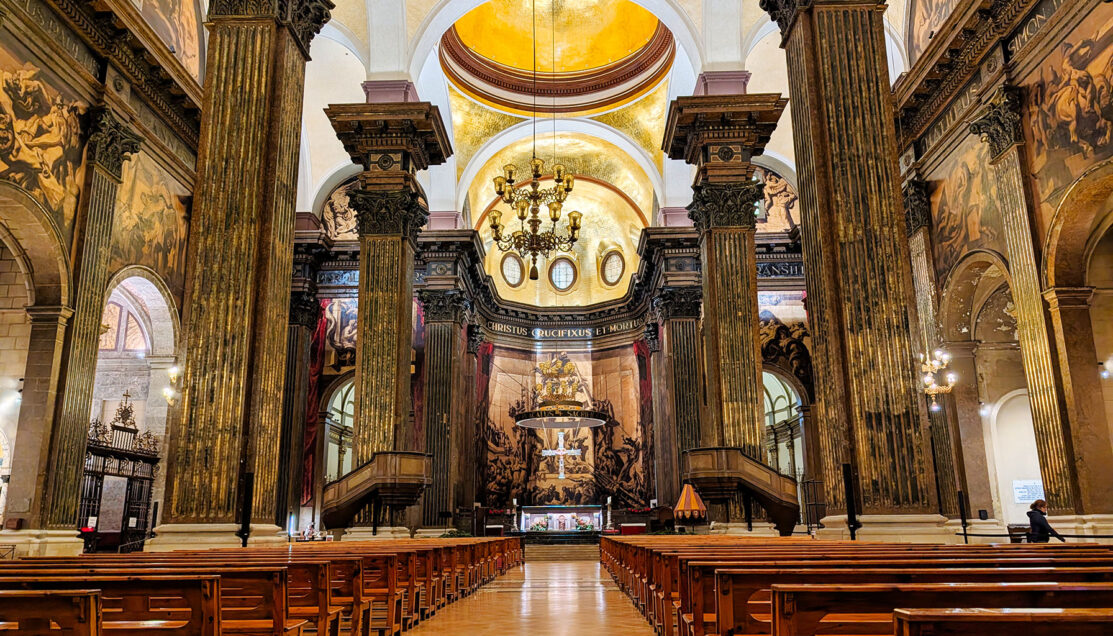
Inside, the scale is immediate. Massive Corinthian columns rise toward a gilded dome, while large painted murals cover the walls, turning the interior into a single, continuous narrative rather than a series of separate altars.
Xavi explained that this was intentional — the cathedral was rebuilt to assert church authority and permanence rather than evolve gradually like the old town.
The Cloister — Vic’s Hidden Medieval Heart
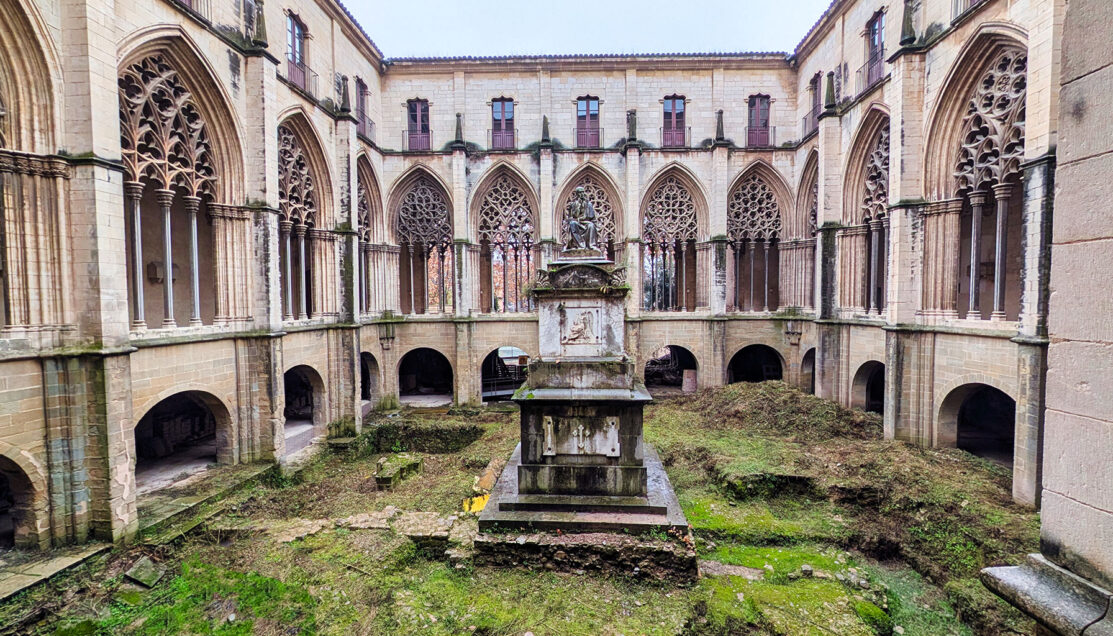
With special permission, we stepped into the cathedral’s cloister, one of the oldest surviving parts of the complex. The mood changed immediately. Where the cathedral was grand and theatrical, the cloister was quiet, geometric, and intimate.
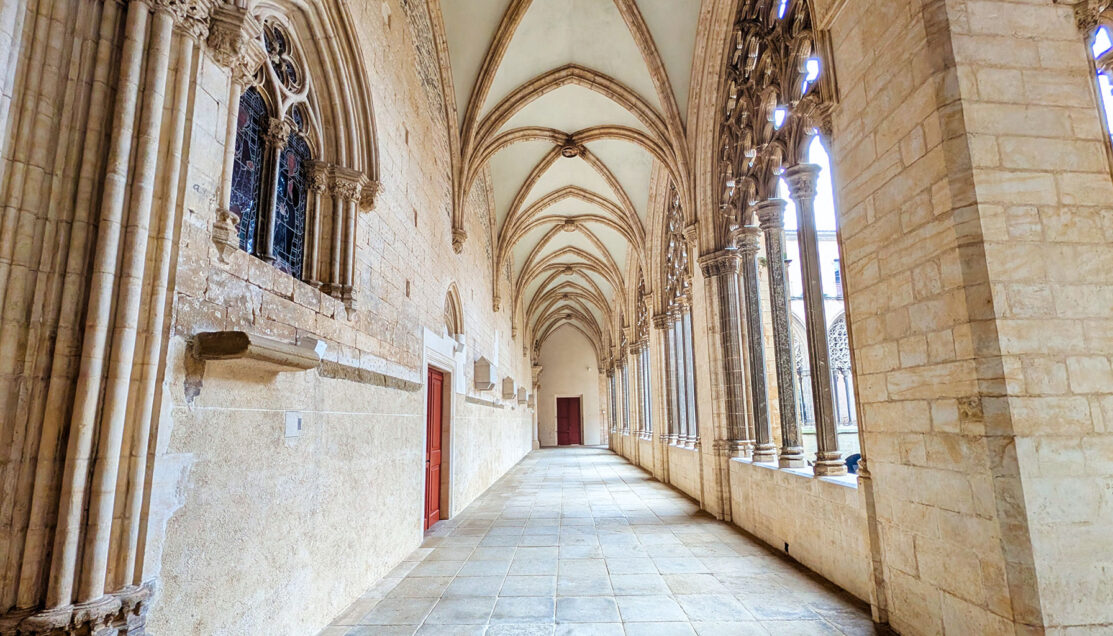
Slender Gothic arches framed a central courtyard where stone foundations, moss, and worn pathways revealed the footprint of earlier centuries. This was the working heart of the religious community — a place for prayer, study, and daily life — and here Vic’s layered history became visible again, just as Xavi had described in Plaça Major.
From Cathedral to River — Vic’s Oldest Crossing
Leaving the cathedral precinct, we walked downhill toward the Mèder River, where rows of trees lined the old riverbank. Just ahead stood the Pont de Queralt, a medieval stone bridge whose low arches once carried traders and travelers into the fortified town.
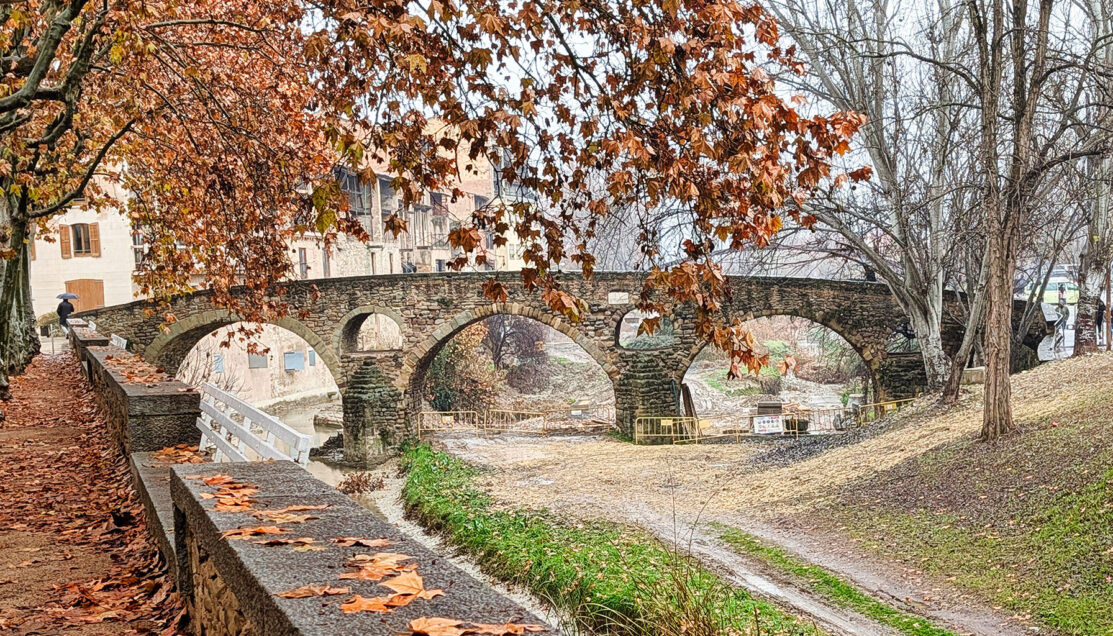
Even today it marks a transition. On one side lies the institutional world of the cathedral and bishops; on the other, the older commercial streets where Roman, medieval, and early-modern Vic overlap.
The Temple of Vic — A Roman City Beneath the Medieval One
A short walk from the bridge brought us to one of Vic’s most unexpected monuments: the Temple Romà, a remarkably preserved 2nd-century Roman temple standing inside the medieval town.
Its survival is part of the story. During the Middle Ages, a fortified palace was built directly around the Roman structure, sealing it inside stone walls for nearly a thousand years. When that medieval building was demolished in the late 19th century, the temple emerged almost intact — its classical columns and portico revealed from what had become, in effect, a protective shell.
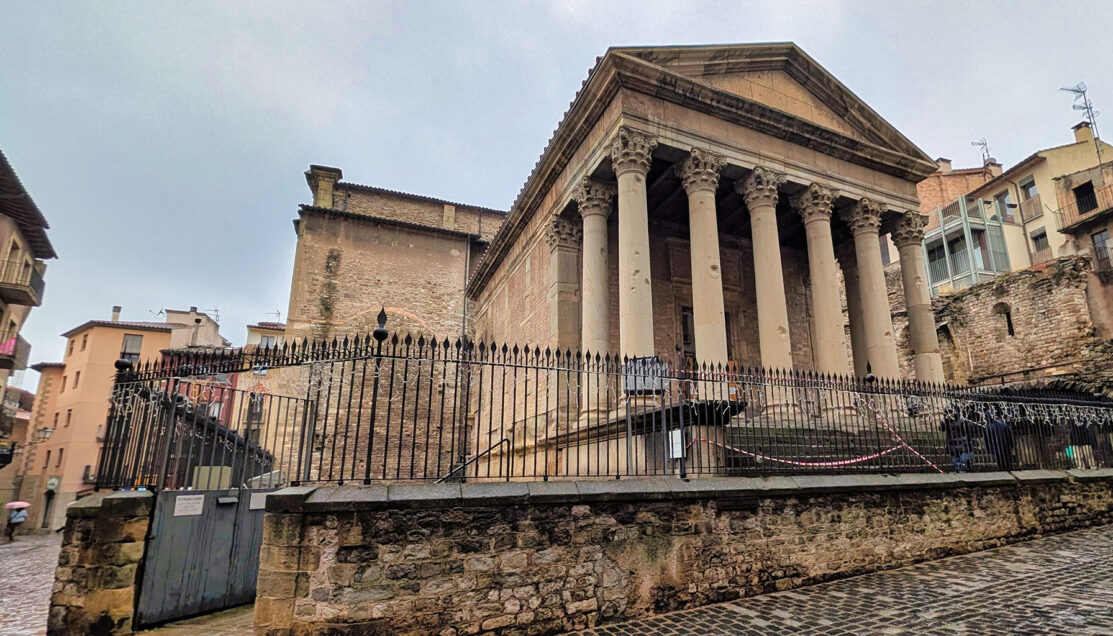
Xavi explained that this was Vic’s history in physical form: Roman foundations hidden inside medieval fortifications, now surrounded by modern streets.
As we walked around the temple, he described its role in Roman Ausa, the settlement that stood here long before Catalonia, Vic, or even Christianity existed.
Standing beside it, Vic’s idea of a “stacked city” became literal — Roman stone at ground level, medieval streets wrapped around it, with Gothic, Baroque, and modern buildings rising above.
A Market Town’s Signature
Just steps from the temple, we stepped into a traditional Vic sausage shop, its walls lined with strings of cured meats and shelves of vermouth and local liqueurs. The proprietor offered samples, giving us a literal taste of the town’s culinary heritage.
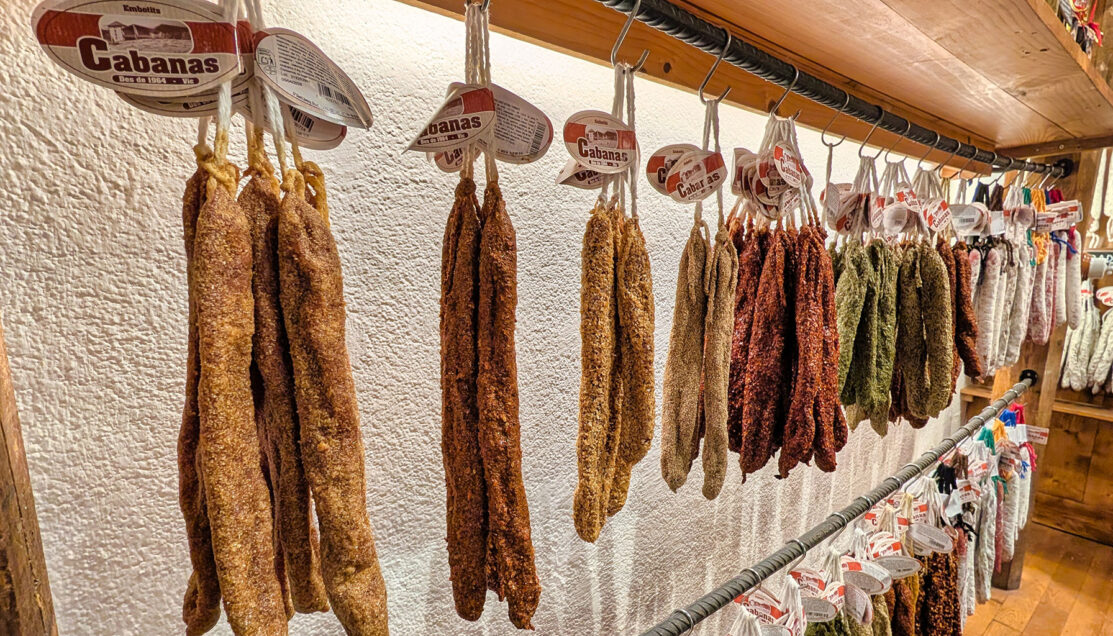
Vic is famous throughout Catalonia for its fuet and llonganissa, dry-cured pork sausages made using methods that date back centuries. The climate of the Osona plain — cool, dry, and naturally ventilated — has long been ideal for curing meat, turning Vic into one of the region’s historic food centers.
Free Time Back in Plaça Major
Before departing, we returned to Plaça Major for about forty minutes of free time. Some visitors continued exploring Vic’s food shops, while others wandered through the rain-dampened market stalls as the square carried on with its daily rhythm.
In the space of a single walk, Vic had revealed more than a thousand years of history — not in museums or isolated ruins, but in a living town where every era remains present, stacked neatly on the next.
② Santa Pau
⚲ Santa Pau, La Garrotxa, 17811, Catalonia, Spain
⧗ 1.5–2 hours (including lunch)
After Vic, we continued by coach into La Garrotxa, Catalonia’s volcanic region. On the drive, our guide explained that Santa Pau would be a small village stop with lunch on our own, recommending we keep it simple—something like tapas at the local café.
Lunch at Centre Cívic — A Local Table, Not a Tourist One
We arrived in Santa Pau in mid-afternoon and went to Bar-Cafeteria Centre Cívic, the town’s municipal café near the civic center. Since lunch wasn’t included, we ordered directly from the menu and ended up with a very typical Catalan meal:
- Croquetes (fried croquettes with a savory filling)
- Pa amb tomàquet (bread rubbed with tomato and olive oil)
- Grilled chicken with fries
- Catalan custard for dessert
- Local white wine
It was a straightforward, working-town café — not something designed for tour groups.
The Community Room and a December Tradition
After we finished lunch, our guide led us through a rear doorway of the café into a community hall used by the town itself. The room was set up with rows of tables and chairs, and along one side a counter had been prepared with wrapped boxes, food baskets, and household items arranged neatly in view.
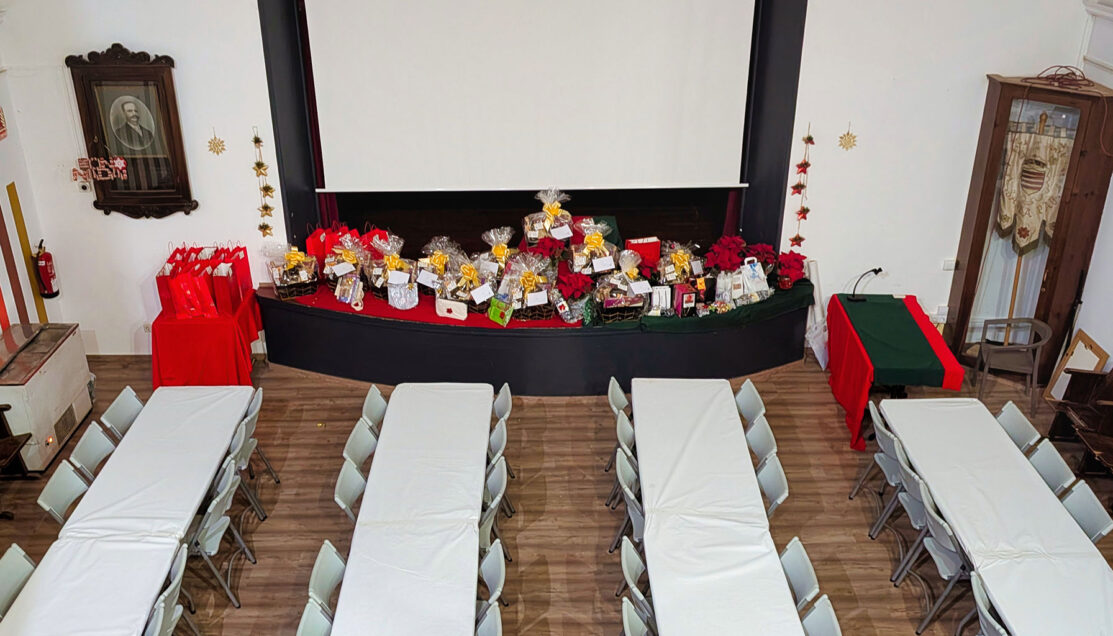
He explained that this setup was for Quina de Nadal, a Catalan Christmas-season game. During December, towns like Santa Pau hold these events as community gatherings. Residents sit at the tables with numbered cards while numbers are called—much like bingo—and the prizes on display are what players win during the game.
Walking Santa Pau’s Medieval Route
From the civic center, we walked directly into Santa Pau’s medieval core. The ground shifted from smooth pavement to rounded cobblestones, and the streets narrowed into stone corridors where upper floors overhang the lanes below.
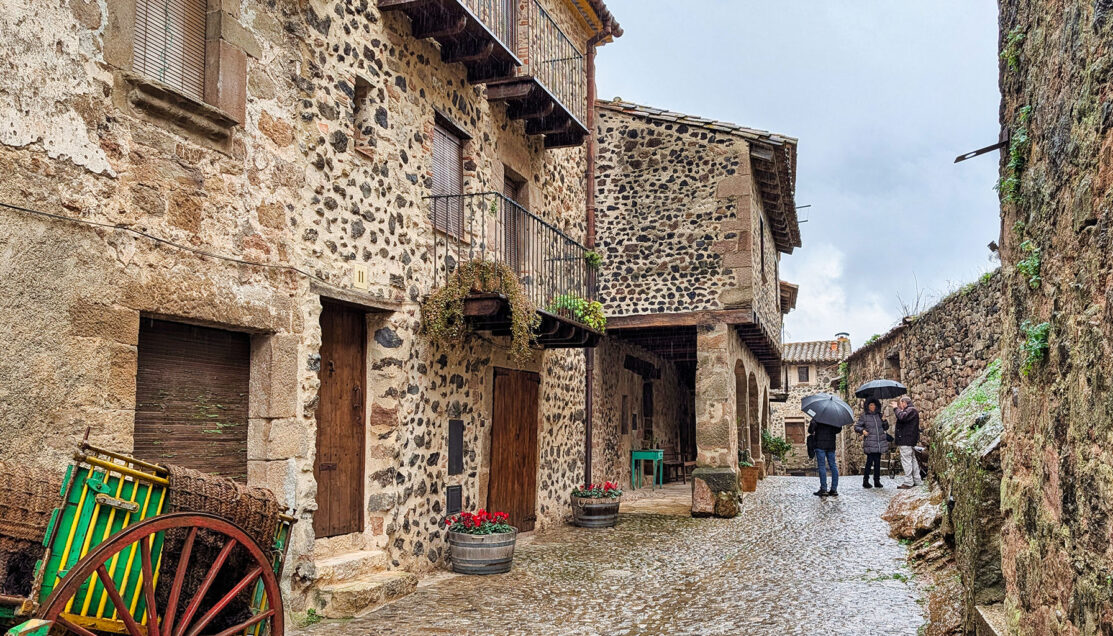
Our guide pointed out how many of the arches and doorways were unusually low, explaining that Santa Pau was built for donkeys, carts, and cattle, not horses or wagons. The proportions of the town still reflect its agricultural origins.
The houses were built of dark volcanic stone with thick walls, small windows, wooden doors, and iron fittings, with façades showing layers of medieval masonry, later repairs, and newer additions stacked together.
Discovering the Ruta Medieval in Reverse
We didn’t encounter route signage at first — we simply walked the medieval layout as it naturally unfolded, moving through arches, past small squares, and along curving stone lanes. Only after we had already crossed much of the historic center did we find the “Ruta Medieval” sign, listing the landmarks we had been threading together:
- Plaça del Mirador (viewpoint square)
- Ajuntament (town hall)
- Llindes al Carrer del Pont (historic stone lintels along Bridge Street)
- Portal de Sant Antoni (medieval gate)
- Plaça Major (main square)
- Església de Santa Maria (parish church)
- Castell de Santa Pau (castle complex)
- Portal de la Vila Vella (old town gate)
Seeing the list at the end made it clear we had already walked the intended medieval circuit — just in reverse.
The Character of the Village
What made the walk stand out most was how quiet the village was. There were few people, almost no signage, and no commercial noise, which made the medieval structure easy to read — how streets funnel into squares, how walls guide movement, and how the town remains organized around its original defensive layout.
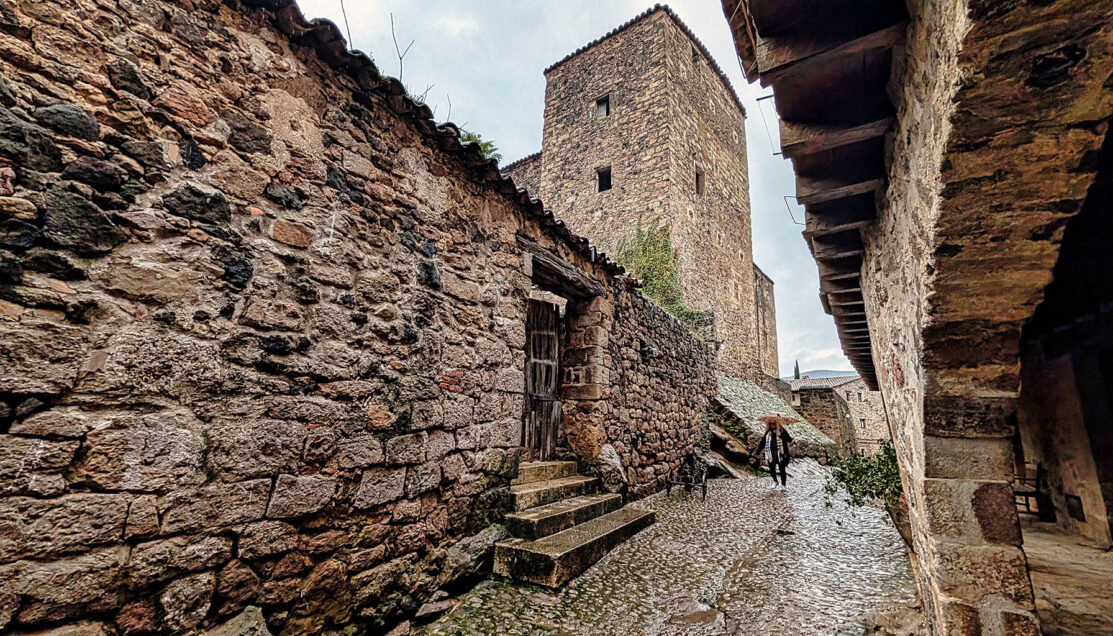
The village didn’t feel like a reconstructed site or an outdoor museum. It felt like a working medieval settlement that simply never tore itself down — houses still lived in, doors still used, balconies still holding flowerpots — all set inside a street plan that hasn’t changed in hundreds of years.
③ Castellfollit de la Roca — Basalt Cliff Viewpoint
⚲ Castellfollit de la Roca viewpoint, 17856, Catalonia, Spain
⧗ 10–20 minutes
A short drive from Santa Pau brought us to Castellfollit de la Roca, one of Catalonia’s most dramatic geological villages. The town sits on a long ridge of basalt columns, formed by ancient lava flows and carved by the Fluvià River below.
We stopped below the village rather than inside it, at a viewing area that looks directly up at the cliff and the line of stone houses along its edge. From here, the entire town could be seen stretched along the ridge, with the church tower rising at the highest point and the rest of the buildings forming a continuous wall behind it.
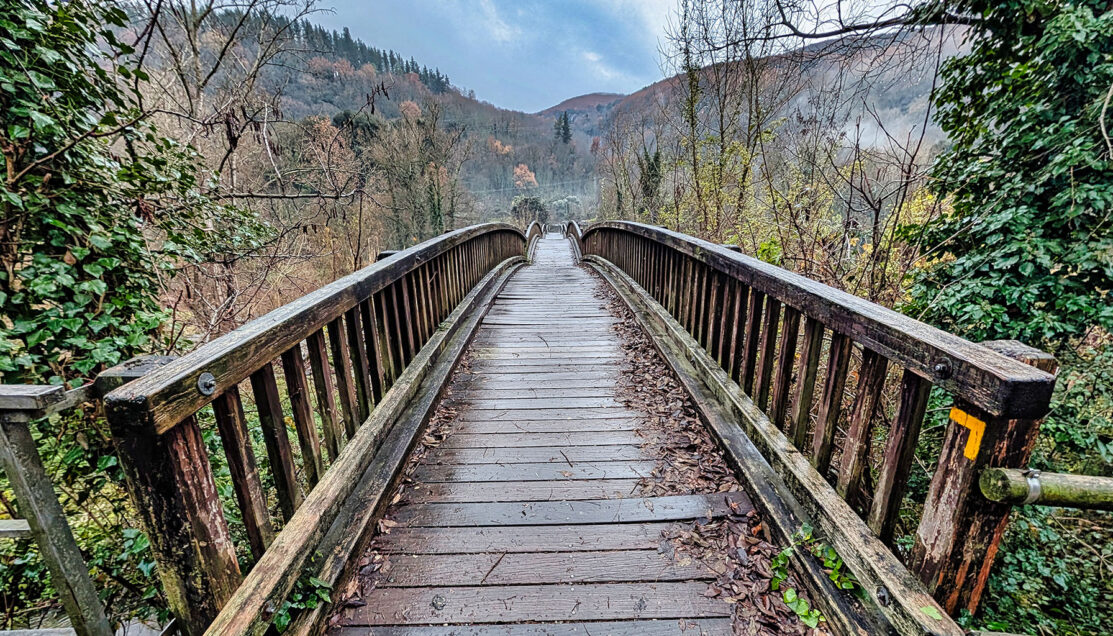
From the parking area, we walked to a wooden pedestrian bridge that crosses the Fluvià at the base of the cliff. The bridge rises gently at the center, creating a natural vantage point over the river and the stone embankments.
From this position, the full composition came into view: the river curving around the cliff, a low weir forming a smooth arc across the water, and above it all, the vertical basalt columns supporting the village. We moved along the bridge and stopped at several points to take photos, lining up the river, the dam, and the cliff-top houses in a single frame.
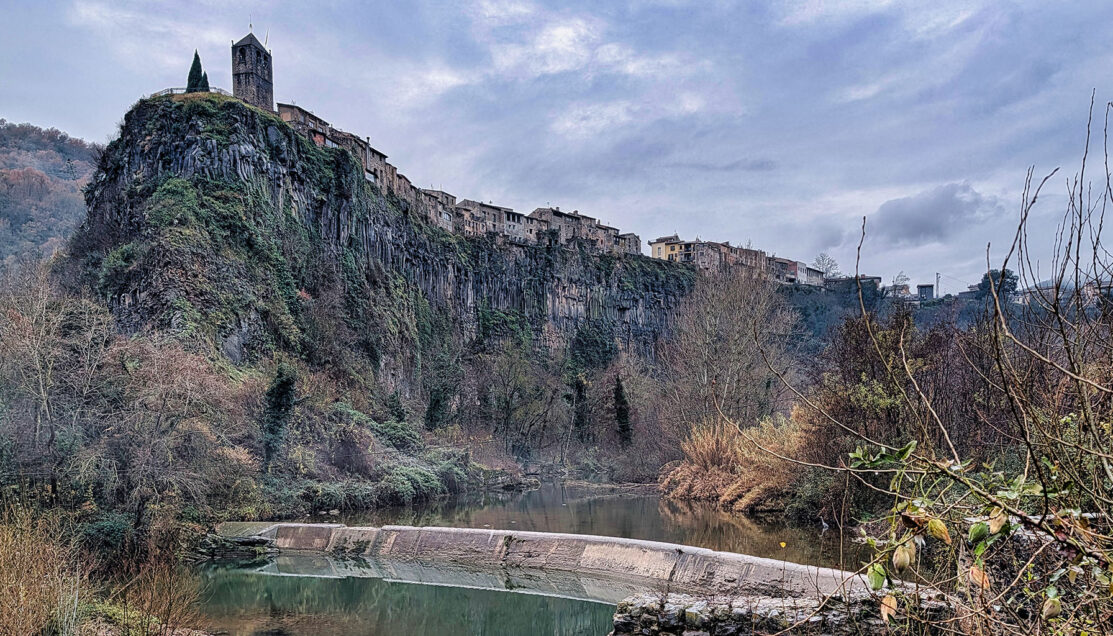
From below, the town’s extreme position was unmistakable — the buildings appear to sit directly on the edge, with sheer rock dropping away beneath them. Xavi explained that this stop was meant to be visual rather than physical. From this angle, the entire geological structure—basalt, river, and village—could be seen together, something that would be lost if we went up into the streets.
After photographing the bridge, the Fluvià, and the cliff, we returned to the coach, having seen Castellfollit from the vantage point that best explains why it is famous.
④ Besalú — Free Time in the Medieval Jewel Box
⚲ Historic Center, Pont Vell, Besalú 17850, Catalonia, Spain
⧗ 1 hour (free time, dusk)
A short drive from Castellfollit brought us to Besalú, one of Catalonia’s most intact medieval towns. Rain was falling and daylight was fading as we arrived, giving us only a narrow window to explore before night settled in.
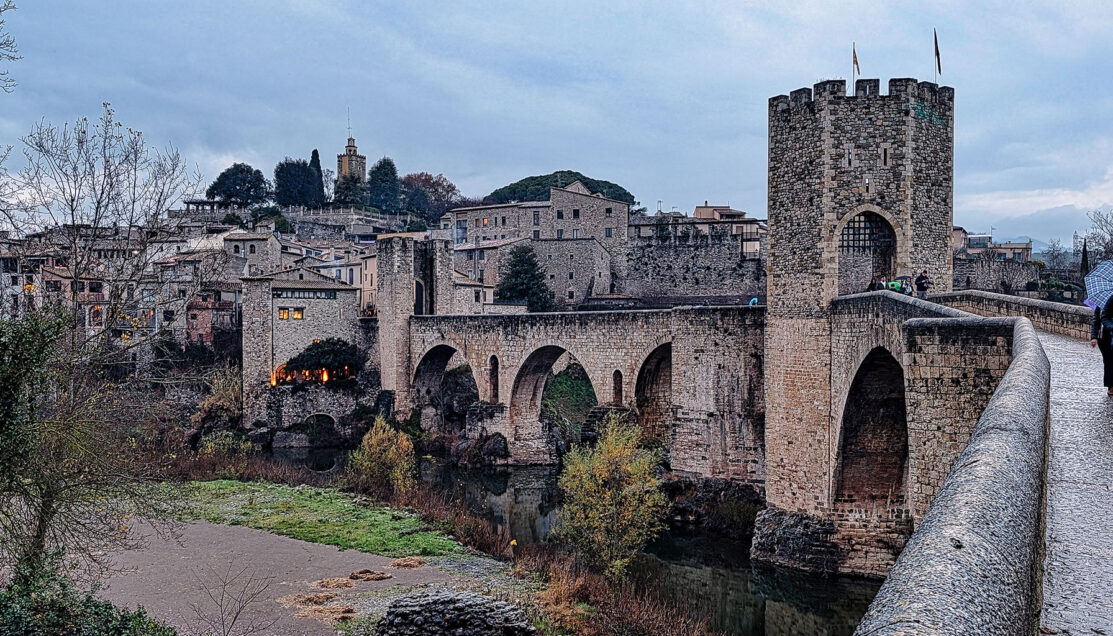
We began by crossing the Pont Vell, the Romanesque bridge that spans the Fluvià River and leads into the walled town. The bridge rises in a series of stone arches toward a square defensive tower at its center. Passing beneath its gated archway, we entered the old town.
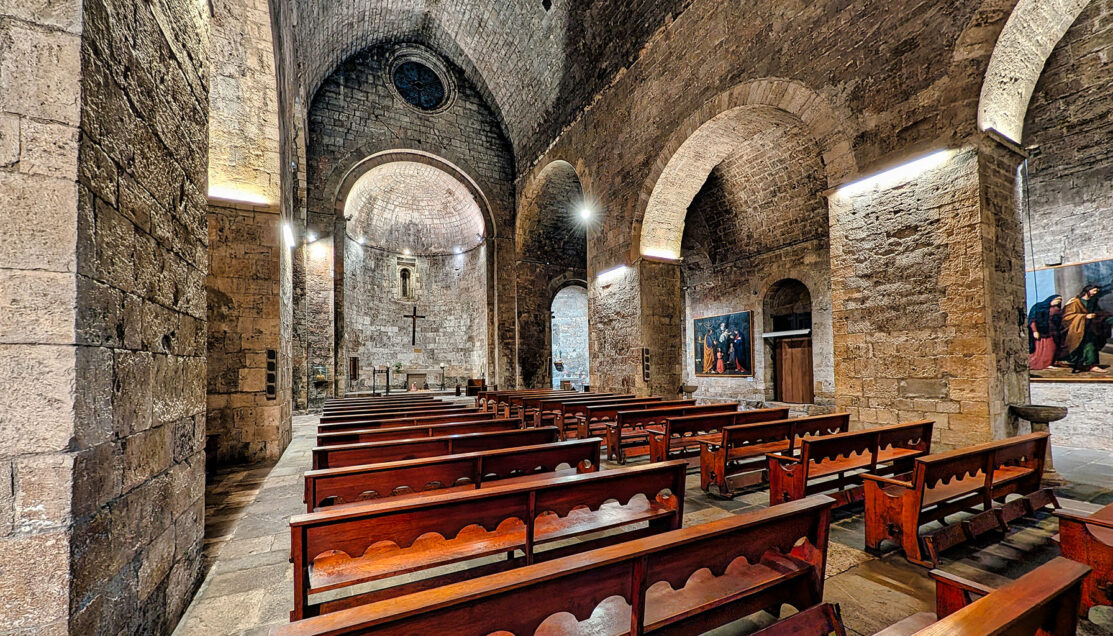
We then walked to Santa Vicenç de Besalú, the town’s Romanesque parish church, and went inside. The thick stone walls, rounded apse, and simple altar created a quiet, enclosed space that contrasted sharply with the rain outside.
From there, we continued toward the Monestir de Sant Pere, Besalú’s large Benedictine monastery. In the square outside, a Christmas installation had been set up, with seasonal lighting reflecting off the rain-slicked stone. Nearby, we wandered through a small holiday diorama exhibit, where detailed miniature winter scenes — likely installed just for the season — added a festive layer to the medieval surroundings.
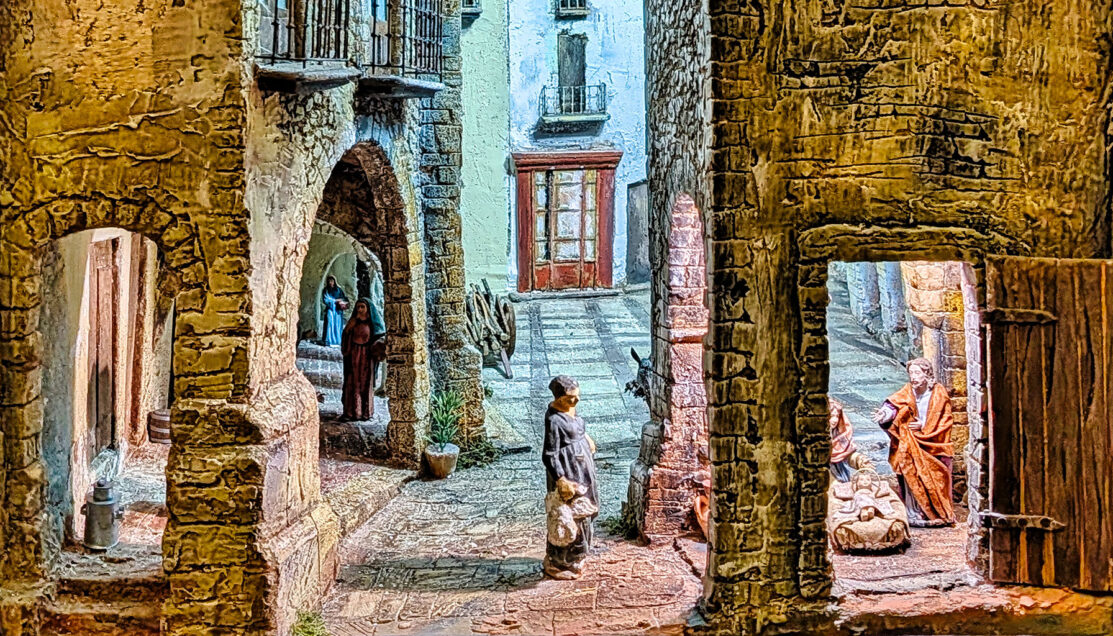
Just outside the diorama exhibit, we found Circusland — the International Circus Palace, which promotes one of the world’s largest circus dioramas. It looked intriguing, but with night fully arriving, we did not have time to go inside.
We crossed into Plaça Major, the town’s main square, on our way back toward the tour van. Arcaded stone buildings surrounded the open space, and café lights and shop windows reflected off the wet pavement as people moved through under umbrellas.
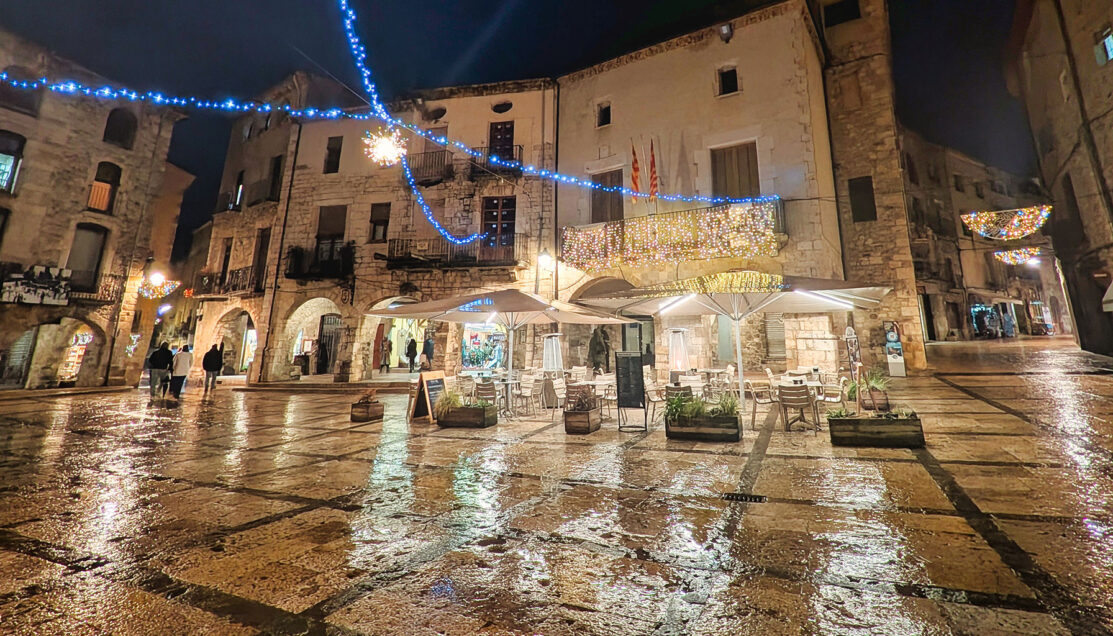
With our hour coming to an end, we turned back toward the bridge. Only later did we learn that Besalú also preserves a medieval Jewish quarter—including a mikveh and synagogue remains—that we never reached, confirming it as a town that rewards slow walking, daylight, and time.
Return to Barcelona
⚲ C-66 → AP-7 (back toward the city)
⧗ 2.5–3 hours (traffic/weather dependent)
We left Besalú in the dark and rain, settling back into the coach for the drive toward Barcelona. The route carried us back through La Garrotxa’s hills and valleys, then onto the faster highways leading into the city.
We arrived around 8:00 PM, the streets wet and reflective under the lights. We were tired, but in the way that comes from a full day spent walking real streets and crossing real bridges, not just watching scenery from a bus window.
It had been a day of layered Catalonia — Vic, Santa Pau, Castellfollit, and Besalú — each showing a different way that history, geography, and daily life still coexist beyond the city.
☑ Who Is This Tour Best For?
- Medieval-town lovers – Four distinctly different historic settings in a single day, from Vic’s layered urban core to the walled village of Santa Pau and the medieval jewel box of Besalú.
- Architecture & “time-layer” travelers – Roman foundations, Romanesque churches, Gothic street plans, and Baroque additions appear side by side, especially in Vic, where centuries overlap in a compact walkable center.
- Photographers – The basalt cliff at Castellfollit de la Roca and the Pont Vell bridge in Besalú provide some of the most visually striking compositions in inland Catalonia.
- Small-group travelers – Tours are limited to eight guests (ours had six), allowing for flexible pacing, easy conversation with the guide, and access to places that large buses simply cannot reach.
⊞ Tour Summary:
- Tour Name: Besalú Vic and Medieval Towns Small Group Full Day Tour from Barcelona
- Offered By: In-Out Barcelona Tours
- Total Duration: Full day
- Main Stops: Vic (walking tour + Roman temple + cathedral), Santa Pau (lunch + medieval walk), Castellfollit de la Roca (photo stop), Besalú (free time + Pont Vell area)

▣ Activity Summary:
- Walking Distance: Moderate (spread across multiple towns; variable during free time).
- Terrain: Cobblestones, slick stone steps in rain, uneven medieval lanes; some inclines.
- Accessibility: Challenging in wet weather (cobbles + steps + narrow lanes).
- Meals Included: No. Lunch stop in Santa Pau.
- Best Practical Tip: In winter, Besalú is better as a standalone day trip so you’re not racing the sunset.
Related Mediterranean Travel: Explore more Mediterranean cruise ports and shore excursions in our complete regional guide.
→ Mediterranean Cruises & Shore Excursions Guide
© OceansAfoot