✘ Salisbury, England • August 23, 2025
⌖ Towering Spires, Magna Carta & Riverside Elegance
Tour Route: Southampton Central → Salisbury Cathedral Tower → Cathedral Interior → Chapter House & Magna Carta → Bell Tower Tea Rooms → Wilton House & Gardens → Return to Southampton Central
Duration: Full Day (Approx. 9 hours round trip)
On a clear Saturday morning, we left Southampton for a day trip into the heart of Wiltshire. Our plan was simple: a direct train to Salisbury, a short hop by local bus, and a carefully timed route that linked some of England’s most enduring landmarks. The itinerary combined three highlights—climbing into the tallest cathedral spire in Britain, viewing the Magna Carta in the Chapter House, and touring the Palladian state rooms and riverside gardens of Wilton House. By the time we returned in the evening, we had covered centuries of history in the span of a single, well-paced journey.
Journey into England’s Medieval Heart
We began the day at Southampton Central Station, boarding the 08:30 Great Western Railway service to Salisbury. The ride was quick and direct—just over half an hour through Hampshire’s countryside of fields and hedgerows. Our Anytime Day Return tickets offered flexibility for the return journey, and with no seat reservations required, boarding was simple and stress-free.
At 09:03, the train pulled into Salisbury Station on South Western Road. From the forecourt, we chose convenience over the 15-minute walk and caught the X3 bus straight into the city center. The short ride set us down near the High Street, ideally placed for a café stop before continuing on toward the Cathedral Close.
① Breakfast: Charlies Cafe
⚲ Charlies Cafe, 35 Catherine Street, Salisbury SP1 2DQ
⧗ 45 minutes
After stepping off the X3 bus in the city center, our first stop was Charlies Cafe, tucked just a short walk from the High Street. The menu was straightforward, and we opted for the American Breakfast—two pancakes, scrambled eggs, bacon, a hash brown, and maple syrup—served hot alongside a pot of brisk English tea.
The timing fit neatly into our schedule. With the 10:15 AM Tower Tour at Salisbury Cathedral already reserved, breakfast gave us a chance to refuel and pause before heading into the Close. When we left the café, we followed the High Street south, the cathedral’s spire already visible above the rooftops, guiding us toward our next stop.
② Salisbury Cathedral & Tower Tour
⚲ Salisbury Cathedral, 6 The Close, Salisbury SP1 2EJ
⧗ 2.5 hours total (including tower tour)
From High Street we entered Cathedral Close through the north gate, stepping into an 80-acre precinct of green lawns, Georgian houses, and historic residences. Ahead of us rose the soaring spire of Salisbury Cathedral, the tallest in Britain at 404 feet. At the west front, we joined the small group gathering for the 10:15 AM Tower Tour, already reserved in advance.
The tour began beside the cathedral’s medieval clock, constructed around 1386 and regarded as the oldest working mechanical clock in the world. Built without hands or a face, its iron frame was designed to strike the hours on a bell. Our guide explained how it once stood in a free-standing tower, was dismantled and forgotten, and only rediscovered centuries later before being reassembled in the 20th century with assistance from Rolls-Royce engineers.
From there, we began the climb—332 steps in all—through the hidden passageways inside the spire. The first stop was a gallery above the nave, where we looked down into the church and across toward the Trinity Chapel. The guide pointed out two highlights of the stained glass: the Prisoners of Conscience Window from the 1980s, glowing in deep cobalt blue, and the angled Moses Window, one of the rare medieval panels to survive the Reformation. Below us, at the crossing, the modern bronze font shimmered with its perfectly level sheet of water, reflecting the arches high above.
Climbing higher, we entered the roof spaces, where enormous oak beams—joined with wooden pegs rather than nails—support the cathedral’s stone vaults and the 400 tons of lead roofing above. Drainage shafts cut through the vaults to relieve floodwater, while inspection wells once allowed masons to check for cracks. A massive pine beam, nicknamed the “mast,” was installed after Christopher Wren’s 17th-century inspection. Later, George Gilbert Scott reinforced the spire in the Victorian era with iron tie rods and bracing.
At the bell chamber, our guide offered ear defenders as he explained the ringing system still in use. The largest bell, inscribed to Charles II, dates from the Restoration, while four smaller bells commemorate battles fought by the local Wiltshire Regiment.
Beyond this, the stairs narrowed as we entered the interior of the spire itself. From the walkways inside the stone shell, we could look down into the crossing far below and up into the hollow shaft above. Our guide pointed out the Peregrine falcons’ nesting box fixed to the south balcony. Each spring, the pair return to raise their young—an unwitting but effective way of keeping the Close almost free of pigeons.
Finally, we stepped onto the external walkway, the reward for the long climb. The views stretched across Wiltshire: to the north, the great earthworks of Old Sarum, the city’s original site; to the south, the River Avon winding through its water meadows toward Harnham; and directly below, the Bishop’s Palace, Mompesson House, and the manicured lawns of the Close. Our guide explained that the spire has long been a landmark for travelers, and in World War II it even served as a navigation point for Allied pilots crossing southern England.
Inside the Cathedral
After completing the tower descent, our guide led us back through the nave to highlight a few final details. Near the ancient clock, he pointed upward to a row of banners—old regimental flags retired to the cathedral. Their faded fabrics hung above the stalls, a reminder of Salisbury’s ties to local military history.
At the crossing, we paused at the modern font by sculptor William Pye, installed in 2008 for the cathedral’s 750th anniversary. Carved from polished black granite, the basin held a perfectly level sheet of water that reflected the arches above like glass. From each corner, narrow streams of water spilled continuously into the floor drains, symbolizing the spread of the four gospels.
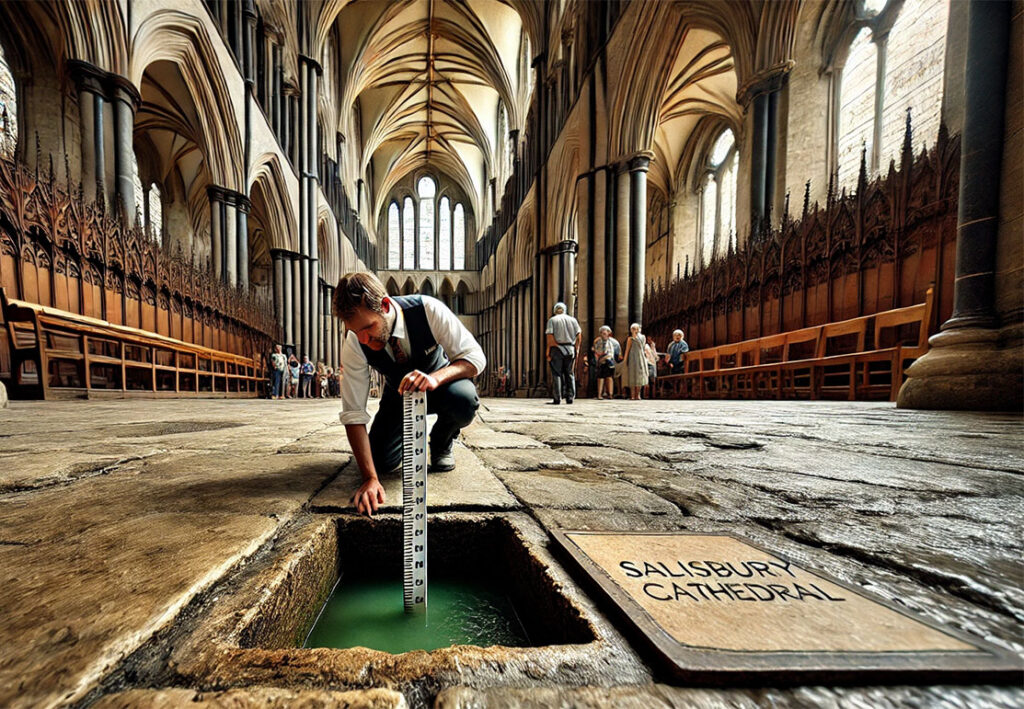
Before leaving the nave, we stopped briefly at the groundwater gauges near the crossing. With foundations only four feet deep, the cathedral depends on stable levels from the River Avon to remain upright. The wooden posts, still checked regularly by staff, record fluctuations over time and emphasize the fragile balance on which this vast structure rests.
With the clock, banners, font, and water levels covered, our time in the nave was complete. We took a few quick photos of the choir stalls, monuments, and cloisters, but with lunch and an afternoon visit to Wilton House ahead, we kept our stop brief before continuing on.
Chapter House & Magna Carta
From the nave we entered the Chapter House, a 13th-century octagonal chamber where the cathedral’s clergy once met. A single central column rises like a tree trunk, its stone ribs branching outward to support the vaulted ceiling. Along the walls, a carved frieze depicts scenes from Genesis and Exodus, functioning as a medieval “picture book” for teaching scripture to those unable to read.
At the far end, carefully displayed in a climate-controlled case, was the chamber’s greatest treasure: Salisbury’s copy of the Magna Carta. Dating to 1215, it is one of only four originals still in existence. Written in Latin on vellum, the manuscript remains remarkably clear despite its age. The exhibition panels explained how this charter—forced on King John by his barons—set out principles of due process and placed limits on royal authority, ideas that shaped English law and later influenced democratic traditions worldwide.
In the Chapter House, a member of the cathedral staff explained that Elias de Dereham, a Salisbury canon present at Runnymede, was entrusted with bringing and safeguarding this copy of the charter. His effigy in the nave links him both to the construction of Salisbury Cathedral and to the preservation of one of history’s most influential documents.
③ Lunch at Bell Tower Tea Rooms
⚲ Bell Tower Tea Rooms, Salisbury Cathedral Close, Salisbury SP1 2EJ
⧗ 45 minutes
After finishing at the Chapter House, we remained within the Cathedral Close for lunch at the Bell Tower Tea Rooms. The café is located just inside the precinct, only steps from the west front of the cathedral, making it the most convenient option before leaving Salisbury for our afternoon visit to Wilton.
We ordered ham and cheese sandwiches, served alongside tea and a slice of cake. Seating was casual, with wooden tables inside and a small number of garden spots overlooking the cathedral lawns. The service was quick, which mattered since we were watching the time to ensure we caught the bus to Wilton House before the final admissions.
④ Wilton House & Gardens
⚲ Wilton House, Wilton, Salisbury SP2 0BJ
⧗ 2 hours
From Salisbury’s city center we walked to Ox Row (Stop U) and boarded the X7 bus toward Wilton. The route carried us around the Wilton Roundabout, paused briefly at the nearby car park, and then continued to a stop directly opposite the main gates of Wilton House. The estate has been the seat of the Earls of Pembroke since the 16th century and remains one of Wiltshire’s most celebrated country houses.
The visit began in the library, a long, book-lined chamber used in The Crown as the setting for Queen Elizabeth II’s private office. From there we entered the working office of the Earl of Pembroke, where one of the house’s rarest treasures was on view: Leda and the Swan, painted by a pupil of Leonardo da Vinci. The painting, usually kept in storage, is displayed only a few times each year to meet tax exemption requirements, and we were fortunate to see it because the bank holiday had opened several normally restricted rooms to visitors.
The route continued into the Single Cube Room, a mathematically precise 30-foot cube designed in the 17th century. Its symmetry and scale created a harmonious backdrop for family portraits and period furnishings.
Next came the magnificent Double Cube Room, double the size at 60 by 30 by 30 feet. Its walls are covered with portraits by Sir Anthony van Dyck, the largest single collection in private hands. A gilded ceiling, stucco cornices, and a monumental marble fireplace emphasized the grandeur. The carpet, specially commissioned for the 2009 film The Young Victoria, now fills the chamber perfectly and has been retained as a permanent feature. Alongside its artistic heritage, the room also played a role in modern history: during World War II it served as a meeting place for Allied leaders planning the D-Day landings.
From there we entered a staircase hall, then turned left into a long corridor lined with display cases and benches. This passage led into the Large Smoking Room, once reserved for gentlemen after dinner, and then into the adjoining Little Smoking Room, a smaller and more intimate retreat decorated with carved moldings.
The tour concluded in a richly furnished green dining room, its walls hung with equestrian portraits and anchored by a marble fireplace. From this room we stepped directly outside into the gardens and parkland along the River Nadder. Our walk included the Palladian Bridge, the Japanese Water Garden, and rose beds bordered with summer flowers. Beyond the formal landscaping, open pasture with grazing sheep framed the house against the Wiltshire countryside. Before departing, we paused at the garden café for refreshments.
Return to Salisbury & Train to Southampton
In the late afternoon we boarded the return bus outside Wilton House and rode back toward Salisbury. The service looped through the Wilton Roundabout, followed South Western Road, and turned onto Mill Road before stopping at Fisherton Street Rail Bridge. From there it was less than a five-minute walk straight into Salisbury Station, a convenient connection point without needing to re-enter the city center.
Around dinner time we were on the direct train south. The ride carried us smoothly through Hampshire’s countryside, and before long we stepped off at Southampton Central, closing out a day that had combined cathedral towers, Magna Carta, and the grandeur of an English country house.
☑ Who Is This Tour Best For?
- Architecture enthusiasts – Britain’s tallest spire and Palladian state rooms.
- History lovers – Magna Carta, D-Day planning, and medieval heritage.
- Art and culture fans – van Dyck portraits, rare da Vinci school painting, film and TV settings.
- Independent travelers – Easy train and bus connections make this accessible.
- Garden walkers – From cloister garths to Japanese gardens and riverside meadows.
⊞ Tour Summary
- Tour Name: Salisbury Day Trip from Southampton
- Offered By: Independent Day Trip
- Total Duration: 9 hours
- Main Stops: Salisbury Cathedral Tower Tour, Cathedral Nave, Chapter House & Magna Carta, Bell Tower Tea Rooms, Wilton House & Gardens

▣ Activity Summary:
- Walking Distance: ~8,000–9,000 steps (including tower climb)
- Terrain: City pavements, cathedral steps, house interiors, gravel garden paths
- Accessibility: Tower Tour not accessible; main cathedral and Wilton gardens partly accessible
- Meals Included: Breakfast at Café Molinari (paid separately), ham & cheese sandwich lunch at Bell Tower Tea Rooms
Excursion Disclaimer: Descriptions of shore excursions on OceansAfoot reflect individual travel experiences and are not official representations of the cruise lines or tour providers mentioned. All information is based on personal participation, publicly available facts, or traveler observation.
© OceansAfoot