✘ Portsmouth, England • August 24, 2025
⌖ Tudor Ships, Nelson’s Flagship & Portsmouth Harborside
Tour Route: Southampton Central → National Museum of the Royal Navy → Mary Rose Museum (Behind-the-Scenes Tour) → Boathouse 7 → HMS Victory → Portsmouth Harbour Tour → Old Portsmouth & Spice Island Inn → Return to Southampton
A bank holiday Sunday carried us from Southampton to Portsmouth, Britain’s great naval port on the Solent. The itinerary blended maritime heritage with living history: a behind-the-scenes tour of the Mary Rose, time aboard Nelson’s Victory, a harbor cruise among modern warships, and a walk into Old Portsmouth, all on cue.
South to the Sea
The day began with breakfast at the Premier Inn Southampton City Centre, only a short walk from Southampton Central Station. From there, we boarded the 08:35 Great Western Railway service toward Portsmouth & Southsea. The ride lasted just over an hour, carrying us through Hampshire’s countryside before we arrived at 09:37.
A quick change of platforms put us onto the 09:56 South Western Railway connection, which covered the final stretch to Portsmouth Harbour Station in under five minutes. The station lies directly on the waterfront, adjacent to the Hard Interchange bus hub and only steps away from the entrance to the historic dockyard.
Before entering, we visited the Portsmouth Visitor Information Centre, located beside the station, where staff provided a free map and walking directions for later in Old Portsmouth. With directions in hand, we crossed the street to Victory Gate, ready to begin exploring Britain’s naval heritage.
① National Museum of the Royal Navy – Nelson Galleries
⚲ HM Naval Base, Victory Gate, Portsmouth PO1 3LJ
⧗ 20 minutes
Before our scheduled Mary Rose tour, we had time to explore part of the National Museum of the Royal Navy, located just inside Victory Gate at the Historic Dockyard. We focused on the Nelson Galleries, which trace the life and legacy of Vice Admiral Horatio Nelson, Britain’s most celebrated naval commander.
The exhibits highlighted Nelson’s naval career, from his early service in the Caribbean and Mediterranean to his decisive role in the Battle of Trafalgar (1805). Personal artifacts on display included uniforms, correspondence, and navigational instruments, offering insight into the man behind the legend. One section detailed Nelson’s leadership style, his injuries sustained in earlier battles, and the circumstances that led to his death aboard HMS Victory.
Although our visit was brief—around 20 minutes—it provided an essential context for the ships and sites we would see later in the day. By the time we left, we had a clearer understanding of Nelson’s central role in Portsmouth’s naval heritage, and how the city remains linked to the memory of Trafalgar.
② Mary Rose Museum – Behind-the-Scenes Tour
⚲ Mary Rose Museum, Main Road, Portsmouth PO1 3PY, United Kingdom
⧗ 1 hour (plus 15 minutes for the film)
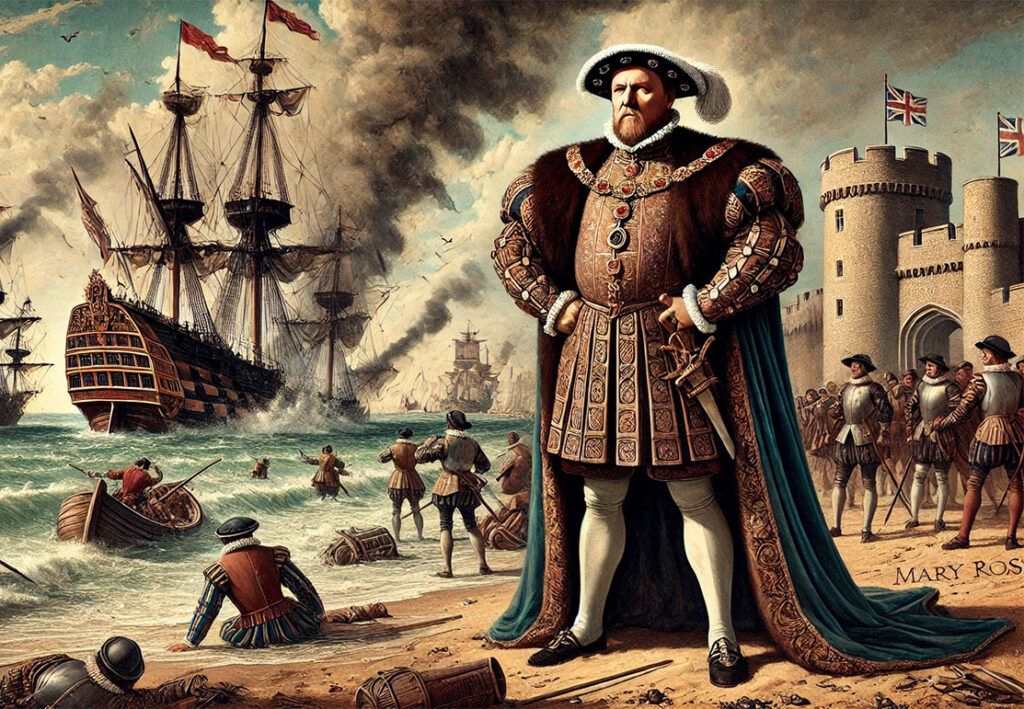
We joined the museum’s Behind-the-Scenes Tour of the Mary Rose, Henry VIII’s flagship that capsized during the Battle of the Solent in 1545. The guide began with the ship’s fate, her rediscovery in the 20th century, and the celebrated 1982 lift that returned her to Portsmouth after more than 400 years beneath the silt.
Discovery & raising
In 1836, fishermen snagged nets on submerged timbers, and divers recovered a bronze cannon stamped with Henry VIII’s arms. A century later, Alexander McKee’s Project Solent Ships and archaeologist Margaret Rule mapped the wreck using Admiralty charts and sonar. After winter storms in 1970 cleared sediment, Tudor artefacts appeared, and in 1971 divers uncovered intact timbers. The surviving port-side hull was later enclosed in a steel cradle, raised in October 1982, and placed into permanent conservation.
Deck-by-deck through the galleries
The tour carried us level by level through the airtight museum, where the preserved hull is displayed on one side and the artefacts of shipboard life on the other.
- ➤ Lower deck & provisions. We saw the oven site and stacks of birch logs, chosen for their hot, smokeless burn. The guide described a sailor’s 5,000-calorie diet of salted meat, peas, fish, biscuit, and “small beer,” compared with the better bread and wine issued to officers.
- ➤ Weapons & ordnance. Bronze and wrought-iron guns, carved linstocks, and stone shot gauges showed how Tudor artillery was handled. The removable powder chambers were so heavy that four men were needed to move them.
- ➤ Trades & tools. A leather carpenter’s tool bag, grindstones, and a barber-surgeon’s kit revealed the work of shipboard craftsmen and medics. Standing under the beams, the guide reminded us that Tudor sailors averaged five foot seven in height—making the six-foot clearance feel tight even for them.
- ➤ Rigging & small craft. Longboat oars fashioned from single timbers, blocks, sheaves, and parrel balls highlighted seamanship and the constant maintenance required.
- ➤ Archery and crossbows. The longbows and arrows are a signature of the Mary Rose’s finds, with some showing signs of heavy use. The guide added the anecdote of actor Robert Hardy, a noted longbow historian, who helped dry a cache of bows during early conservation. At this point, we also tried an interactive crossbow pull test, using replicas to experience the strength required to load and hold them. It gave a clear sense of the physical demands Tudor archers faced.
- ➤ Personal belongings. Wooden dishes, bowls, spoons, pewter tankards, and tally sticks brought to life the everyday world of the crew. The tally sticks in particular prompted the story of the 1834 fire at Parliament, when a pile of obsolete sticks was burned for disposal and accidentally destroyed the medieval chambers.
Collections room & learning area
After a short stop in the study space, our guide unlocked a collections gallery reserved for the tour. Inside were additional displays not seen on the main visitor route: sword grips, kidney daggers, rigging blocks, and decorated wooden bowls. Stepping out, we entered a learning area where a large wall map of the 1545 battle illustrated how the Mary Rose capsized during a sharp maneuver with her gunports open, sinking in full view of Henry VIII.
Conservation explained
From the walkways, the guide pointed out the steel cradle still surrounding the hull—the same design used during the lift. She explained the three phases of conservation: years of seawater spray, nearly two decades of polymer impregnation (polyethylene glycol), and finally controlled drying. The museum’s “oyster shell” building keeps the environment stable without drilling into the Victorian dry dock below which is a listed monument.
Balcony & 4D film
Near the end, we stepped outside to a small balcony overlooking the dockyard, with clear views across the basins and of HMS Victory in her conservation rigging. Returning inside, we concluded with the “Dive the Mary Rose” 4D film, which brought together the Tudor sinking, the modern rediscovery, and the 1982 lift.
③ Lunch at Boathouse 7
⚲ Boathouse 7, HM Naval Base, Portsmouth PO1 3LJ
⧗ 45 minutes
Crossing the Historic Dockyard from the Mary Rose, we stepped into Boathouse 7, one of the few surviving Victorian slip buildings. Erected in the mid-19th century to serve shipbuilding and repair, the cavernous hall still carries its industrial bones—arched timber beams, iron struts, and tall windows that spill light onto the harbor basins outside.
The space has been sensitively repurposed as a café and events venue, making it a natural pause point between major attractions. We settled at a wooden table beneath the soaring rafters and ordered a simple lunch before continuing on with the day.
What caught our attention most, however, was the long row of vintage coin-operated amusement machines lining the back wall. Restored to working order, each invited a 20p coin to spring its miniature drama to life. Some offered cautionary tales—The Miser’s Dream with its grasping old man or The Drunkard’s Dream amid barrels labeled “Beer is Best.” Others leaned on spectacle: the macabre Death of a Traitor and The American Execution, or the eerie tableaux of Haunted House and The Haunted Churchyard. Fortune-telling figures like The Mysterious Hand and Great Aunt Shipton added a mystical edge, while lighter novelties provided balance—All Sport and Super Steer-a-Ball for skill, a sand-table driving challenge, the chuckling puppet of Laughing Sailor, and even a Dance with the Wombles display.
Together, these quirky machines evoked the heyday of British seaside amusements, recalling a similar collection we had encountered in the medieval town of Rye on a previous trip. Set here within the Historic Dockyard, they offered an unexpected but nostalgic diversion before we stepped back into the naval heritage of Portsmouth.
④ HMS Victory
⚲ HMS Victory, HM Naval Base, Portsmouth PO1 3LJ
⧗ 30–45 minutes
From Boathouse 7 we continued to the most iconic ship in Portsmouth: HMS Victory, Lord Nelson’s flagship at the Battle of Trafalgar (1805). Launched in 1765 at Chatham, the 104-gun vessel carried more than 800 men at full complement. She has been preserved in dry dock here since 1922 and, remarkably, remains the world’s oldest commissioned warship, still serving ceremonially as the flagship of the First Sea Lord.
Walking through the ship
We began on the upper deck, where interpretive panels traced the ship’s career before descending into the gun decks. Rows of reproduction cannon lined each side, lashed with breeching ropes, while hammocks swung between them to illustrate how sailors slept in the same space as their guns. The low ceilings forced us to stoop through narrow passages, a reminder of the cramped and exhausting realities of life at sea.
At the stern we reached the admiral’s quarters, where Nelson lived and worked. Compared to the common sailors’ hammocks, these spaces felt almost luxurious—dining table, stern gallery windows, and furniture arranged to reflect the flagship’s command role during Trafalgar.
The dry dock vantage
Perhaps most striking was the opportunity to step below the ship, inside the dry dock itself. From this perspective the immense oak hull towered overhead, supported in cradles. Patches of original copper sheathing were still visible, protection once used against shipworm and marine growth. Standing directly beneath the keel gave a powerful sense of scale and of the engineering needed to maintain a 250-year-old vessel.
Interpretation and preservation
Audio and visual displays inside Victory recounted Nelson’s final moments on the quarterdeck, where he was struck by a musket ball and later died below decks. Around the ship, scaffolding and protective covers revealed the ongoing conservation program, designed to stabilize the timbers against centuries of weathering while keeping the ship accessible to visitors.
This stop tied together the Nelson story we had glimpsed earlier at the National Museum of the Royal Navy with the physical reality of his flagship. Moving through Victory’s decks, standing in her admiral’s cabin, and then walking directly beneath her keel transformed Trafalgar from history on a panel into an experience in three dimensions.
⑤ Portsmouth Harbour Tour
⚲ Jetty near HMS Warrior
⧗ 45 minutes
With the dockyard visits complete, we boarded the Ali Cat, one of the small passenger vessels used for the included harbor tours. These cruises are a standard feature of the Ultimate Explorer Ticket, departing hourly in the afternoon from the jetty near HMS Warrior.
The route through the harbor
The 45-minute circuit took us across Portsmouth Harbour, still an active base of the Royal Navy. From the water we passed modern warships, including Type 45 destroyers and support vessels, alongside the historic dockyard where Victory and the Mary Rose lie preserved. The guide pointed out Gosport across the water—home to submarine facilities and training establishments—and explained how the narrow entrance to the Solent has made this one of Britain’s most defensible naval bases since the Tudor era.
Historic layers of defense
Along the shoreline we saw Palmerston’s Forts, 19th-century sea forts built to guard against invasion by Napoleon III’s France, later repurposed as anti-aircraft positions during World War II. We also cruised past the King’s Stairs, where Henry VIII is said to have boarded royal launches to inspect his fleet—most poignantly in July 1545 when he watched the Mary Rose sink. The guide added that in later centuries prisoners of war, particularly French captives during the Napoleonic Wars, were used to deepen and expand the harbor to accommodate Britain’s growing naval fleet.
Modern navy alongside heritage
The harbor remains fully operational. On our sailing, two Ukrainian minesweepers were moored for training, while Royal Fleet Auxiliary tankers lay in ordinary. Our guide described ongoing dredging efforts to maintain berths for the Navy’s Queen Elizabeth-class aircraft carriers, the largest ships ever to serve in Britain’s fleet.
Concluding the circuit
As this was the final sailing of the day, the vessel did not return to the Warrior jetty. Instead, we disembarked at Gunwharf Quays, directly beside the Millennium Promenade. This convenient drop-off placed us within walking distance of Old Portsmouth, setting up the last leg of our day.
⑥ Old Portsmouth & Spice Island Inn
⚲ Spice Island Inn, 1 Bath Square, Portsmouth PO1 2JL, United Kingdom
⚑15 minutes (via Millennium Promenade from Gunwharf Quays Marina)
⧗ 1 hour
From Gunwharf Quays we joined the Millennium Promenade, its route marked by a cast-iron anchor chain that winds around the marina and curves past Camber Dock into Old Portsmouth—the city’s original settlement and, for centuries, its hub of maritime trade.
This district, long known as Spice Island, took its name from the 17th and 18th-century ships that landed here with cargoes of spices, tobacco, and wine from Britain’s expanding overseas routes. Georgian warehouses still line the narrow streets, many now converted into pubs and restaurants overlooking the Solent.
After comparing the menus of two waterfront pubs—the Still & West and the Spice Island Inn—we chose the latter, which offered dishes more to our taste. Prominently positioned at the harbor mouth, the inn combined exposed beams and nautical memorabilia inside with a terrace overlooking the channel. Here, over Chicken Kiev and a pint of Guinness, we watched ferries and yachts navigating the narrow entrance.
When dinner was finished, we followed the promenade back to Portsmouth Harbour Station, arriving around 18:45. From there we caught the 19:20 South Western Railway service, changing at Fratton, and reached Southampton Central just after 20:10—ending a full day of dockyard exploration, naval history, and harbor views.
Return to Southampton
⚲ Portsmouth Harbour → Fratton → Southampton Central
⧗ 1 hour
The later return train extended the journey slightly, but it provided a final transition from Portsmouth’s working waterfront back into the bustle of Southampton.
☑ Who Is This Tour Best For?
- Naval history enthusiasts – in-depth exploration of Britain’s maritime legacy.
- Heritage travelers – from Tudor shipwrecks to Nelson’s flagship.
- Photographers – dramatic dockyard settings, harbor views, and coastal pubs.
- Families – interactive museum exhibits and accessible walking routes.
- Independent cruisers – self-paced excursion easily reached by train.
- Casual explorers – chance to enjoy a pub meal with harbor views.
⊞ Tour Summary
- Tour Name: Ultimate Portsmouth Harbour Day Trip
Offered By: Independent Day Trip
Total Duration: ~11 hours
Main Stops: National Museum of the Royal Navy, Mary Rose Museum, Boathouse 7, HMS Victory, Portsmouth Harbour Tour, Old Portsmouth & Spice Island Inn

▣ Activity Summary:
- Walking Distance: ~6,000–8,000 steps
- Terrain: Pavement, museum floors, dockyard paths; generally flat
- Accessibility: Moderate; stair climbing inside historic ships, low clearances
- Meals Included: Independent meal at Spice Island Inn (Chicken Kiev and Guinness)
- Excursion Disclaimer: Descriptions of shore excursions on OceansAfoot reflect individual travel
Excursion Disclaimer: Descriptions of shore excursions on OceansAfoot reflect individual travel experiences and are not official representations of the cruise lines or tour providers mentioned. All information is based on personal participation, publicly available facts, or traveler observation.
© OceansAfoot