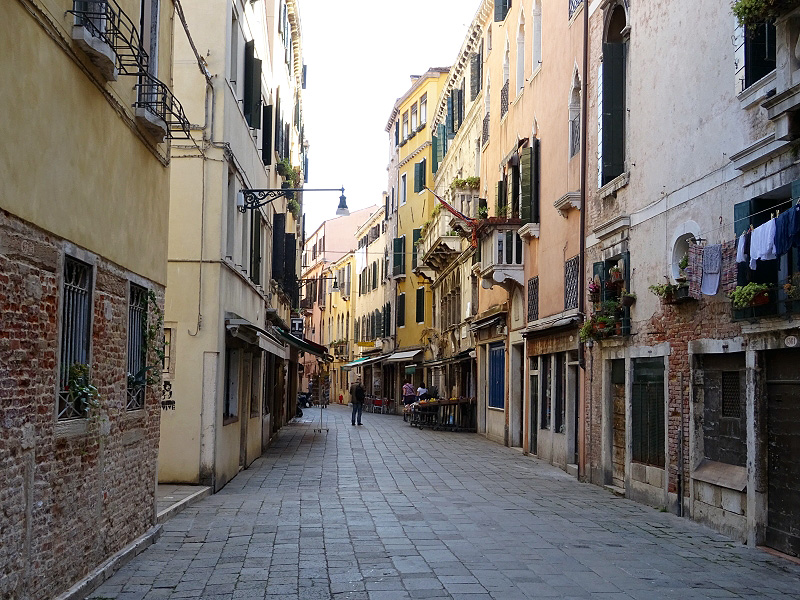
Street in Venice
✘ Venice, Italy • May 21, 2016 | Port: Venice, Italy • Region: Mediterranean Cruises
🏞️ Backstreets, Bridges, and Boats in the Floating City
Tour Route: Ship motor launch → Piazzale Roma → Hospital San Giovanni e Paolo (Castello) → St. Mark’s Square → Castello gondola ride → Rossopomodoro Pizzeria (San Marco) → Motor launch landing stage on Grand Canal
Venice began the moment we stepped off the ship and realized the city would not meet us with roads. The first transfer was by motor launch, and that short ride mattered. It reset the scale. We weren’t “heading into town” so much as being carried into a place where water is the primary surface and walking is the only way to move once you’re inside it.
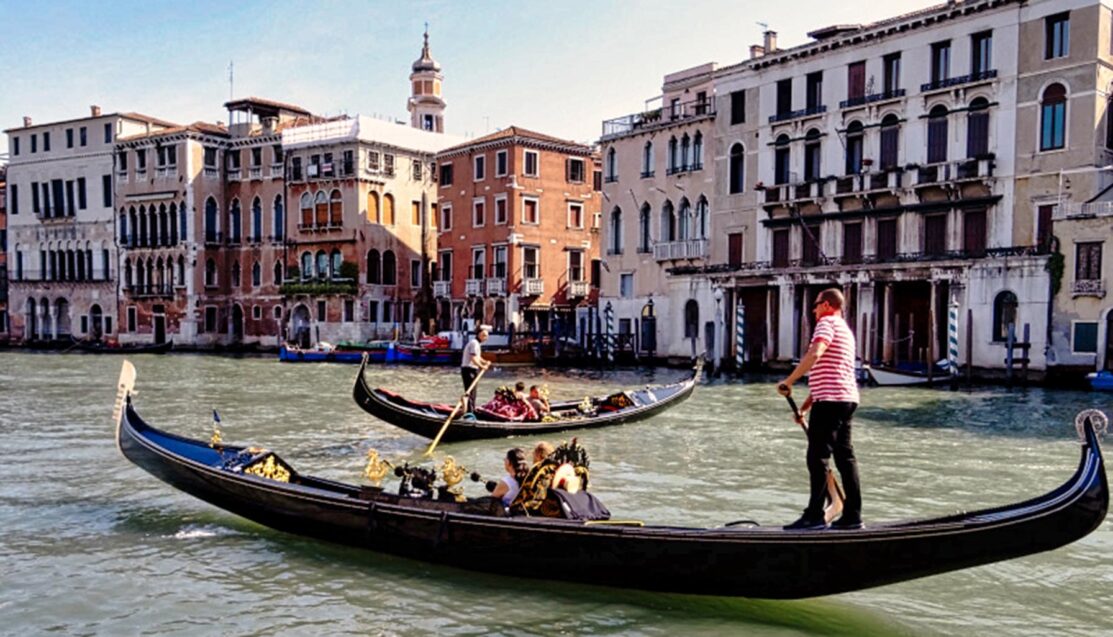
Traditional Venetian gondolas move along the Grand Canal, the city’s primary historic waterway lined with centuries-old palaces.
The boat let us off at Piazzale Roma — the edge of vehicular Venice — and within minutes the environment tightened. Rolling luggage disappeared. Curbs and lanes vanished. The ground became stone, the routes became corridors, and every forward movement started to include small interruptions: a bridge rise, a bridge descent, a turn that immediately removed the last landmark you were using to stay oriented.
The tour’s logic was straightforward. We would walk with the guide through the residential districts first — Cannaregio and then Castello — aiming toward the larger civic spaces near the center. A planned café pause near the Basilica of Santi Giovanni e Paolo created the midpoint and regrouping anchor. After that, the structure loosened: guests could follow the guide onward or peel off and navigate independently, using the city’s San Marco signs as a built-in routing system.
① Cannaregio to Castello on Foot
⚲ Piazzale Roma → Cannaregio → Castello → Campo Santi Giovanni e Paolo, Venice, Italy
⧗ Approximately 2 hours
We left Piazzale Roma and within a few steps the pavement narrowed to stone. The first bridge rose directly in front of us — a short climb of worn steps, a brief pause at the crest, then a descent into another corridor of buildings. That pattern repeated itself again and again: up, over, down, turn. Venice does not allow long, uninterrupted lines of travel.
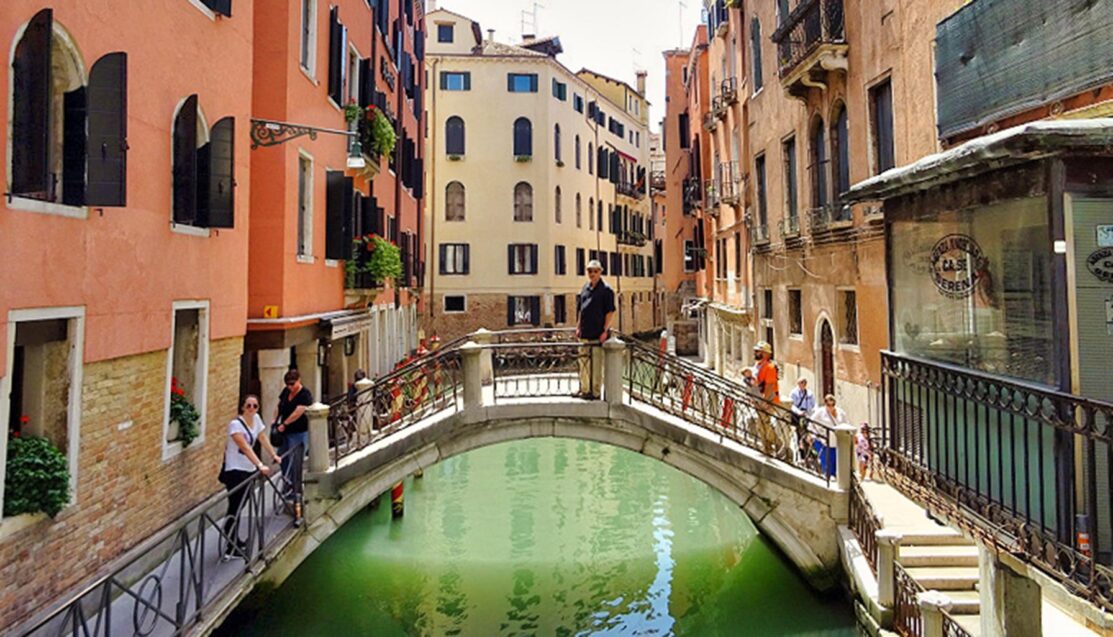
Small pedestrian bridges like this one connect Venice’s narrow residential lanes across the city’s dense network of canals.
Cannaregio felt residential almost immediately. Ground-floor doors opened straight onto canal edges. Some were reinforced with temporary flood barriers, metal tracks visible along the jambs. Windows sat just above water level, tide stains marking how high the lagoon can rise. Deliveries were happening by boat. No trucks. No loading docks. Just narrow hulls pressed against stone.
We moved in a tight formation, adjusting constantly for opposing foot traffic. When a delivery cart appeared, the group compressed into doorways to let it pass. The guide did not need a microphone; the streets were narrow enough that normal speaking volume carried.
At one small courtyard, we paused where Marco Polo’s residence once stood. There is no preserved house — only a marked square embedded within the urban grid. The significance is geographic rather than architectural. This was a merchant city, and merchants lived within the same dense fabric we were now navigating. The story attaches to the space, not to a monument.
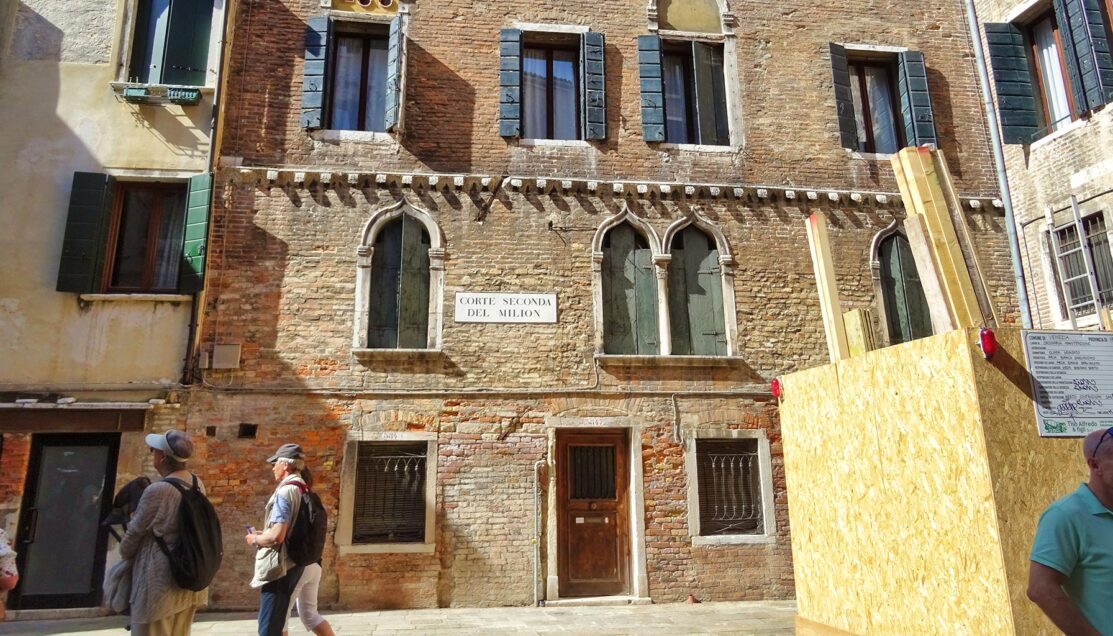
A plaque in this courtyard marks the traditional location associated with the residence of Venetian merchant Marco Polo.
Crossing into Castello, the atmosphere shifted subtly. Fewer souvenir displays. Fewer open storefronts. Bridges narrowed further, some without decorative railings — just stone parapets polished smooth at hand height. The canal water here felt closer, more contained, with light reflecting upward onto stucco walls.
The approach to Campo Santi Giovanni e Paolo opened without warning. One final turn through a tight passage, and the corridor dissolved into one of Venice’s largest open squares. The red-brick façade of the Basilica dominated the far side. The equestrian statue of Bartolomeo Colleoni stood offset in front, anchoring the open space in bronze.
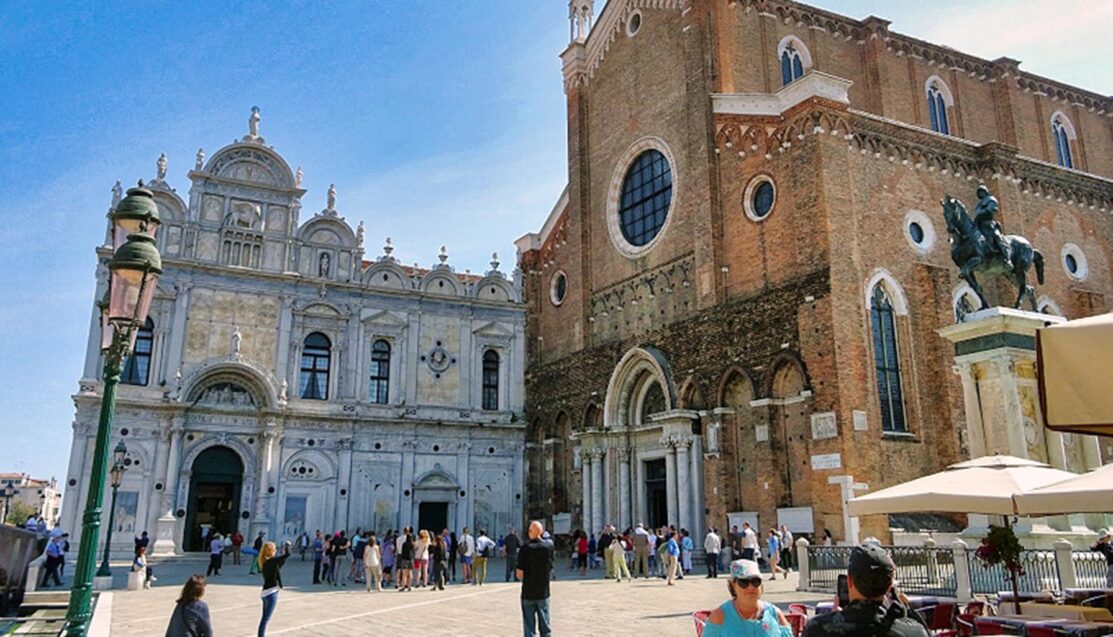
Campo Santi Giovanni e Paolo centers on the Dominican basilica and the equestrian statue of condottiero Bartolomeo Colleoni.
Chairs at the café were arranged facing outward toward the campo. Coffee was served quickly, accompanied by a small plate of Venetian biscuits. From our seats, we could watch the square function — pedestrians crossing diagonally, visitors studying the basilica entrance, children cutting across the open paving stones. After the compression of the preceding streets, the space felt expansive, almost strategic.
This was the midpoint. The structured walk ended here. From this square, you could retrace your steps with the guide — or continue forward into the deeper weave of Venice.
② Following the San Marco Signs
⚲ Castello → Piazza San Marco, Venice, Italy
⧗ Independent continuation
We left the campo without the guide and committed to the yellow “San Marco” signs fixed high on building corners. They appear at just the right moment — usually at a fork where instinct would send you the wrong way.
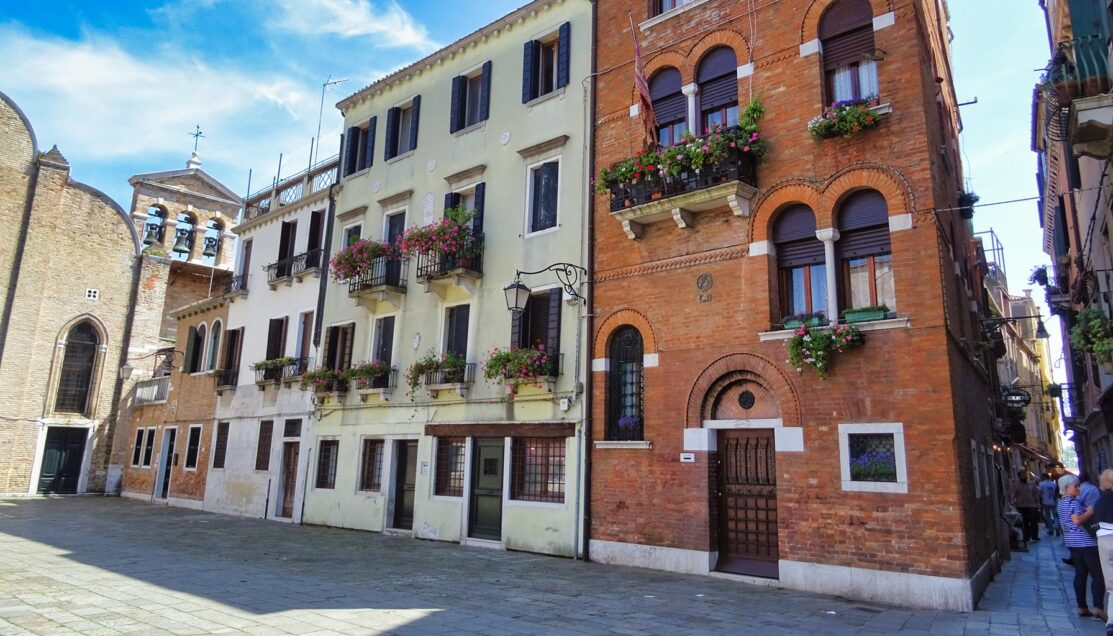
Colorful apartment buildings with flowered balconies reflect the residential character of Venice’s Castello district.
The first stretch narrowed quickly. Two people could pass comfortably; three required adjustment. A bridge rose ahead — steeper than the previous ones — with no ramp, just stone steps worn slightly concave at the center. At the crest, the canal opened briefly below us, then disappeared again as we descended into another corridor.
The pattern repeated: bridge, alley, small canal crossing, turn.
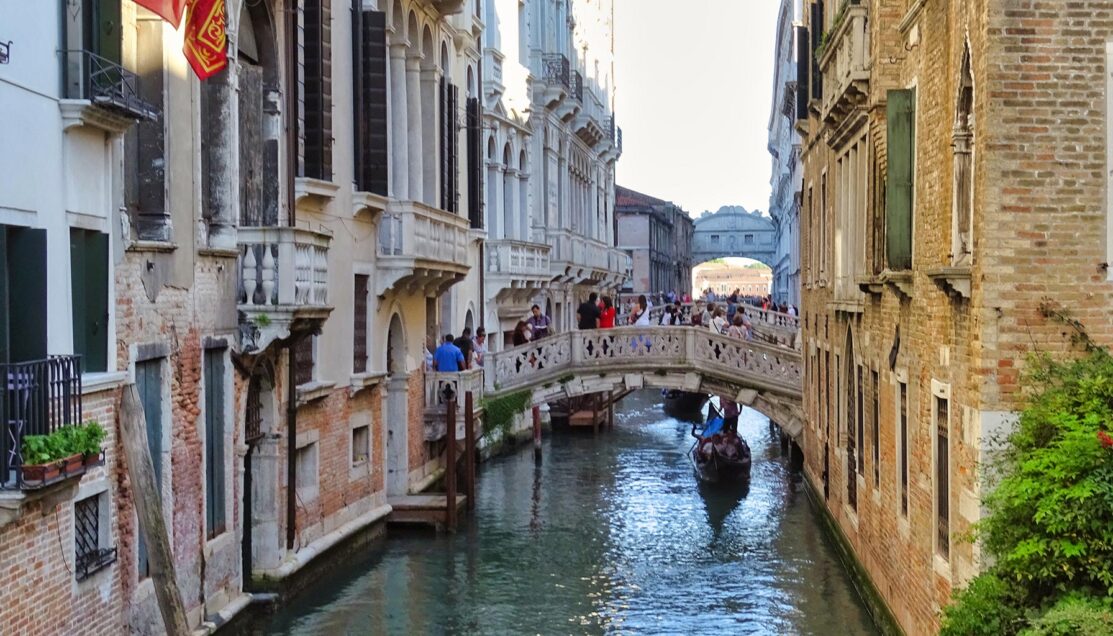
A small stone pedestrian bridge spans a narrow canal near the Bridge of Sighs, linking tightly packed Venetian lanes.
Shops began appearing more frequently as we advanced. Window displays shifted from household goods and neighborhood cafés to masks, glass, leather, and printed menus posted in multiple languages. Sound increased gradually — not abruptly, but in layers. More footsteps. More voices. The echo changed as the spaces widened.
Orientation in Venice is less about direction and more about flow. If foot traffic thickens and storefront density increases, you are moving toward a major anchor point.
One final passage tightened to shoulder width before releasing us into open light. The space expanded immediately — no transitional plaza, no gentle widening — just the full scale of Piazza San Marco.
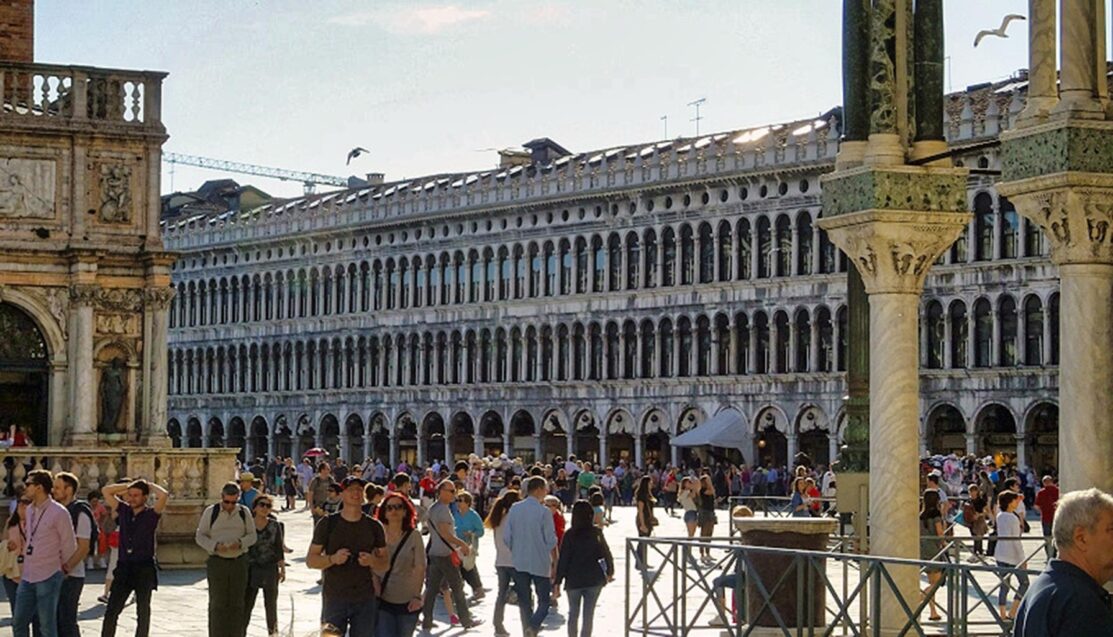
The arcaded façade of the Procuratie lines the northern edge of Piazza San Marco, historically housing offices of the Venetian Republic.
The arcades of the Procuratie framed the square in long horizontal lines. The Campanile rose vertically from an otherwise flat expanse of paving stone. After the compression of Cannaregio and Castello, the piazza felt less like a square and more like a clearing carved from density.
Movement changed here. Instead of single-file walking, the flow became multidirectional. Tour groups clustered. Independent travelers paused mid-square to orient themselves. Café seating extended beneath the arcades.
We had moved from neighborhood Venice into civic Venice — not by bus or transfer, but by incremental shifts in width, sound, and storefront density, one bridge at a time.
③ Il Canovaccio Mask Shop
⚲ Near Campo Santi Giovanni e Paolo, Venice, Italy
⧗ Approximately 20 minutes
Earlier, while still in Castello near the hospital square, we had stepped into Il Canovaccio — a small storefront that could easily be missed if you weren’t watching the doorways.
The interior was narrow but vertical. Masks covered nearly every wall surface from waist height to ceiling. Traditional Carnival forms dominated the upper rows: long-beaked Medico della Peste designs, gilded half-masks, feathered and hand-painted theatrical pieces. Below them sat smaller decorative items arranged tightly along shelving.
The shop attendant explained that Carnival runs for roughly two weeks each February, when masks like these return to the streets and piazzas. She showed us a short video on her phone — dancers in full costume filling narrow Venetian lanes, the same kind of lanes we had just walked through. The setting made the explanation tangible. These were not costume props detached from context; they were scaled to the architecture of the city itself.
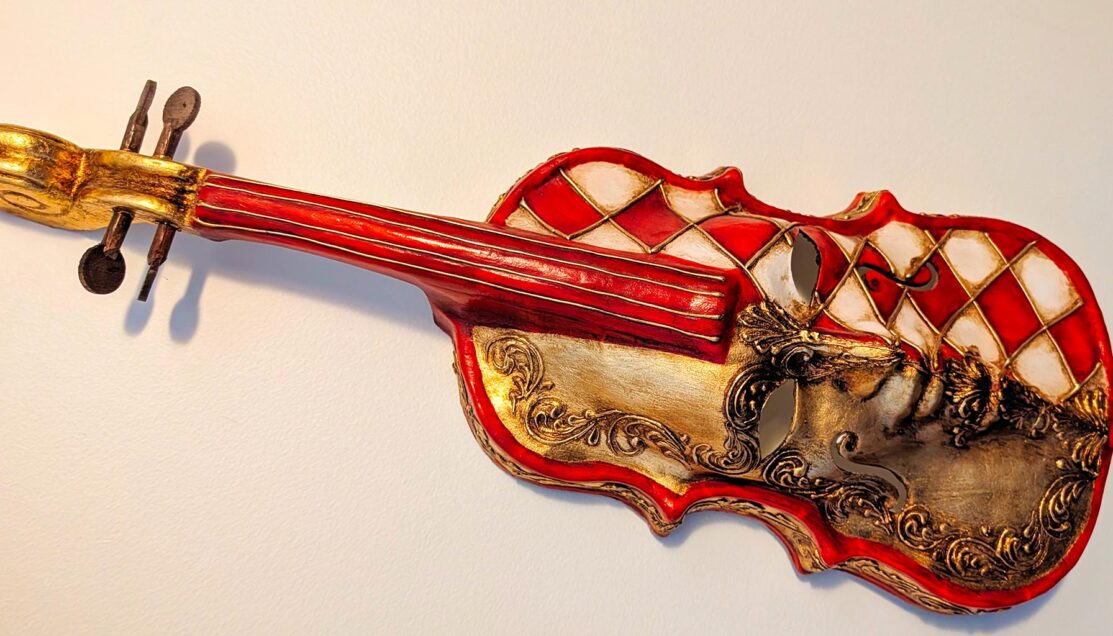
This decorative Venetian souvenir combines a carnival mask motif with a stylized violin, reflecting the city’s theatrical Carnival tradition.
We selected a decorative masked violin — smaller than the elaborate Carnival pieces, but detailed enough to reflect the tradition — and waited briefly while it was wrapped in protective paper.
④ Gondola Ride in Castello
⚲ Gondola stand, Castello district, Venice, Italy
⧗ 30 minutes
With time before lunch, we moved back toward the quieter canals of Castello and located a gondola stand along a narrow interior waterway.
The gondola sat low against the stone edge, rocking slightly with passing wake. Boarding required stepping down first onto the side platform, then into the hull while the gondolier counterbalanced the shift in weight. Once seated, the city immediately changed perspective. Pavement disappeared. Eye level dropped to just above the waterline.
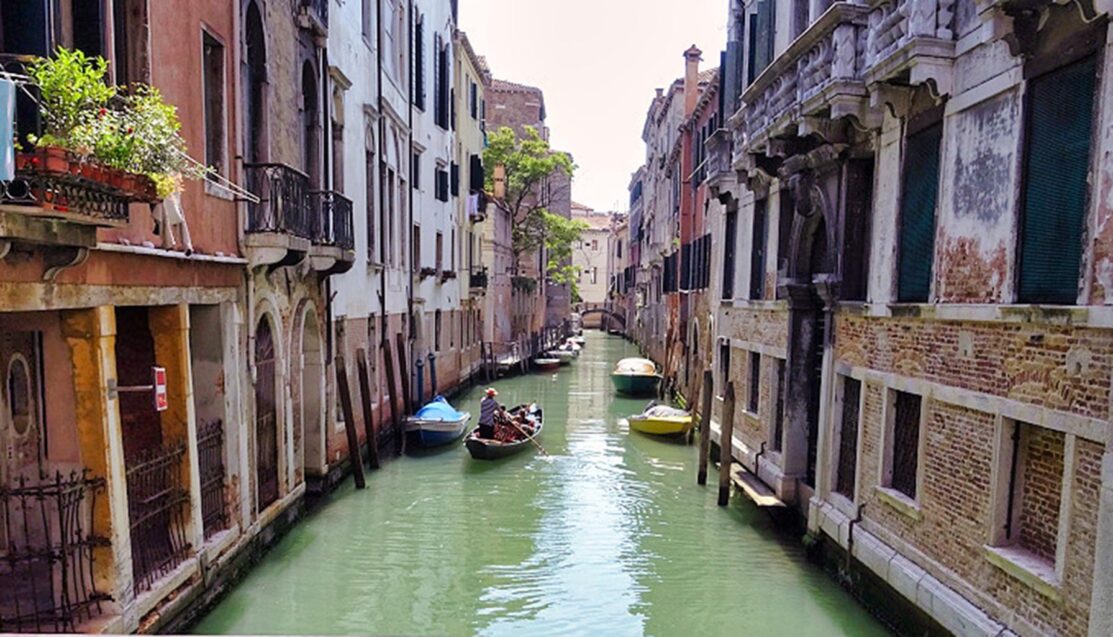
Quiet residential canals in Castello function as local waterways where small boats replace streets for access and transport.
The canal was barely wider than the boat itself. Stone foundations rose directly from the water, darkened at the base by tide exposure. Windows opened at eye height. In some cases, doorways sat only inches above the canal surface. The relationship between building and water was continuous — no visible setback, no buffer.
As we moved forward, the gondolier’s single oar worked in slow, deliberate strokes against the forcola. The sound was minimal: water against hull, the soft scrape of wood in its notch, occasional footsteps crossing overhead when we passed beneath a bridge.
Each bridge created a momentary compression of light. The bow slipped into shadow, voices echoed briefly against stone, then we emerged again into filtered sun between tightly spaced buildings.
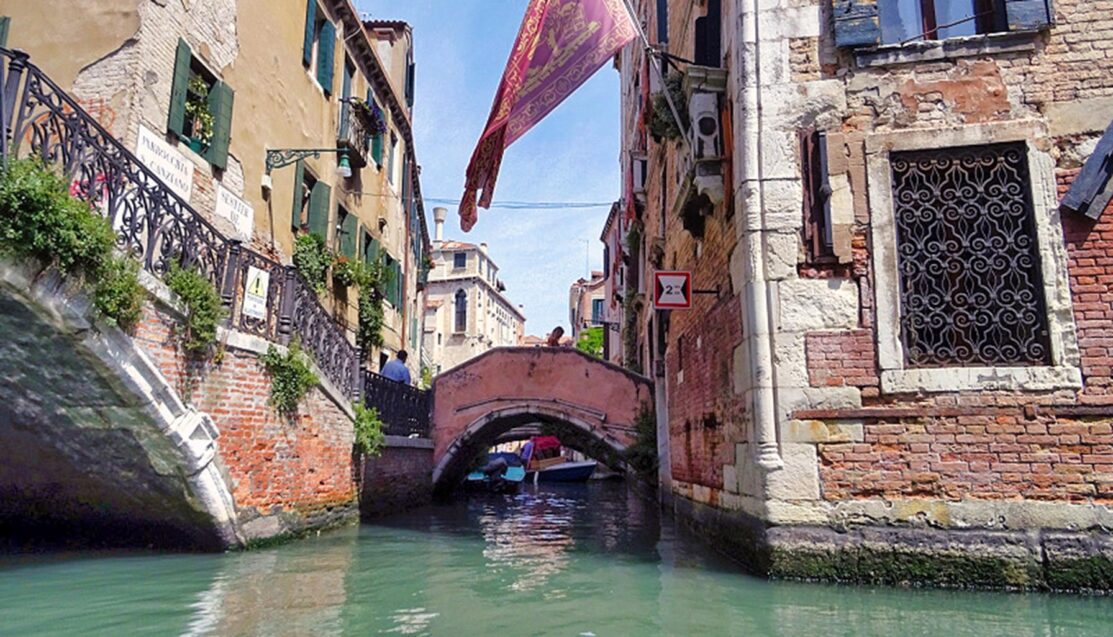
A small arched bridge crosses a narrow residential canal in Castello, linking the tightly spaced pedestrian lanes.
There was no through-traffic here. No vaporetti. No tour boats. The route functioned as a residential corridor rather than a showcase canal. Laundry hung above interior courtyards. Small balconies projected outward just enough to observe the canal below.
The ride was not about speed or distance. It was about scale. Venice at ground level feels compressed; from the water, it feels engineered — foundations exposed, service doors visible, tide marks measurable.
After roughly half an hour, the gondola returned to the same stone edge where we had boarded. The gondolier steadied the hull with his foot against the wall. We stepped back up onto pavement, readjusted to solid footing, and re-entered the pedestrian current.
⑤ Finding & Lunch at Rossopomodoro
⚲ Calle Larga di S. Marco 404, Venice, Italy
⧗ Approximately 1 hour
During the guided portion of the walk, we asked where to find the best pizza in Venice.
She didn’t hesitate. “Rossopomodoro,” she said — translating it loosely as the “Red Tomato.”
With that, lunch became the next objective.
Starting from the edge of the piazza, we moved into surrounding lanes, committing to corridors that did not initially look promising. Twice we followed what seemed like the correct direction only to reach a dead-end canal. Each correction required retracing steps over the same bridge, recalibrating, and choosing again.
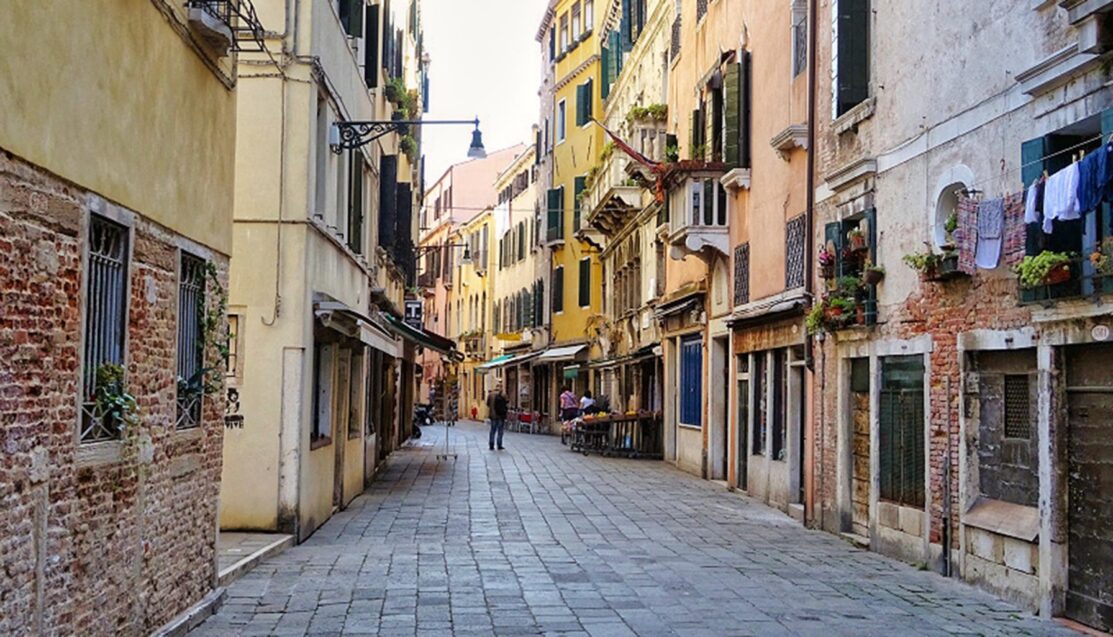
This wider pedestrian street near Piazza San Marco provides one of the clearer walking corridors through Venice’s dense alley network.
Street signs are mounted high in Venice. Once we began looking upward instead of forward, the route clarified.
The storefront appeared suddenly — outdoor tables arranged tightly along Calle Larga di S. Marco, red signage above the entrance. We secured a table and learned lunch service had not yet begun.
When service opened, the transition was immediate. Staff reset tables quickly and the compact patio filled within minutes. Seating was arranged close to the pedestrian flow — no courtyard wall, no interior buffer. Foot traffic passed within a few feet of the table edge.
Menus were pizza-focused. We ordered the Diavola with spicy salami, along with a half bottle of red wine and still water.
⌖ The Meal
The pizza arrived on a white ceramic plate, crust blistered from the oven with slight char at the edges. The salami was distributed evenly across the surface, oil pooling lightly between slices. The crust required folding at the tip to manage cleanly, consistent with a thin Neapolitan-style base.
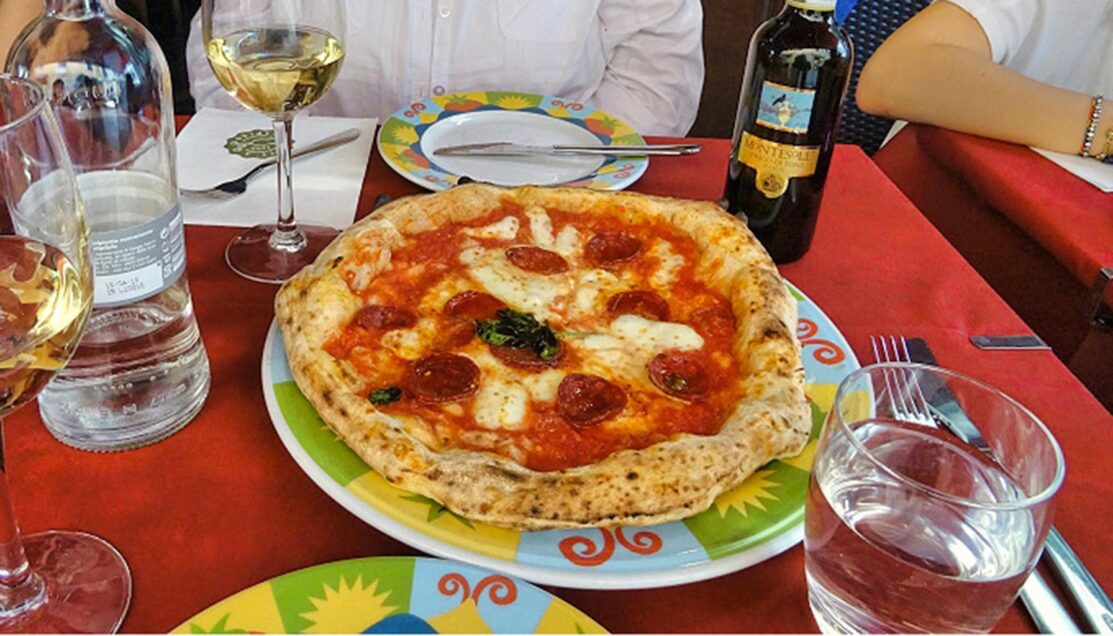
Pizza Diavola topped with spicy Italian salami is served at Rossopomodoro, a Neapolitan-style pizzeria near Piazza San Marco.
Wine was served at the table in a small glass carafe. Water arrived bottled and chilled. Service was efficient but not lingering. Plates were cleared promptly once finished, and new guests were already waiting near the entrance.
The total bill came to €22.10.
Once payment was settled, chairs shifted, tables were wiped down, and the turnover cycle began again — the street functioning as both dining room and corridor.
⑦ Independent Exploration Around San Marco
⚲ Piazza San Marco and surrounding districts, Venice, Italy
⧗ Approximately 1.5 hours
After lunch, there was no fixed objective — only remaining time and a compact city grid that rewards movement.
We began by attempting to move deliberately away from Piazza San Marco. The first corridor narrowed quickly, then crossed a short bridge, then split without warning. We chose left. Within minutes, the flow of pedestrians increased again. A familiar arcade appeared ahead.
Back in the square.
We tried again — this time choosing a lane that appeared less trafficked. It remained quiet for several turns, with shuttered doors and minimal storefront signage. Then a widening in light signaled proximity to an open space. The paving stones expanded beneath our feet.
Again, the piazza.
Venice creates the impression of randomness, but major anchors exert gravitational pull. San Marco functions as a central node. Many surrounding corridors ultimately resolve toward it.
Between those loops, we paused in a smaller campo with café seating positioned beneath shade. The square felt proportionally different — intimate rather than monumental. A brief water stop created a reset point before we selected yet another narrow exit passage.
This final corridor bent twice in quick succession, crossed a low bridge, and opened unexpectedly onto the Grand Canal. Directly ahead sat the floating landing stage for our return motor launch.
There was no dramatic reveal — just recognition. After repeated returns to San Marco, this exit aligned exactly where it needed to be.
The city had guided us back to water.
✅ Who Is This Tour Best For?
- First-time visitors to Venice – Structured walking through residential districts before reaching San Marco creates orientation rather than disorientation.
- Travelers who prefer movement over monuments – The experience is built around walking surfaces, bridges, canal crossings, and spatial shifts rather than interior museum visits.
- Urban-form observers – Clear exposure to how Venice functions at ground level and at water level, including foundations, flood adaptations, and pedestrian circulation.
- Independent explorers – Built-in flexibility after the guided segment allows confident navigation using the city’s posted San Marco routing system.
- Photographers focused on texture and scale – Repetitive bridge crossings, narrow corridors, canal reflections, and the abrupt expansion into Piazza San Marco provide varied compositional settings.
- Cruisers comfortable with sustained walking – Multiple stepped bridges, uneven stone surfaces, and continuous pedestrian flow define the experience.
📰 Tour Summary
- Tour Name: Secret Venice Walking Tour
- Offered By: Royal Caribbean
- Total Duration: Approximately 4 hours
- Main Stops: Cannaregio walking route, Campo Santi Giovanni e Paolo, Il, Piazza San Marco, Castello gondola ride
- Drive-By Highlights: Grand Canal façades during motor launch transfer
- Activity Level: Moderate to Active – sustained walking over cobblestone and stepped bridges
▣ Activity Summary
- Walking Distance: Substantial (multiple neighborhood crossings; step-heavy)
- Terrain: Cobblestone streets, frequent stepped bridges without ramps, narrow corridors, occasional open campos
- Accessibility: Limited – not wheelchair accessible due to bridge steps and uneven surfaces
- Meal Included: No (independent lunch stop)
- Boat Transfers: Yes – motor launch at beginning and end; optional gondola ride
Explore More Mediterranean Cruise Ports
© OceansAfoot