✘ Honolulu, Oʻahu, Hawaii • October 19, 2024
⌖ Palaces, Missionaries, and Waikiki Reflections
Tour Route: Honolulu Pier (Walk) → ʻIolani Palace → King Kamehameha Statue → Historic Banyan Tree → Hawaiian Mission Houses → Park West Fine Art Museum → Waikiki Beach Stroll → Patrick’s Roadhouse Five-0
Our morning began with a pleasant 15-minute walk from the cruise ship to ʻIolani Palace, the last royal residence of Hawaii’s monarchy and a powerful emblem of the islands’ rich cultural heritage. Approaching along the path beside the Coronation Pavilion, we marveled at the palace’s striking exterior of Hawaiian and Western architectural styles. Taking time to enjoy the grounds, we captured photos of the palace, documented native birds, and strolled through a nearby grove of banyan trees.
① ʻIolani Palace – Hawaii’s Royal Legacy
Address: 364 S King St, Honolulu, HI 96813
Time Spent: 1-hour
After checking in for our timed entry, we joined a small group of about ten other visitors. Before stepping inside, we received a brief orientation covering preservation guidelines—rules for photography, phone usage, and bag storage. We slipped on protective shoe coverings to help preserve the palace floors and received audio guides, which would provide detailed commentary throughout the tour.
The Grand Hall: An Era of Innovation
The tour began in the Grand Hall, a place of architectural grandeur and technological innovation. Built in 1882 during King Kalākaua’s reign, ʻIolani Palace was among the first royal residences worldwide to have electric lighting, even predating the White House. It also had a telephone system that connected the palace with nearby buildings in Honolulu. In the center of the hall stood an elegant coral wood staircase, winding upward—a preserved original feature from the palace’s earliest days. Portraits of past Hawaiian monarchs lined the walls, honoring Hawaii’s royal legacy and leadership.
The Blue Room: Diplomacy and Gatherings
Next, we entered the Blue Room, a space dedicated to receptions and smaller gatherings. The room displayed portraits of Hawaiian royalty, including King Kalākaua and Queen Liliʻuokalani, reinforcing the kingdom’s cultural prominence. At one end, a large portrait of Louis-Philippe, the King of France, hung on the wall—a diplomatic gift underscoring Hawaii’s recognized status on the world stage. The room’s arrangement highlighted its purpose as a venue for hosting both international dignitaries and prominent local guests, with an elevator nearby to facilitate easy access to the palace’s upper levels.
The State Dining Room: Hawaiian Hospitality
In the State Dining Room, the royal dining table was elegantly set with French china adorned with Hawaii’s royal crest. The table was a centerpiece for state dinners that showcased Hawaiian hospitality. Guests, including diplomats from Japan and the United States, enjoyed fine meals here while surrounded by portraits of European nobility. Open windows allowed the gentle sounds of the Royal Hawaiian Band to drift in, enhancing the atmosphere.
The Service Area: Practical Luxury
Adjacent to the State Dining Room, the service area included a butler’s pantry and a restroom outfitted with conveniences ahead of its time: both hot and cold running water and a flush toilet. The area also featured a dumbwaiter to transport food from the kitchen below, making service for grand events smooth and efficient.
The Throne Room: Ceremonial Grandeur
Across the hall was the Throne Room, perhaps the most ceremonial room in the palace. Here, the royal thrones stood, flanked by kahili (feather standards), symbols of Hawaiian royalty and dignity. The room, adorned with Hawaiian and Western emblems of power, served as a venue for official receptions, grand balls, and other state events. Symbols of authority, including a narwhal tusk and a Kapu Stick, were placed prominently, underscoring Hawaii’s unique royal heritage.
The King’s Library: A Vision of Learning and Progress
Moving to the upper floor, we visited King Kalākaua’s private library, a space filled with volumes on history, literature, and science, along with photo albums from his global travels. A telephone, one of the first in Honolulu, was mounted on the wall, showcasing Kalākaua’s passion for technology and progress. This room reflected the king’s intellectual curiosity, housing books from around the world and emphasizing his role as a forward-thinking ruler.
The Queen’s Bedroom: A Legacy of Compassion
Next, we saw the Queen’s Bedroom, where Queen Kapiʻolani prepared for formal events. Her personal motto, embroidered on the bed linens, translated to “Strive for the Summit,” expressing her dedication to helping others. She was known for her philanthropic efforts, including establishing a maternity home and supporting initiatives for those affected by Hansen’s disease. This room served as a testament to her compassionate legacy.
Guest Rooms: Family Connections
The guest rooms hosted members of the extended royal family, including Queen Kapiʻolani’s nephews, the Piʻikoi brothers, whom she helped raise. Photographs of the young princes added a personal touch, highlighting the queen’s devotion to her family and underscoring the palace’s role as a center of family and royal responsibility.
The Queen’s Imprisonment Room: Resilience and Reflection
The last stop on our tour was the Queen’s Imprisonment Room, where Queen Liliʻuokalani was held after a failed attempt to restore the monarchy. Here, she sewed her “crazy quilt,” each fabric piece symbolizing her memories and hopes for Hawaii’s future—a powerful testament to her resilience during this turbulent time.
Reflections on Hawaii’s Monarchy
The tour concluded with a reflection on Hawaii’s transition from a kingdom to a U.S. territory, noting how, in 1893, American and European businessmen, backed by the U.S. Minister and Marines, forced Queen Liliʻuokalani to abdicate, ultimately seizing control of Hawaii.
② King Kamehameha Statue
Address: 417 S. King St., Honolulu, HI 96813
Time Spent: 5-minutes
Leaving ʻIolani Palace, we walked a short distance to Aliiolani Hale and the iconic King Kamehameha Statue. Standing proudly before Hawaii’s historic judicial building, the statue commemorates the leader who unified the Hawaiian Islands under one kingdom.
③ Historic Banyan Tree
Address: 465 S King St #102, Honolulu, HI 96813 (located at the rear of the building)
Time Spent: 10-minutes
Nearby, we found ourselves beneath the towering branches of Honolulu’s Historic Banyan Tree. Located near King and Punchbowl streets, the tree’s sprawling network of roots and branches forms a natural tunnel, allowing visitors to walk through its center. This colossal tree offers a serene pause amidst the busy city, representing Hawaii’s lush beauty and providing a peaceful connection to the island’s natural heritage.
④ Hawaiian Mission Houses
Address: 553 S. King St., Honolulu, HI 96813
Time Spent: 1-hour
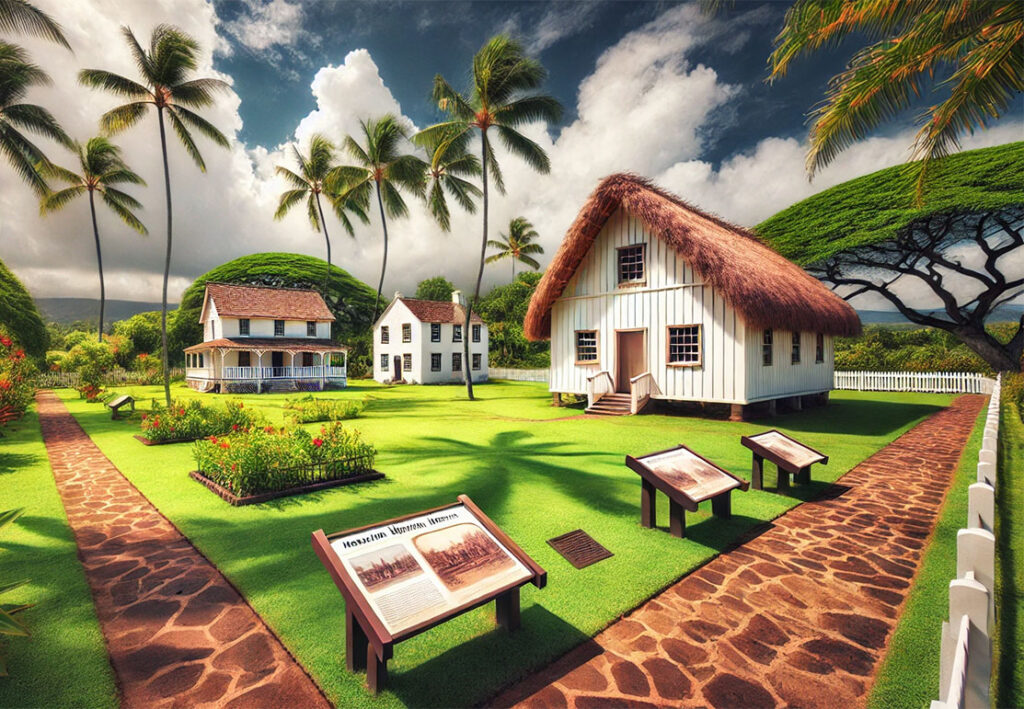
After a quick bite, we arrived at the Hawaiian Mission Houses Historic Site for our timed entry, joining as the only couple on the afternoon tour. Here, we learned about the early American missionaries sent by the American Board of Commissioners for Foreign Missions (ABCFM), whose mission to bring Christianity, literacy, and Western education profoundly impacted Hawaii.
Inspired by Henry ʻŌpūkahaʻia, a young Hawaiian who embraced Christianity while studying in Connecticut, these missionaries arrived during a time of transformation. King Kamehameha II, with Queen Kaʻahumanu’s support, had recently abolished the kapu system, a traditional religious code. This reform opened doors for the missionaries to introduce schools, churches, and healthcare.
1821 Mission House: A New England Home in Hawaii
Our tour began at the 1821 Mission House, the oldest wooden structure in Hawaii, built from New England lumber that had been pre-cut and shipped across the Pacific. This simple yet durable house was the missionaries’ first home, symbolizing their adaptation to Hawaiian life while holding onto New England traditions.
The Chamberlain House: Storage and Adaptation
Next, we explored the Chamberlain House, a central storage location for supplies that supported missionaries across the islands. As we walked through its rooms, we learned that this house was where missionaries navigated the balance between Western ideals and Hawaiian ways of life. Daily provisions were managed here, helping the missionaries to establish a stable presence and work towards their mission goals while remaining sensitive to the local culture and its traditions.
Traditional Thatched Hale: Early Missionary Adaptation
A nearby traditional hale, or grass hut, provided insight into the missionaries’ early years when they initially lived in Hawaiian-style homes. The move from these temporary grass huts to more permanent Western-style residences represented both a practical shift and a cultural adaptation, as missionaries sought to establish what they viewed as “civilized” living standards on the islands.
The Printing Room: The Birth of Hawaiian Literacy
The Printing Room housed Hawaii’s first printing press, a crucial asset to the missionaries’ literacy campaign. Here, Hawaiian-language materials were printed, facilitating both religious and educational outreach. Missionaries developed a written Hawaiian language, which boosted literacy rates and made religious texts and educational materials accessible across the islands, marking a transformative moment in Hawaiian education.
Dr. Gerrit Judd’s Office: Western Medicine in Hawaii
In the basement, we visited Dr. Gerrit Judd’s office, where he treated patients and administered vaccinations during health crises like the smallpox epidemic. Judd’s medical knowledge and early vaccination campaigns had a profound impact on Hawaiian healthcare, gradually introducing Western practices that ultimately replaced many traditional healing methods.
The Basement Depository: Essential Supplies and Provisions
Our tour concluded in the Basement Depository, where supplies sent from New England were stored. This area held goods essential to the missionaries’ daily life, underscoring the practical support needed to sustain their work and marking it as a vital part of the mission’s history.
Artifacts of Change: Blending Cultures
Artifacts displayed throughout the site, including clothing that combined Hawaiian and New England styles, illustrated the cultural blending that naturally took place over time. These pieces not only speak to the everyday lives of the missionaries but also reveal the ways in which Hawaiian and Western practices became intertwined. The legacy of the missionaries, complex and enduring, has left a lasting imprint on Hawaiian society, echoing in its education, governance, and cultural landscape to this day.
⑤ Park West Fine Art Museum & Gallery
Address: 226 Lewers St, Suite L118, Waikiki Beach Walk, Honolulu, HI 96815
Time Spent: 45-minutes
After the mission house tour, we took an Uber to Park West Fine Art Museum & Gallery at Waikiki Beach. Here, we explored a captivating collection of art, from contemporary works to classic reproductions—a refreshing change from the day’s historical focus. We also watched a local artist at work and enjoyed a brief conversation about her inspirations. The gallery’s vibrant exhibits provided a lively contrast to the past, and afterward, we strolled through nearby shops, enjoying a bit of leisurely shopping.
⑥ Waikiki Beach Walk
Time Spent: Stroll
Next, we headed down to Waikiki Beach for a relaxing stroll along the sand and out onto a small pier, where the afternoon light cast a warm glow over the shoreline. We then walked along the shore just outside the breakwater, watching surfers attempt to “catch a wave.”
⑦ Patrick’s Roadhouse Five-0 & Tower Bar
Address: 3 Aloha Tower Dr #1311, Honolulu, HI 96813
Time Spent: 45-minutes
Our day concluded with a brief delay due to a lively Pride parade, but we soon reached Patrick’s Roadhouse Five-0 & Tower Bar at Aloha Tower. There, we enjoyed a delicious meal with views of the departing Norwegian Pride of America, a fitting scene to close out our day. After dinner, a short walk brought us back to the ship, marking the end of a day rich in cultural discovery and reflection.
☑ Who Is This Tour Best For?
- History buffs: Royal monarchy, overthrow era, and missionary history in context.
- Architecture lovers: Hawaiian-Victorian palace interiors, historic churches, and civic buildings.
- Culture & museum goers: Guided interpretations, artifacts, printing press, and fine-art gallery.
- Photographers: Palace exteriors, Kamehameha statue, banyan canopies, Waikiki shoreline.
- Leisure walkers: Mostly flat city walking with indoor stops and plenty of shade breaks.
- Families & mixed groups: Varied, short segments that balance learning with free time.
⊞ Tour Summary
- Tour Name: A Journey Through Hawaiian Heritage
- Total Duration: 7 hours
- Main Stops: ʻIolani Palace (1 hr), King Kamehameha Statue (5 min), Historic Banyan Tree (10 min), Hawaiian Mission Houses (1 hr), Park West Fine Art Museum (45 min), Waikiki Beach (stroll), Patrick’s Roadhouse (45 min)
- Drive-By Highlights: Coronation Pavilion, Aliʻiōlani Hale, Waikiki shopping streets, Aloha Tower

▣ Activity Summary
- Walking Distance: 5,000–7,000 steps (15-min walk to/from pier + site touring).
- Terrain: City sidewalks, indoor floors, a few stairs/thresholds; banyan area can be uneven.
- Accessibility: Easy–Moderate. ʻIolani Palace and Mission Houses include stairs; elevator/assistance may be limited—check on arrival. Wheelchair access varies by site.
- Meals Included: None (dining at Patrick’s Roadhouse was on your own).
- What to Bring: Sun protection, light breathable layers, comfy walking shoes, water, small daypack.
Excursion Disclaimer: Descriptions of shore excursions on OceansAfoot reflect individual travel experiences and are not official representations of the cruise lines or tour providers mentioned. All information is based on personal participation, publicly available facts, or traveler observation.
© OceansAfoot