✘ Belfast, Northern Ireland • August 29, 2025
⌖ Cliffs, Columns, and Coastal Folklore in Northern Ireland
Tour Route: Belfast → Giant’s Causeway → Portrush (lunch) → Dunluce Castle (photo stop) → White Park Bay & Rathlin Island (viewpoint) → Carrick-a-Rede (viewpoint) → Ballycastle (drive-through) → Glens of Antrim → Glenarm Castle Estate (tea) → Ballygally / Carnlough / Red Arch Tunnel → Larne → Belfast
Our coach departed Belfast port just after 8:00 a.m., setting out on a full-day journey along the Causeway Coastal Route, regarded as one of Northern Ireland’s most scenic drives. As the city streets gave way to open country, the road unfolded past rolling farmland, stone cottages, and the rugged hillsides of County Antrim. The guide used this stretch to highlight how the land had been shaped first by volcanic eruptions and later by glacial carving, a landscape equally tied to geology and to centuries of mythology.
The first leg of the trip lasted a little over an hour, with commentary filling in the stories of salmon-fishing villages, clan strongholds, and filming sites that have made the coastline a natural stage for productions like Game of Thrones. From the windows, the experience was as much visual as historical — cliffs dropping to the sea on one side, patchwork fields climbing inland on the other.
① Giant’s Causeway (First Stop)
⚲ Giant’s Causeway Visitor Centre, 44 Causeway Rd, Bushmills, County Antrim, BT57 8SU, Northern Ireland
⧗ Approximately 2 hours
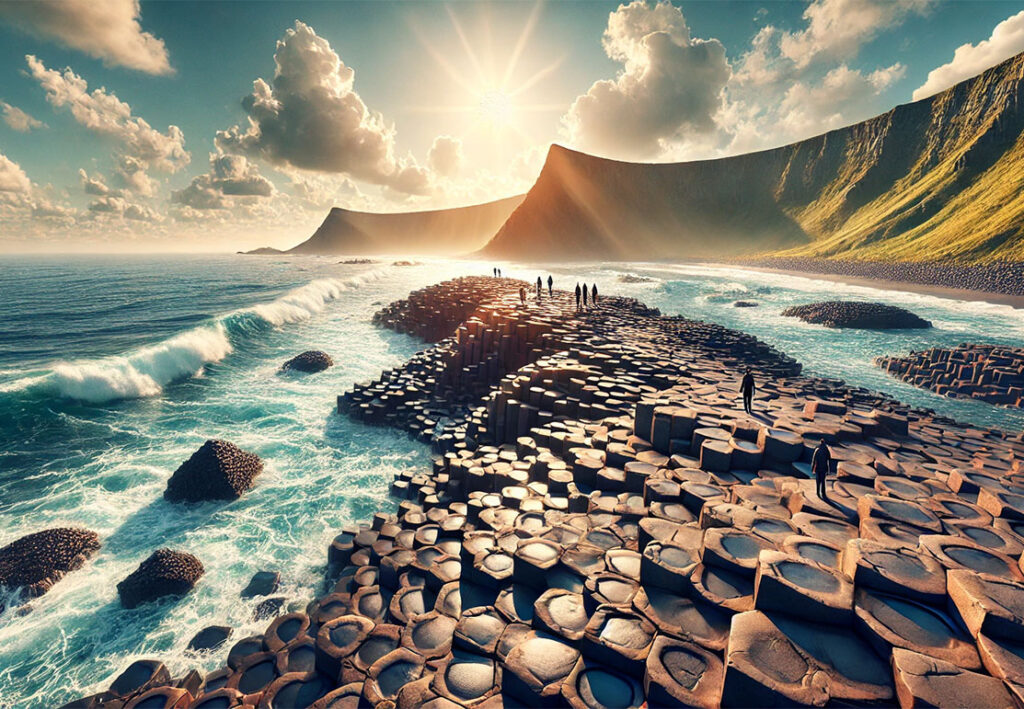
The first stop of the excursion was the Giant’s Causeway, Northern Ireland’s only UNESCO World Heritage Site. After arrival, the group entered the Visitor Centre, where facilities, exhibits, and interpretive displays introduced both the geological origins and the folklore surrounding the formation.
From there, the party set out on the ¾-mile paved path leading downhill toward the shoreline, with a shuttle bus available for those preferring not to walk. Along the way, a National Trust guide pointed out the first basalt formations at the Little Causeway, before continuing to the broad expanse of the Middle Causeway, where thousands of polygonal columns extend into the sea like natural stepping stones.
It was here, at the Middle Causeway, that the guide concluded his formal commentary. He explained the options for further exploration:
- ➤ Remain at the shoreline to examine the stones more closely.
- ➤ Continue farther to the Organ Pipes, a striking cliff face of vertical basalt columns.
- ➤ Climb the Shepherd’s Steps, a steep stairway leading to the clifftop path with panoramic views.
The guide reminded everyone to keep track of time before releasing the group for independent exploration. During this period, some walked to formations such as the Wishing Chair and the Giant’s Boot, while others undertook the climb toward the Organ Pipes or the upper trails.
Throughout the visit, the commentary emphasized both science and legend. Geologists explain that the columns were created around 60 million years ago, when cooling lava fractured into mostly hexagonal shapes. Local tradition, however, credits the giant Finn McCool, said to have built the stones as a bridge to Scotland to confront his rival Benandonner.
In total, the group spent about two hours on site, combining the guided walk with free exploration, photography, and the climb back to the Visitor Centre. For those who preferred not to make the uphill walk, a shuttle bus was available at a cost of £1 per person, payable in cash or by credit card. In practice, however, the return service could be slow; on this occasion the wait and journey together took about 30 minutes.
② Lunch in Portrush
⚲ Portrush Atlantic Hotel, 73 Main Street, Portrush, County Antrim, BT56 8BN, Northern Ireland
⧗ Approximately 1 hour
After leaving Giant’s Causeway, the coach continued a short distance into Portrush, one of the Causeway Coast’s best-known seaside towns. Lunch was scheduled at the Portrush Atlantic Hotel, a long-established property situated on Main Street near the harbor.
The group was served a plated two-course meal. It began with the soup of the day — a squash-based starter accompanied by bread. The main course featured Roasted Armagh Chicken Supreme, paired with tenderstem broccoli, garlic, sun-dried tomato and parmesan sauce, and mashed potatoes. The poultry, sourced from County Armagh (often called the “Orchard of Ireland”), underscored the regional connection of the menu.
Portrush itself has a long tradition of hospitality. Once a small fishing village, the town expanded rapidly in the 19th century after the railway linked it with Belfast. It soon became a popular holiday destination, attracting visitors to its long sandy beaches and Victorian promenade. Many of the historic hotels and terraces from that era remain, including the Atlantic Hotel where the group dined.
The one-hour break provided sufficient time for a relaxed sit-down meal, restroom facilities, and a short chance to step outside before rejoining the coach to continue east along the Antrim Coast.
③ Dunluce Castle Viewpoint
⚲ Dunluce Castle, 87 Dunluce Road, Bushmills, County Antrim, BT57 8UY, Northern Ireland
⧗ 10 minutes
After lunch, the coach continued a short distance to the official Dunluce Castle viewpoint, where the group disembarked for a brief photographic stop. From this vantage, the castle ruins stood in dramatic relief, perched on a basalt headland with sheer cliffs dropping into the North Atlantic on both sides.
The guide explained that Dunluce was first constructed in the early 1500s by the MacQuillan family, before passing to the MacDonnells, who expanded it into the seat of the Earls of Antrim. Its location, while defensible, was also precarious. In 1639, part of the castle’s kitchen collapsed into the sea during a storm, hastening its abandonment as a noble residence.
Today the site is preserved by the Northern Ireland Environment Agency and has gained fresh attention through popular culture. It served as the model for Castle Greyjoy in Game of Thrones and is said to have inspired C.S. Lewis’s Cair Paravel in The Chronicles of Narnia.
④ White Park Bay & Rathlin Island
⚲ White Park Bay, Causeway Road, Ballintoy, County Antrim, Northern Ireland
⧗ 5 minutes
The next stop was a brief pause at a roadside lay-by overlooking White Park Bay, a sweeping crescent of pale sand framed by chalk cliffs and grassy dunes. From this elevated viewpoint, the group stepped out to photograph one of the most unspoiled beaches along the Causeway Coast.
The guide noted that archaeological excavations have revealed traces of Neolithic and Bronze Age settlements, showing that farming and fishing communities thrived here more than 4,000 years ago. Remnants of later fishermen’s cottages still dot the dunes, reminders of a more recent coastal livelihood.
From the same vantage point, the guide also directed attention to Rathlin Island, lying just offshore. As Northern Ireland’s only inhabited island, it is home to vast seabird colonies in summer — puffins, guillemots, and kittiwakes — monitored by the Royal Society for the Protection of Birds (RSPB). Rathlin also entered communications history when Marconi conducted wireless telegraph experiments here at the end of the 19th century.
⑤ Carrick-a-Rede Rope Bridge Viewpoint
⚲ Carrick-a-Rede Viewpoint, Ballintoy, County Antrim, BT54 6LS, Northern Ireland
⧗ 15 minutes
The coach continued east to the Carrick-a-Rede viewpoint, one of the most photographed locations on the Antrim Coast. Although this excursion did not include crossing the bridge itself, the roadside stop provided clear views of the span and the rugged cliffs surrounding Ballintoy.
From the lay-by, the bridge could be seen stretching about 20 meters (66 feet) across a narrow chasm nearly 30 meters (100 feet) deep, connecting the mainland to Carrick Island. According to the guide, the bridge was first erected more than 350 years ago by salmon fishermen who required seasonal access to set their nets. As late as the 1960s, up to 200 salmon a day were being landed here during peak runs. By the 1980s, however, stocks had collapsed, and commercial fishing ended, leaving the bridge as a cultural and heritage landmark.
Now maintained by the National Trust as part of the Causeway Coast Way walking trail, the modern reinforced structure is safe for visitors, though even from a distance it retains the sense of daring once faced by fishermen balancing above the rocks and sea.
⟳ Ballycastle — Drive-Through
⚲ Ballycastle, County Antrim, Northern Ireland
⧗ Drive-through with commentary
After leaving the Carrick-a-Rede viewpoint, the coach continued east into Ballycastle, the principal town along this part of the Antrim Coast. Though there was no scheduled stop, the drive-through offered views of several landmarks while the guide provided commentary on the town’s history and traditions.
One of the most prominent sights was St. Patrick’s and St. Brigid’s Church, a 19th-century stone building with a tall clock tower and adjoining cemetery, set just inland from the harbor. The route also passed newer residential developments, reflecting Ballycastle’s evolution from a traditional market town to a commuter base and seaside holiday destination.
The guide highlighted Ballycastle’s reputation as the home of the Ould Lammas Fair, a tradition more than 400 years old. Still held each August, the fair blends livestock trading with food stalls, music, and entertainment. Its most distinctive treats are dulse (dried seaweed) and yellowman (a brittle honeycomb toffee), both long associated with the festival.
⟳ Glens of Antrim Drive
⚲ Scenic route through the Glens of Antrim, County Antrim, Northern Ireland
⧗ Approximately 1 hour (drive with commentary)
Leaving Ballycastle, the coach turned inland to follow the route through the Glens of Antrim, a chain of nine valleys carved by glaciers during the last Ice Age. This part of the excursion was viewed from the coach, with the guide highlighting landmarks as the scenery shifted between dramatic uplands and sheltered, fertile valleys.
The road first passed through Cushendall, a town framed by Lurigethan Mountain. Along the roadside, murals celebrating Gaelic sports decorated the GAA playing fields, underscoring the enduring importance of hurling and football in community life. These vivid displays linked the natural landscape with the living traditions of the glens.
Farther along, the route skirted Cushendun, a village known for its distinctive whitewashed houses, designed in the 1920s by architect Clough Williams-Ellis. The guide also drew attention to traces of the past: hedge schools, once used for clandestine Catholic education under the penal laws, and stone viaducts, which carried early roads and railways across the valleys.
The glens themselves have long been shaped by small-scale farming. Typical holdings were just 30–40 acres, requiring families to supplement their income through weaving, quarrying, or fishing. Today, the region continues to adapt, producing specialty goods such as Broighter Gold rapeseed oil, which has become a local export.
⑥ Glenarm Castle Estate — Walled Garden Tea Room
⚲ Glenarm Castle Estate, 2 Castle Lane, Glenarm, County Antrim, BT44 0BQ, Northern Ireland
⧗ Approximately 45 minutes
The final stop of the excursion was at the Glenarm Castle Estate, seat of the McDonnell family, Earls of Antrim. Promotional descriptions often imply a castle visit, but in reality, the main house is a private residence. It is not open to tour groups, and thick vegetation and surrounding woodland prevent meaningful views or photographs of the building itself. Visitors should be aware that the castle itself is not accessible or visible during this stop.
Instead, the coach brought the group to the Walled Garden Tea Room, a café located in converted outbuildings beside the gardens. Here, a traditional refreshment was served: freshly baked scones with jam and cream, accompanied by tea or coffee. The setting was informal, featuring modern interiors and outdoor seating rather than historic castle halls.
The guide noted that Glenarm Castle is among the oldest continuously inhabited castles in Ireland, with the McDonnell family in residence since the early 17th century. While the house remains private, the surrounding estate is occasionally used for seasonal public events, including open garden days, fairs, and concerts.
The 45-minute break provided time for refreshments, restrooms, and browsing a small gift area before the coach reassembled for the return drive to Belfast.
Return Drive to Belfast
Location: Causeway Coastal Route southbound to Belfast
Time Spent: Approximately 1 hour 45 minutes
The return journey followed the Causeway Coastal Route, offering a final sequence of landmarks along the Antrim shoreline. The guide used this leg of the trip to point out visible sites and share additional stories that framed both local and national history.
At Ballygally, the group passed Ballygally Castle, a 17th-century plantation-era stronghold now operating as a hotel. Locally, it is best known for the “Ghost Room”, linked to the legend of Lady Isabella Shaw, who, according to tradition, fell to her death while trying to escape confinement in the tower.
Farther south, the coach passed through the Red Arch Tunnel, its iron-rich stone giving the passage its distinctive hue. In nearby Carnlough, the guide noted the harbor works and limestone quarries, built as famine-relief projects during the mid-19th century. These efforts provided employment for hundreds of local people at the height of the potato famine.
The commentary then turned to Belfast’s wartime past. Much of the city’s housing stock was destroyed in the 1941 Luftwaffe raids, when German bombers targeted shipyards and aircraft factories. Thousands were displaced, and many families were later housed in prefabricated “emergency homes,” some of which stood for decades afterward.
As the road approached Larne Harbour, passengers saw the natural inlet that has long served as a maritime hub. Today it remains active for ferries and cargo, marked by the three tall chimneys of Ballylumford Power Station at its entrance.
From Larne, the route turned inland. By late afternoon the coach re-entered Belfast, concluding the day’s excursion. After a circuit of geology, legend, and history along the Antrim Coast, the group returned to the ship with a deeper understanding of Northern Ireland’s landscapes and heritage.
☑ Who Is This Tour Best For?
- Geology enthusiasts — the basalt columns of the Giant’s Causeway showcase volcanic origins and natural design.
- Legend seekers — stories of Finn McCool bring Irish folklore to life along the coast.
- Scenic travelers — panoramic stops at White Park Bay, Rathlin Island, and Carrick-a-Rede highlight Northern Ireland’s rugged shoreline.
- History lovers — Dunluce Castle, famine-relief projects, and wartime Belfast provide a timeline of heritage.
- Cultural explorers — Portrush hospitality, Glenarm traditions, and Ballycastle’s Ould Lammas Fair reveal local identity.
- Photography enthusiasts — coastal cliffs, medieval ruins, and sweeping glens offer dramatic subjects throughout the day.
- Travelers seeking a full-day excursion — a nine-hour route blends guided visits with drive-by commentary across the Antrim Coast and Glens.
⊞ Tour Summary
- Tour Name: Ultimate Giant’s Causeway
- Offered By: Princess Cruises
- Total Duration: 9 hours
- Main Stops: Giant’s Causeway, Portrush Atlantic Hotel (lunch), Dunluce Castle (photo stop), White Park Bay & Rathlin Island (viewpoint), Carrick-a-Rede Rope Bridge Viewpoint, Ballycastle (drive-through), Glens of Antrim drive, Glenarm Castle Estate (afternoon tea)
- Drive-By Highlights: Cushendall, Cushendun, Ballygally Castle, Causeway Coastal Route villages
▣ Activity Summary:
- Walking Distance: 7,000–8,000 steps depending on walking route at Giant’s Causeway
- Terrain: Paved visitor paths, sloping descent/ascent at the Causeway, uneven basalt stones at shoreline
- Accessibility: Moderate; walking sticks recommended for those with balance concerns
- Meals Included: Full lunch at Portrush Atlantic Hotel and scones with tea/coffee at Walled Garden café
Excursion Disclaimer: Descriptions of shore excursions on OceansAfoot reflect individual travel experiences and are not official representations of the cruise lines or tour providers mentioned. All information is based on personal participation, publicly available facts, or traveler observation.
© OceansAfoot