✘ Long Beach, California • October 12, 2024
⌖ Historic Icons, Art Deco Gems, and Cultural Landmarks
Tour Route: Hyatt Regency Long Beach → Cooper Arms → East Village Arts District (New Amsterdam Restaurant → Insurance Exchange Building → The Blind Donkey → Hotel Metropolitan) → Long Beach Museum of Art Downtown → Insurance Exchange Building (top floor)
A Journey Begins: Stepping Back in Time
On a sunlit afternoon, our exploration began with a leisurely 15-minute walk from the Hyatt Regency Long Beach to Cooper Arms, marking our entry into the East Village Arts District and the start of the Docent-Led Architectural Walking Tour. The tour promised a deep dive into the city’s historical architecture and cultural evolution, setting the stage to appreciate how Long Beach has balanced historic preservation with modern adaptation.
① Cooper Arms
Address: 455 East Ocean Boulevard, Long Beach, CA 90802
Time Spent: 1-hour
Built in 1923, Cooper Arms stands as a 12-story icon of Renaissance Revival architecture, capturing the elegance of the early 20th century. Initially designed as a cooperative residence, it attracted affluent visitors seeking refined, temporary stays. Our guide, Mike, accompanied by a trainee from the Long Beach Heritage tour group, welcomed our small assembly into the lobby. Here, he introduced us to the building’s elaborate plasterwork and ornate moldings, which reveal the architectural artistry of its time.
A unique feature of Cooper Arms is its original single-pane windows, also dating back to 1923. While these windows enhance the building’s authenticity, they allow the sounds of Ocean Boulevard to seep through, connecting residents with the lively street below. In an effort to balance comfort with preservation, some residents have opted for dual-pane windows—a choice that sparks occasional debate over maintaining historical integrity in a modern context.
A Glimpse Inside: Stories of Modern Adaptation
We continued to the eighth floor, entering a private condo that demonstrated the Cooper Arms’ versatility in adapting to modern tastes. This unit embraced an industrial aesthetic, with exposed concrete beams and unplastered walls showcasing the building’s original structural elements. The minimalist design created a striking contrast to the Cooper’s vintage elegance, showcasing the building’s adaptability to evolving styles.
Mike shared insights into how residents’ renovations reflect the balance between honoring historical character and introducing contemporary comforts. The exposed beams symbolize a respectful nod to the building’s origins, embodying its resilience and personality. Through choices like these, residents celebrate the Cooper’s history while adapting it for modern living.
The 11th Floor: Views and Historic Insights
One highlight of the tour was reaching the 12th floor, where we enjoyed panoramic views of Long Beach through the original 1923 windows. From this vantage point, the city unfolded as a layered landscape of past and present. Mike narrated the city’s evolution from a booming oil town to a cultural and tourist hub, pointing out landmarks like the Villa Riviera and sharing stories of events like the Long Beach Grand Prix that have shaped its identity.
Here, Mike also touched on the 1933 earthquake, which profoundly impacted Long Beach’s architecture. The disaster led to new building codes and a shift toward Art Deco styles, which emphasized structural strength while preserving elegance. From the 12th floor, we could see remnants of historic buildings that had endured the quake, a visual testament to the resilience that defines Long Beach’s architectural heritage.
② Exploring the East Village Arts District
Location: East Village Arts District, Long Beach, CA 90802
Time Spent: 45 minutes
Our tour continued outdoors as we strolled through the East Village Arts District, taking in its vibrant mix of historic and artistic structures. We paused at the New Amsterdam Restaurant, admiring the intricate tile work on its façade that speaks to its storied past. Mike explained how buildings like this have preserved unique elements from earlier eras, adding character to the district.
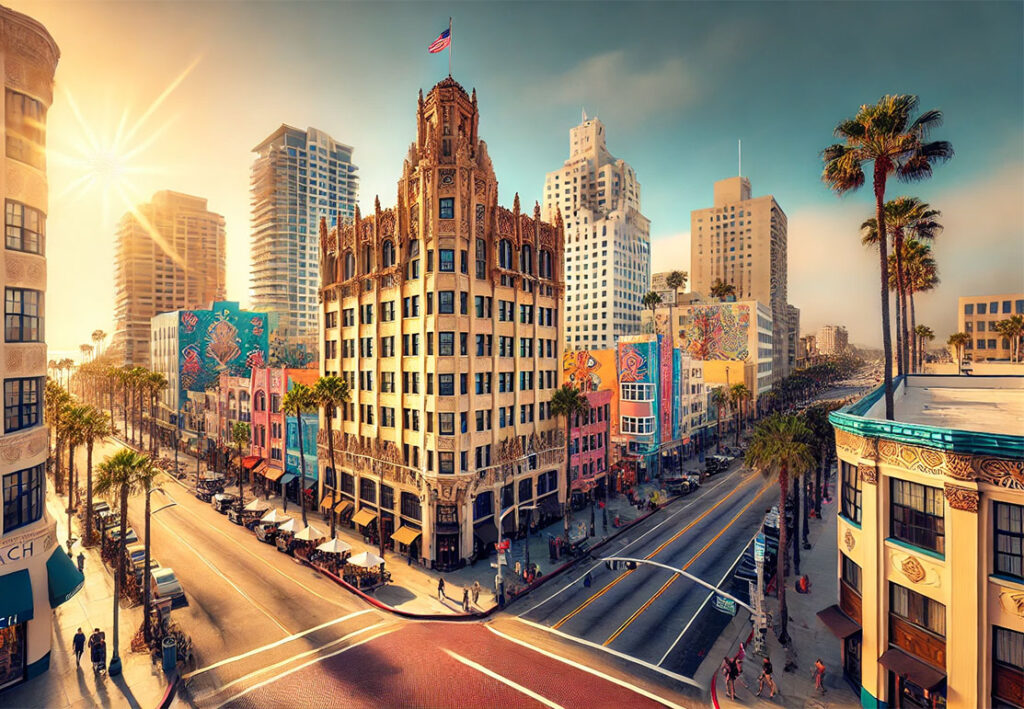
Across the street from the Insurance Exchange Building, we took in the building’s Art Deco style, complete with Egyptian-inspired “King Tut” motifs. Mike noted that these details reflect the fascination with ancient Egypt following the discovery of Tutankhamun’s tomb in the 1920s, a trend that influenced architecture across Long Beach. Art Deco’s geometric patterns and exotic flourishes have become hallmarks of the city’s aesthetic, adding depth and historical layers to its landscape.
Nearby, we stopped in front of The Blind Donkey, a rustic bar that has appeared in notable films like La La Land, adding cinematic allure to the neighborhood. Mike explained that Long Beach’s architecture and scenic streets make it a versatile stand-in for various filming locations. Another notable landmark, the Hotel Metropolitan, also boasts a cinematic past, featuring in movies such as Anchorman: The Legend of Ron Burgundy. This historic hotel once served as a lively hub for visitors, from oil workers to tourists, as Long Beach evolved from a transient town into a community with staying power.
③ Long Beach Museum of Art (LBMA) Downtown
Address: 356 E 3rd Street, Long Beach, CA 90802
Time Spent: 20 minutes
Just a short walk down Elm Avenue brought us to the Long Beach Museum of Art (LBMA) Downtown, a cultural landmark housed in the former National Cash Register Building. This former industrial space has been transformed into a thriving art center, showcasing how Long Beach reimagines historic sites. Inside, we explored the Chris Eckert: Overload exhibit, where mechanical innovation meets art, reflecting LBMA Downtown’s commitment to connecting historical roots with contemporary expression.
On the second floor, we saw a preserved photograph of the building from its industrial days, capturing it as a hub for business machinery. Mike explained how this transformation into an art museum embodies Long Beach’s vision of preserving heritage while infusing it with new purpose. The visit underscored how historic spaces continue to serve the community in fresh, meaningful ways.
④ Insurance Exchange Building (Interior Visit)
Address: 205 East Broadway, Long Beach, CA 90802
Time Spent: 30 minutes
Our final significant stop was at the top floor of the Insurance Exchange Building, which we had previously seen only from across the street. Here, we could fully appreciate its Art Deco design, with geometric patterns and intricate details that characterize the style. Mike noted the importance of Art Deco in Long Beach’s development, with sleek and bold elements becoming citywide hallmarks.
The 1933 earthquake and its architectural impact were revisited here, as this event led to extensive rebuilding and new codes that fortified structures without sacrificing style. Mike shared insights into the work of prominent architects, such as Schilling & Schilling, whose contributions to the post-earthquake landscape helped shape Long Beach’s unique identity. His detailed commentary offered a glimpse into how adversity spurred a blend of resilience, artistry, and practical design throughout the city.
⑤ Optional Meal Stop: Modica’s Restaurant
Address: 455 East Ocean Boulevard, Long Beach, CA 90802
Time Spent: 45 minutes
After the tour’s conclusion, we made our way to Modica’s Restaurant, a local favorite known for its inviting ambiance and hearty dishes. This final stop provided a chance to unwind and reflect on the day’s journey. As we enjoyed our meal, the stories of Long Beach’s historical and architectural legacy resonated, deepening our appreciation for this city where history and modernity harmoniously blend. The tour left us with a lasting impression of Long Beach as a place of enduring charm and cultural richness.
☑ Who Is This Tour Best For?
- Architecture Lovers: Renaissance Revival, Art Deco, and adaptive reuse.
- History Buffs: Stories of 1920s glamour and the 1933 earthquake.
- Cultural Explorers: Art museums and cinematic landmarks.
- Photographers: Iconic façades, tiled details, and skyline views.
- Food Lovers: Casual dining in a historic district.
⊞ Tour Summary
- Tour Name: Docent-Led Architectural Walking Tour
- Offered By: Long Beach Heritage
- Total Duration: 3 hours
- Main Stops: Cooper Arms, East Village Arts District, LBMA Downtown, Insurance Exchange Building
- Walk-By Highlights: Villa Riviera, Long Beach Grand Prix route, neighborhood façades
▣ Activity Summary
- Walking Distance: ~4,000–5,000 steps
- Terrain: City sidewalks, building interiors, flat terrain
- Accessibility: Moderate; elevators available at major stops, some uneven sidewalks outdoors
- Meals Included: None (lunch at Modica’s was independent, after the tour)
Excursion Disclaimer: Descriptions of shore excursions on OceansAfoot reflect individual travel experiences and are not official representations of the cruise lines or tour providers mentioned. All information is based on personal participation, publicly available facts, or traveler observation.
© OceansAfoot