✘ Ushuaia, Argentina • February 15, 2025
⌖ Fur Seals, Sea Lions, and Seabirds at the End of the World
Tour Route: Ushuaia Port → Isla de los Lobos → Les Éclaireurs Lighthouse → Isla de los Pájaros → Return to Ushuaia
The rain came down in sheets as we stepped off the Sapphire Princess, walking the short 500 feet across the pier to board the Chonek, our vessel for the afternoon. Despite the downpour, the ship’s crew from Tolkeyen Patagonia welcomed passengers quickly, ensuring everyone got aboard without lingering too long in the cold, driving rain.
Once inside the heated main areas, we shook off the water from our jackets and settled into the cushioned seats. Through the large panoramic windows, we could see the Beagle Channel ahead, its surface choppy under the heavy rainfall. Some passengers ventured onto the small rear deck, where the steady rain dripped from the edges of jackets and hoods, creating small puddles on the deck.
The port of Ushuaia, often called “the end of the world,” bustled with activity as we readied to depart. Fortunately, the worst of the rain began to ease as the Chonek eased away from the dock, though the clouds remained low and heavy. The dramatic, moody weather only enhanced the sense of adventure—after all, we were sailing through a region known for its unpredictable and extreme conditions.
Departure from Ushuaia: Gateway to the Southern Ocean
⚲ Port of Ushuaia, Avenida Prefectura Naval, Ushuaia, Argentina
⧗ 30 minutes
As we left the dock, the guide’s voice came over the loudspeaker, setting the stage for our journey. The Beagle Channel, a 180-kilometer-long passage, provided a crucial link between the Atlantic and Pacific Oceans. It was named after the HMS Beagle, the ship that carried Charles Darwin on his famous voyage in the 1830s.
The guide also spoke of the Yaghan people (also called the Yámana), the original inhabitants of these waters. Unlike the bundled-up passengers aboard Chonek, the Yaghan wore little to no clothing, their bodies adapted to the cold through a higher metabolic rate and the applying thick layers of animal fat to their skin. They used fire to stay warm, even in their handmade bark canoes, a sight that astonished early European explorers and inspired the name Tierra del Fuego—“Land of Fire.”
With the city of Ushuaia shrinking behind us, we headed east, the wind strengthening as we reached open waters.
① Wildlife Encounters – Fur Seals & Sea Lions
⚲ Isla de los Lobos, Beagle Channel, Argentina
⧗ 20 minutes
The first stop was Isla de los Lobos, a rocky islet covered with South American sea lions and fur seals. Even before we got close, we could hear the deep, guttural barks of the dominant males, warning younger males to keep their distance. The scent of salt, fish, and damp fur filled the air.
The guide explained the difference between sea lions and fur seals:
- ➤ Fur seals, the first arrivals of the winter season, had thicker coats that made them more resistant to the cold and rain. These were the animals that early seal hunters nearly drove to extinction in the 19th century due to their highly prized pelts.
- ➤ Sea lions, in contrast, were larger, heavier, and more social, with males growing up to 350 kilograms (770 pounds). They had shorter fur but thick layers of blubber that kept them warm.
At the center of the colony, a massive bull sea lion stood on the highest rock, his golden-brown mane ruffling in the wind. Surrounding him were his harem of females, each significantly smaller, some nursing young pups. The guide explained that these dominant males fought fiercely for territory, sometimes engaging in bloody battles to maintain control.
Further down the rocky outcrop, younger sea lions played in the water, their slick bodies diving and twisting gracefully beneath the waves. Overhead, imperial cormorants circled, waiting for a chance to steal scraps of fish.
We drifted close enough to observe the intricate social dynamics—from the constant movement of juveniles testing their boundaries to the watchful eyes of mothers keeping their pups close.
② Les Éclaireurs Lighthouse – Sentinel of the Channel
⚲ Les Éclaireurs Lighthouse, Beagle Channel, Argentina
⧗ 15 minutes
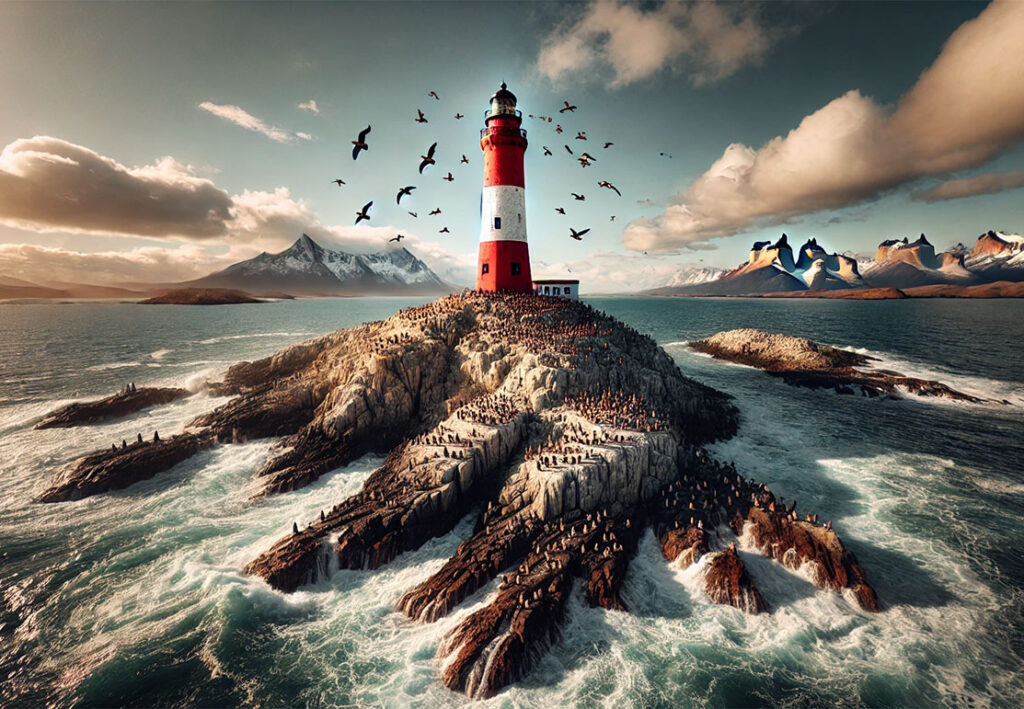
As Chonek continued east, Les Éclaireurs Lighthouse emerged, its red-and-white tower standing alone on a rugged, wind-battered islet. The lighthouse, built in 1920, remains an active navigation beacon, its solar-powered light flashing every five seconds, warning vessels of submerged reefs and dangerous currents that have claimed many ships over the years.
The guide clarified a common misconception—while often called the “Lighthouse at the End of the World,” Les Éclaireurs is not the one that inspired Jules Verne’s novel. That honor belongs to the Juan de Salvamento Lighthouse on Isla de los Estados, a far more isolated and difficult-to-reach beacon, more than 300 kilometers to the east in the open Atlantic Ocean.
This lighthouse, however, has its own tragic history. In 1930, the German passenger ship Mount Cervantes struck a submerged rock near this very spot. Though all passengers survived, the vessel sank, becoming another casualty of the Beagle Channel’s unpredictable waters.
As Chonek circled the rocky islet, the sound of waves crashing against the cliffs underscored the harsh conditions that sailors have faced for centuries. Imperial cormorants nested along the ledges, their black-and-white bodies blending into the jagged stone. At first glance, their posture and coloring made them resemble penguins, but as one lifted its wings to dry, it revealed itself as a skilled diving bird rather than a flightless one.
③ Birdlife of the Beagle Channel – Opportunists and Hunters
⚲ Isla de los Pájaros, Beagle Channel, Argentina
⧗ 20 minutes
A short distance from the lighthouse, Chonek slowed as we approached Isla de los Pájaros, one of the most important seabird nesting sites in the Beagle Channel. From a distance, the rocky island appeared dark and uneven, but as we drew closer, it became clear that the surface was alive with movement—thousands of imperial cormorants crowded the cliffs, packed together in dense colonies.
The guide explained that imperial cormorants are expert divers, capable of plunging 40 meters (131 feet) underwater in search of fish. These birds, sometimes referred to as “sea ravens” due to their sleek black-and-white plumage, spread their wings to dry after each dive, a behavior that helps them regulate body temperature since their feathers lack full waterproofing.
Above the island, southern giant petrels soared on broad, two-meter wings, effortlessly riding the strong gusts sweeping across the channel. Unlike the cormorants, which hunt live fish, petrels are scavengers, known to feed on carrion, discarded fish, and even weakened seabirds. Their keen sense of smell and opportunistic feeding habits make them one of the most important natural recyclers in this ecosystem.
A different kind of hunter, however, dominated the skies—the skuas. Described by the guide as aggressive and opportunistic, these birds often disrupt nesting seabirds, stealing eggs or even preying on unattended chicks. They patrolled the airspace above the cormorant colonies, waiting for an opportunity to strike. While the petrels thrived on scavenging, the skuas actively harassed other birds, forcing them away from their nests.
As Chonek completed its slow loop around Isla de los Pájaros, the interaction between predators, scavengers, and prey became apparent—each species played a critical role in maintaining the delicate balance of life in the Beagle Channel. In this remote, windswept environment, survival was dictated by adaptation and relentless competition.
Return to Ushuaia
⚲ Ushuaia Port, Avenida Prefectura Naval, Ushuaia, Argentina
As we now turned back toward Ushuaia, the wind picked up once again.. The once-heavy rain had faded to a mist, but the cold still bit through layers of clothing, a final reminder of the harsh environment we had just explored.
The guide took the last leg of the journey to share more about the Yaghan people, the original inhabitants of the Beagle Channel. He explained how these nomadic seafarers navigated these icy waters in bark canoes, using fire to keep warm, while their bodies had adapted over centuries to endure the extreme cold. Their higher metabolism, larger lung capacity, and remarkable knowledge of the sea had allowed them to thrive in this region for thousands of years. However, European colonization, disease, and forced assimilation had nearly erased their way of life, leaving behind only traces of their once-dominant presence.
As Ushuaia’s colorful buildings came into view, passengers gathered near the windows of the main cabin and along the upper deck, reflecting on the untamed beauty of the Beagle Channel—a land of towering peaks, storm-swept islands, and an ecosystem in constant motion.
By the time Chonek docked beside the Sapphire Princess, the rain had all but stopped, though the chill lingered in the air. We stepped off the boat cold, windswept, and exhilarated, grateful to have witnessed this remote corner of the world.
☑ Who Is This Tour Best For?
- Wildlife Lovers: Close encounters with sea lions, fur seals, and seabirds.
- History Buffs: Darwin’s HMS Beagle, lighthouses, and shipwreck lore.
- Nature Photographers: Misty straits, dramatic skies, and island colonies.
- Cultural Explorers: Stories of the Yaghan people and Tierra del Fuego.
- Adventure Seekers: Braving Patagonia’s unpredictable weather and seas.
⊞ Tour Summary
- Tour Name: Beagle Channel Wildlife Cruise
- Offered By: Princess Cruises (via Tolkeyen Patagonia)
- Total Duration: 2.5 hours
- Main Stops: Isla de los Lobos, Les Éclaireurs Lighthouse, Isla de los Pájaros
- Drive-By Highlights: Beagle Channel, Ushuaia coastline, Andes Mountains
▣ Activity Summary
- Walking Distance: Minimal (short pier walk)
- Terrain: Boat decks (wet, slippery in rain)
- Accessibility: Easy; seated indoor cabin available, decks exposed to wind/rain
- Meals Included: None provided
Excursion Disclaimer: Descriptions of shore excursions on OceansAfoot reflect individual travel experiences and are not official representations of the cruise lines or tour providers mentioned. All information is based on personal participation, publicly available facts, or traveler observation.
© OceansAfoot