✘ Oulu, Finland • June 23, 2026
⌖ A Wooden Seaport Shaped by the Age of Sail
Tour Route: Old Raahe → Old Pharmacy → Holy Trinity Church → Packhouse Museum → Trade House of Lang → Crown Granary Museum → Return to Oulu
Our afternoon excursion left Oulu with a group of fourteen for the drive south to Raahe, a small coastal town whose historic center remains closely tied to Finland’s Age of Sail. Our guide, Niina, was herself a Raahe resident and was dressed for the afternoon in the style of a mamselli, an unmarried woman of the mid-19th century. She used the costume to introduce some of the people and customs that would recur throughout the visit.
About an hour later, the coach reached the waterfront edge of Old Raahe. Founded in 1649, the town developed around seafaring, shipbuilding and trade, then was substantially rebuilt after a fire destroyed three-quarters of it in 1810. The historic center that emerged from that rebuilding is now one of Finland’s best-preserved 19th-century wooden towns, with low houses, enclosed courtyards and narrow streets still functioning as part of the modern city rather than as a reconstructed museum district.
We stepped off near the Packhouse Museum and gathered first along the waterfront before beginning the walk into Old Raahe.
① Old Raahe
⚲ Old Raahe, Raahe, Finland
⧗ ~25 minutes before the Old Pharmacy
The walk began beside the Packhouse Museum, where we first gathered along the waterfront before following our guide toward Myhrberg Park. The park occupies the area of Raahe’s original marketplace, close to the town’s early civic center. From there, the route turned inland through the wooden streets and courtyards of Old Raahe.
Raahe was founded in 1649, and much of the town seen today reflects the rebuilding that followed the great fire of 1810. Roughly three-quarters of Raahe’s buildings were destroyed, after which a new plan introduced wider streets and a more formal central square. Old Raahe now preserves around 150 historic residential buildings and remains a functioning neighborhood rather than a museum compound.
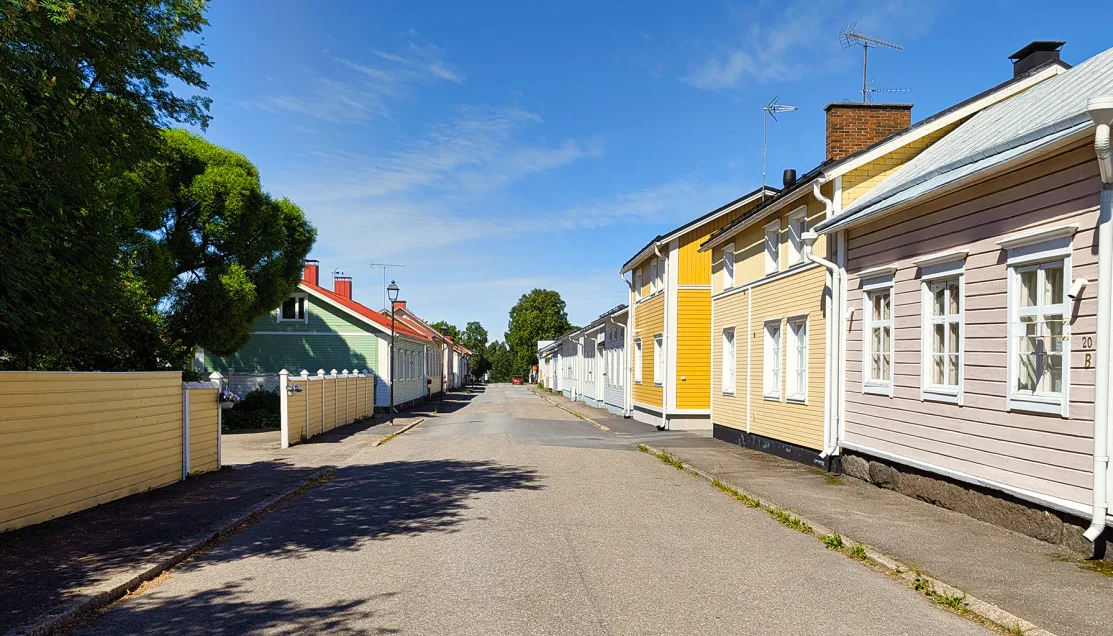
Old Raahe’s surviving wooden townscape includes roughly 150 historic residential buildings, many dating from the rebuilding that followed the 1810 fire.
At Myhrberg Park, our guide stopped beside the monument to Maximilian August Myhrberg before leading us toward Brahenkatu 2. We passed beneath the arched gateway into the courtyard there, one of several moments during the walk when the street-facing wooden façades opened into enclosed courtyards behind them. The historic district was not experienced as a series of isolated monuments. Much of the visit came from moving through the compact street grid and seeing how houses, courtyards and public buildings remained interwoven.
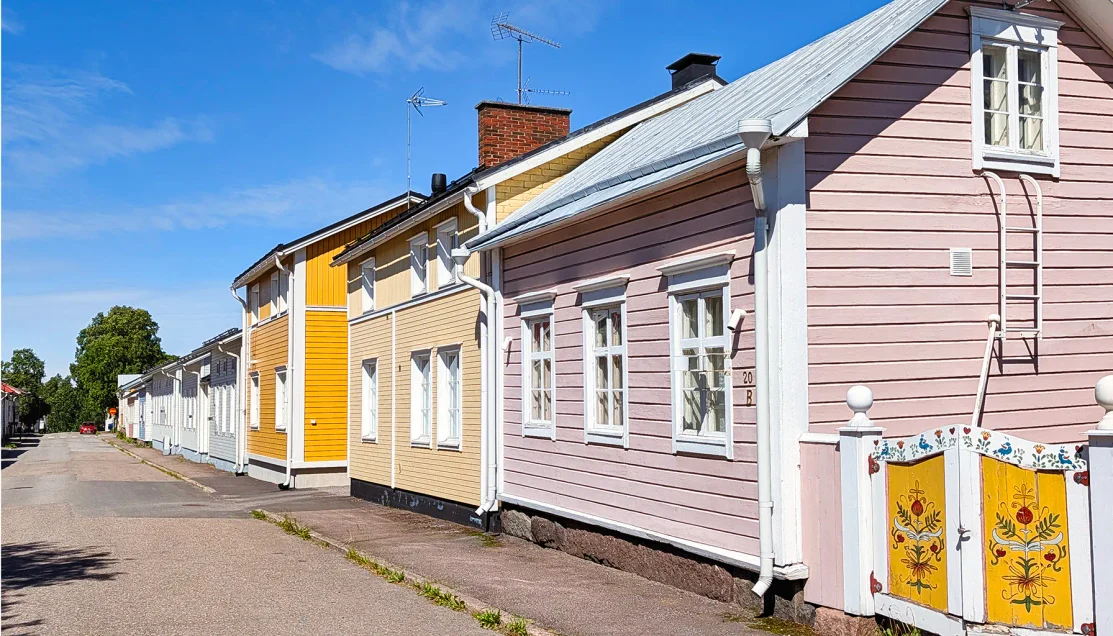
Closely spaced wooden houses, stone foundations and enclosed gates remain characteristic features of the historic residential district.
As we continued, our guide pointed out details that reflected Raahe’s long connection with seafaring. Among them were the so-called gossip mirrors, mounted beside windows so residents could watch activity along the street, and pairs of porcelain ship dogs displayed in windows. Originally brought home from England by sailors, the dogs traditionally carried a message: when they faced outward, the man of the household was away at sea; when they faced inward, he was home.
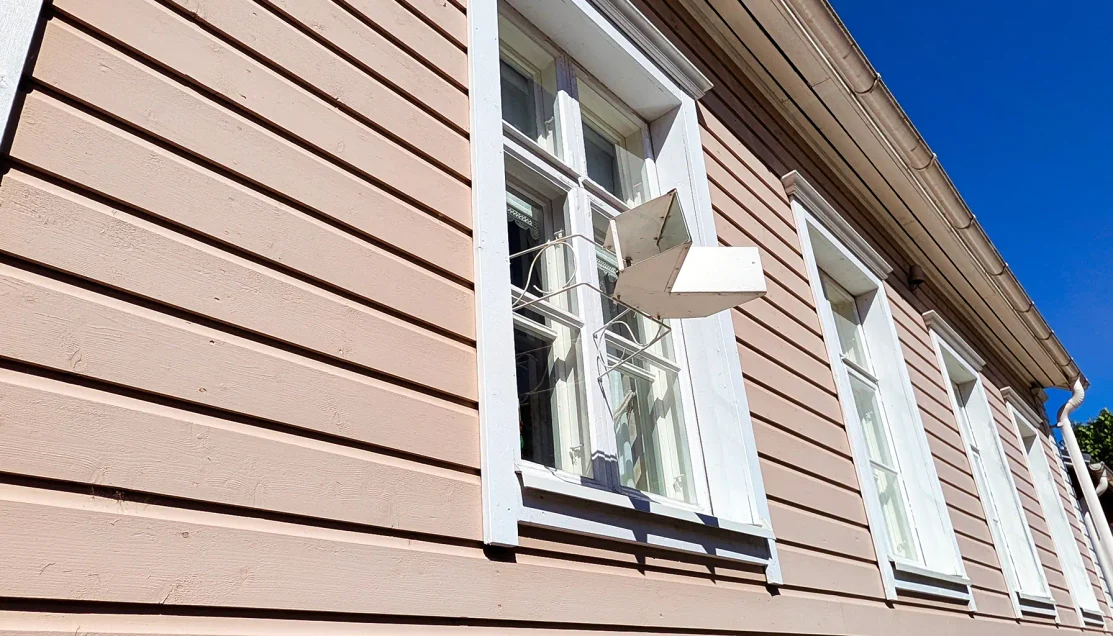
Mounted beside a street-facing window, the two-mirror device allowed someone inside to observe activity in both directions along the street
The walk continued past buildings associated with Raahe’s later commercial and cultural life, including Raahe Theatre, while pastel-painted wooden houses continued along the narrow streets. These streetscapes were the defining feature of the first portion of the excursion, more so than any single structure.
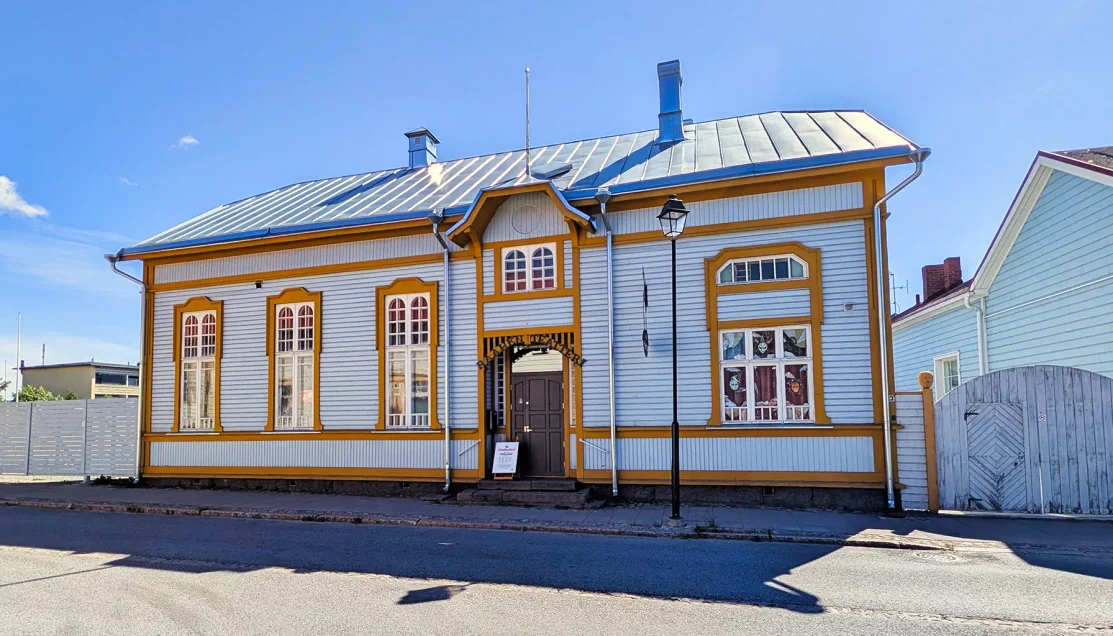
The approximately 110-year-old Jugend-style building, originally built for the Salvation Army, is now home to an active amateur theatre.
From there, the group entered one of the historic buildings for the first extended indoor stop of the afternoon.
② Old Pharmacy
⚲ Kauppakatu 31, Raahe, Finland
⧗ ~10 minutes
The Old Pharmacy preserves an authentic pharmacy setting rather than a reconstructed interpretation. Raahe’s first pharmacy was established in 1793, and the business moved to this building on Kauppakatu in 1924, remaining here until 1998. The furnishings from the earlier pharmacy on Kirkkokatu, renewed in 1900, were moved here as well, along with the eagle that had guarded its former entrance.
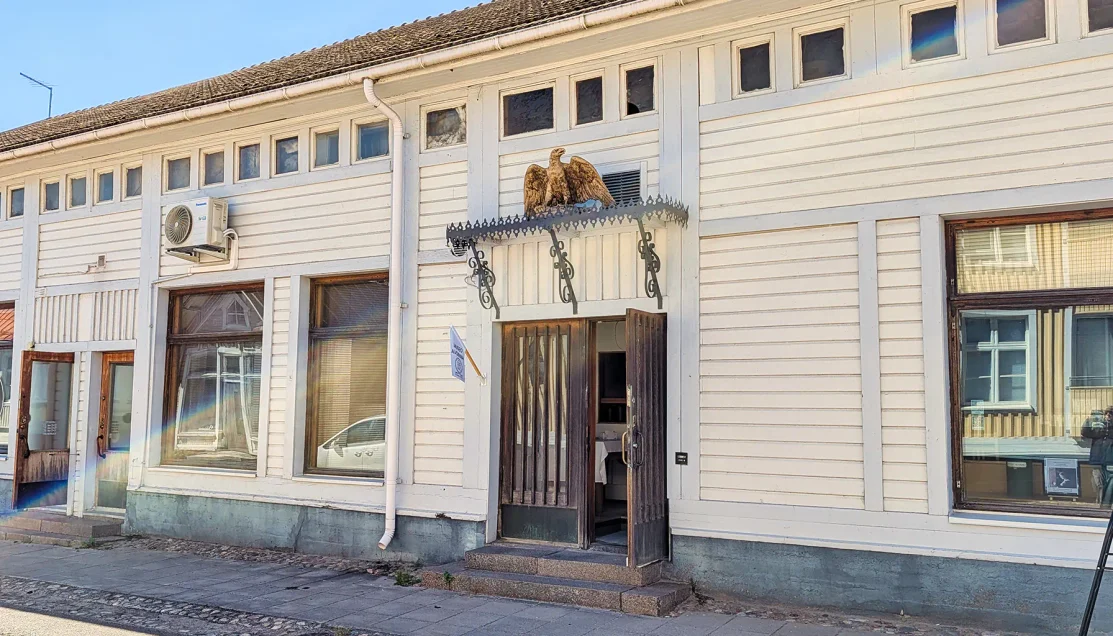
The eagle above the Kauppakatu entrance was retained from the pharmacy’s earlier location on Kirkkokatu.
Inside, we gathered around the long wooden dispensing counter while a staff member gave us a short introduction to the building and collection. Shelves and drawers still held pharmacy jars, bottles, medicine boxes and equipment used when medicines were compounded on site. Some of the containers date to the 18th century, and the collection is considered one of Finland’s most significant collections of historic pharmaceutical objects.
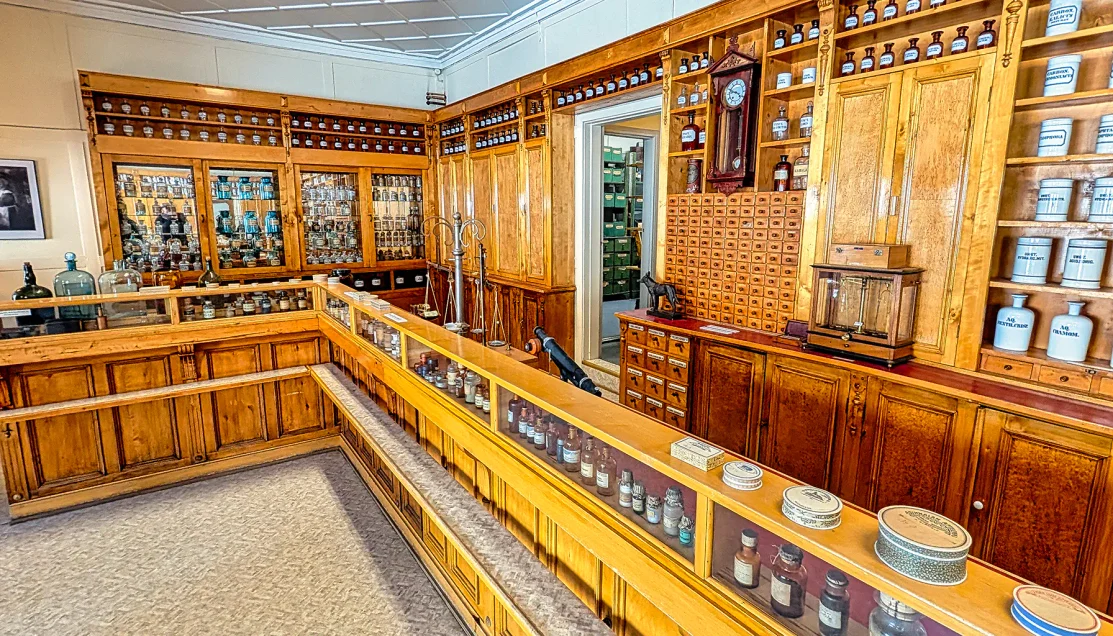
Original wooden cabinetry surrounds the dispensing room, with medicine jars and bottles still arranged on its shelves.
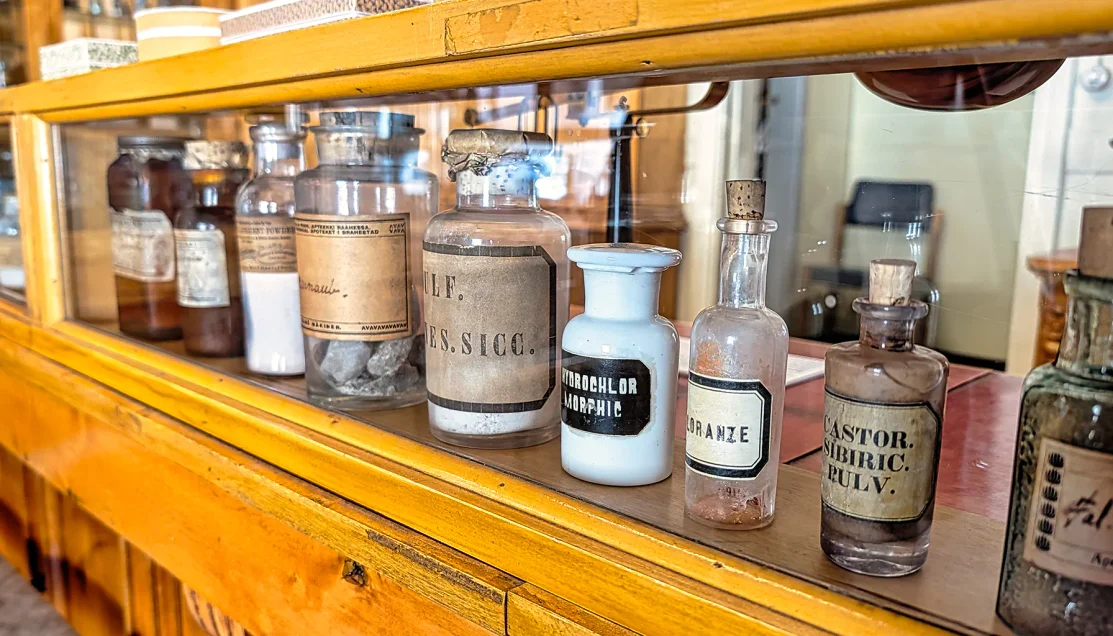
Glass and ceramic containers retain their original labels, and some of the pharmacy’s old jars still contain medicines.
The explanation also drew attention to a large mechanical cash register that had remained with the pharmacy. We were told that it had been manufactured in Dayton, Ohio, purchased through a supplier in Helsinki in the late 1920s, and was believed to remain operational. That unexpected Ohio connection made the object stand out among the older Finnish pharmacy furnishings.
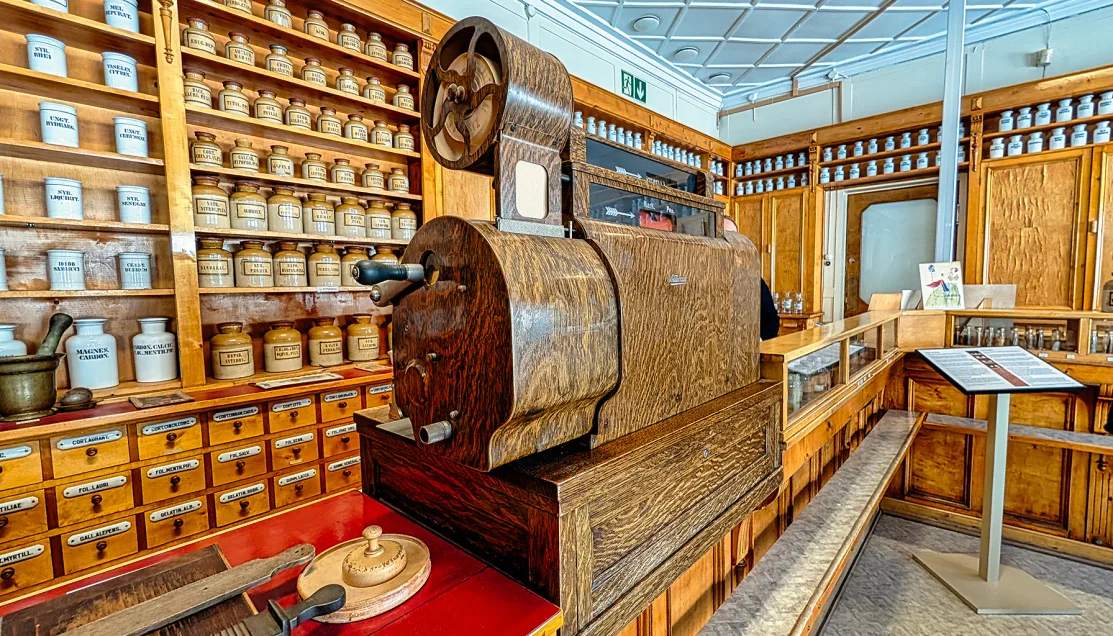
The American-made register was purchased through a Helsinki supplier in the late 1920s and reportedly remained in use for decades.
After the brief interior visit, we returned to the street and continued through Old Raahe toward the town’s principal square and church.
③ Holy Trinity Church
⚲ Raahe, Finland
⧗ ~10 minutes
The route brought us through Pekkatori, the formal square created as part of the town plan drawn up after the 1810 fire. It remains one of Finland’s best-preserved wooden market squares and forms the centerpiece of the rebuilt town plan.
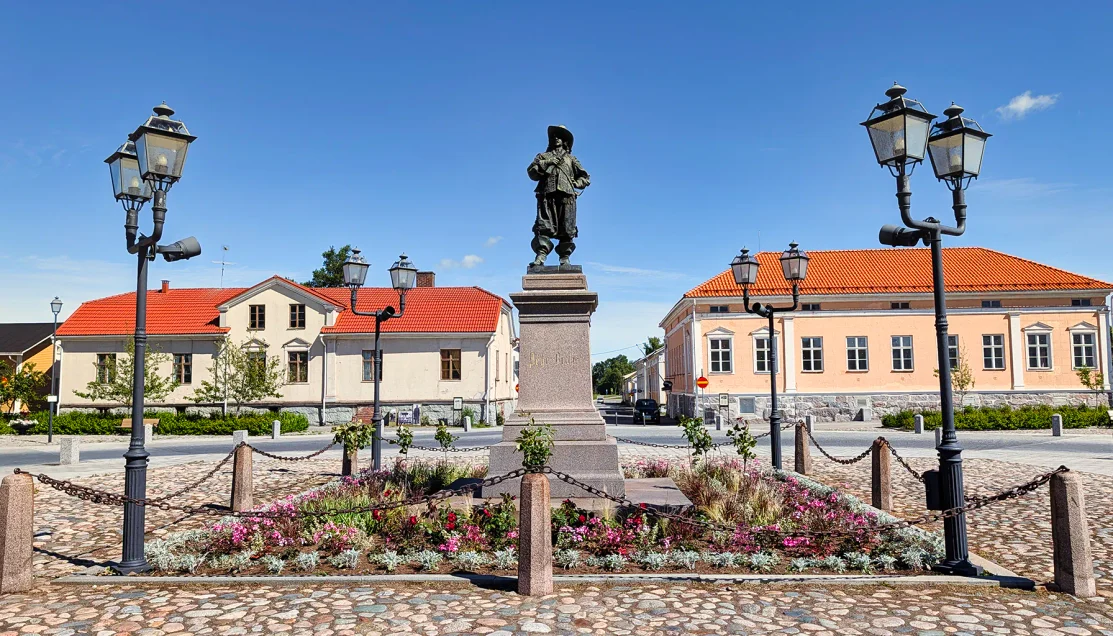
The formal market square was laid out as part of Raahe’s rebuilding after the devastating town fire of 1810.
From the square, the granite tower of Holy Trinity Church rose above the surrounding wooden buildings. The present church replaced Raahe’s earlier wooden church, which burned in 1908. Designed by architect Josef Stenbäck and completed in 1912, the new church was built largely from granite quarried from islands off Raahe, with stone chosen to make the replacement more resistant to fire. Its 52-meter tower became a prominent landmark above the low wooden town.
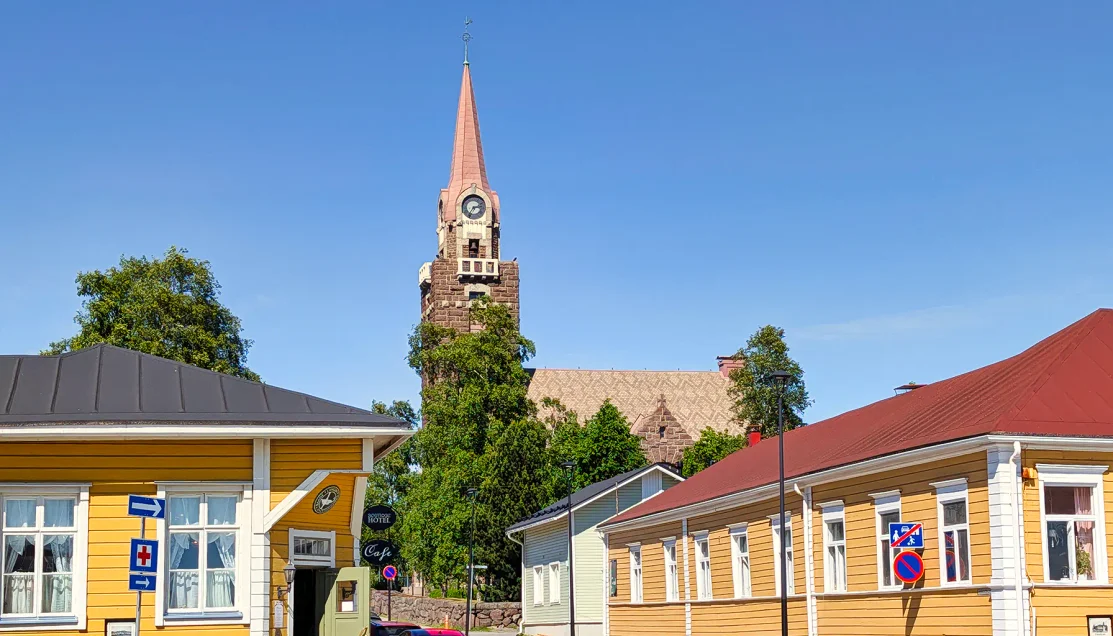
The 52-meter granite tower rises above the low wooden buildings of Old Raahe, making the church one of the town’s most prominent landmarks.
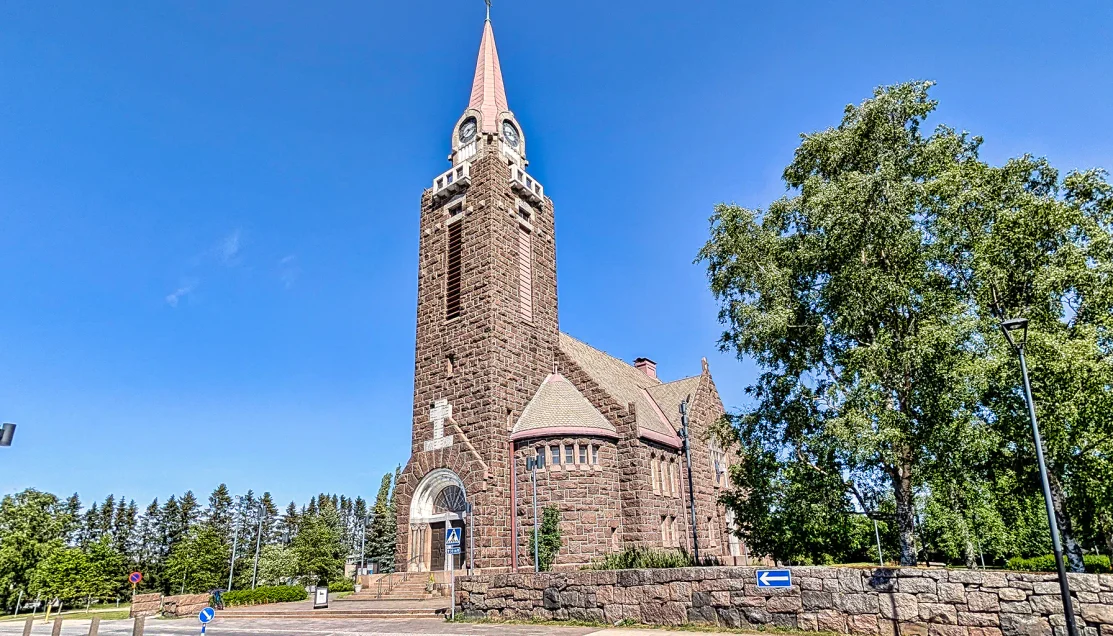
Completed in 1912, the granite church replaced Raahe’s earlier wooden church, which was destroyed by fire in 1908.
We entered the church and moved into the nave, where the pale interior contrasts with the much more colorful church furnishings we would later see at the Packhouse Museum. The altar painting, completed by Eero Järnefelt in 1926, depicts Christ calming the storm, an especially fitting subject for a church in a town whose prosperity and daily life were long tied to the sea. A pipe organ fills the rear gallery, while carved details, galleries and the vaulted ceiling draw the eye upward.
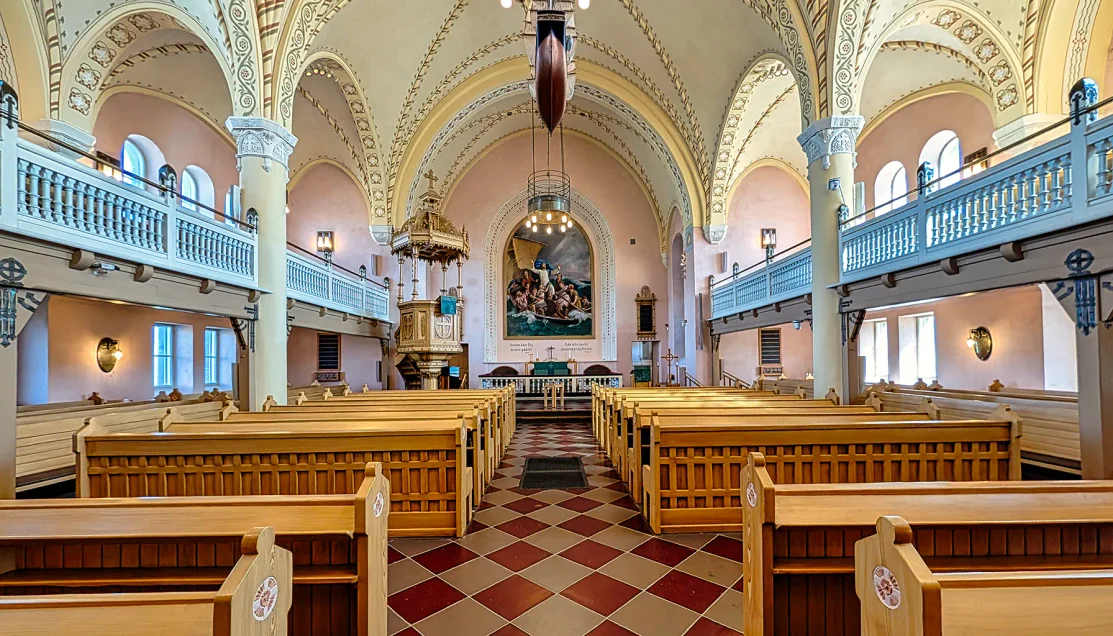
The nave is framed by side galleries and a decorated vaulted ceiling, with Eero Järnefelt’s 1926 altar painting depicting Christ calming the storm at its center.
Our guide explained that many of the painted wooden sculptures from the earlier church had already been removed during renovation when the building caught fire in 1908. Because they were no longer inside the church, they survived.
Leaving Holy Trinity Church, we continued along Kauppakatu, Cortenkatu and Rantakatu through the wooden district before circling back toward the waterfront. The church tower remained visible between the low houses until we reached the Packhouse Museum.
④ Packhouse Museum
⚲ Rantakatu 33, Raahe, Finland
⧗ ~30 minutes
The walk returned us to the waterfront and the blue wooden Packhouse Museum, the building we had first seen on arriving in Raahe. Built in 1848 as the town’s customs house and packhouse, the building also housed a seamen’s house. Raahe Museum, founded in 1862, moved into the building in the 1890s.
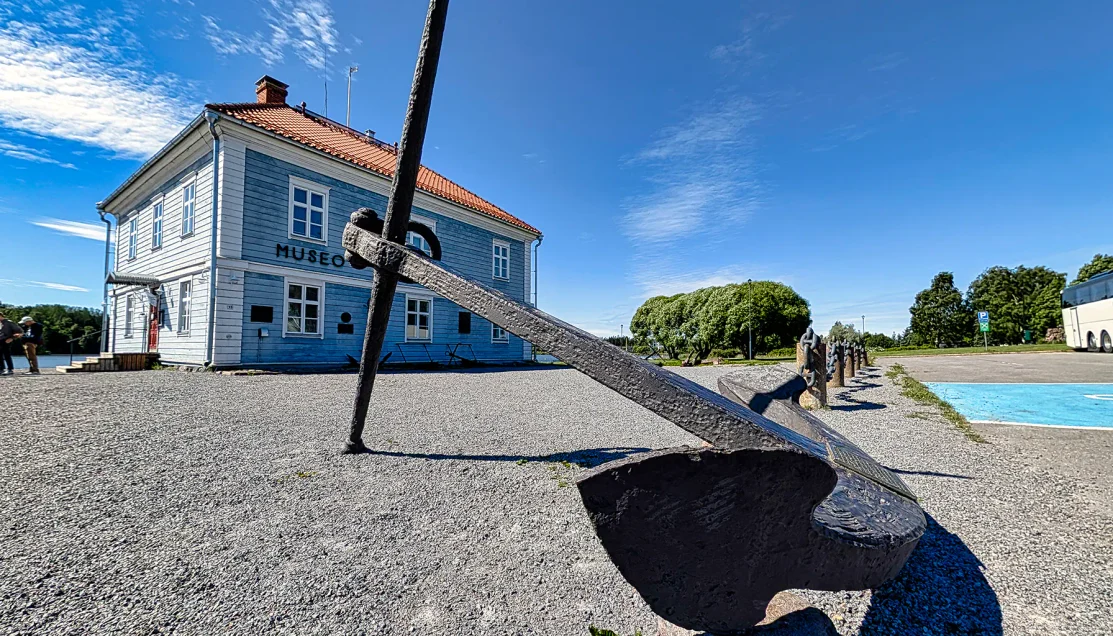
A massive iron anchor outside the waterfront museum reflects the seafaring heritage preserved within its collections.
The museum’s rooms reflect how closely Raahe’s history was tied to the sea. During the 19th century, sailors returned from distant voyages with natural specimens, everyday objects and exotic curiosities, part of a collection that still feels more like an old cabinet of curiosities than a modern chronological museum. Ship models, paintings and navigational equipment fill the maritime displays alongside objects brought home from overseas.
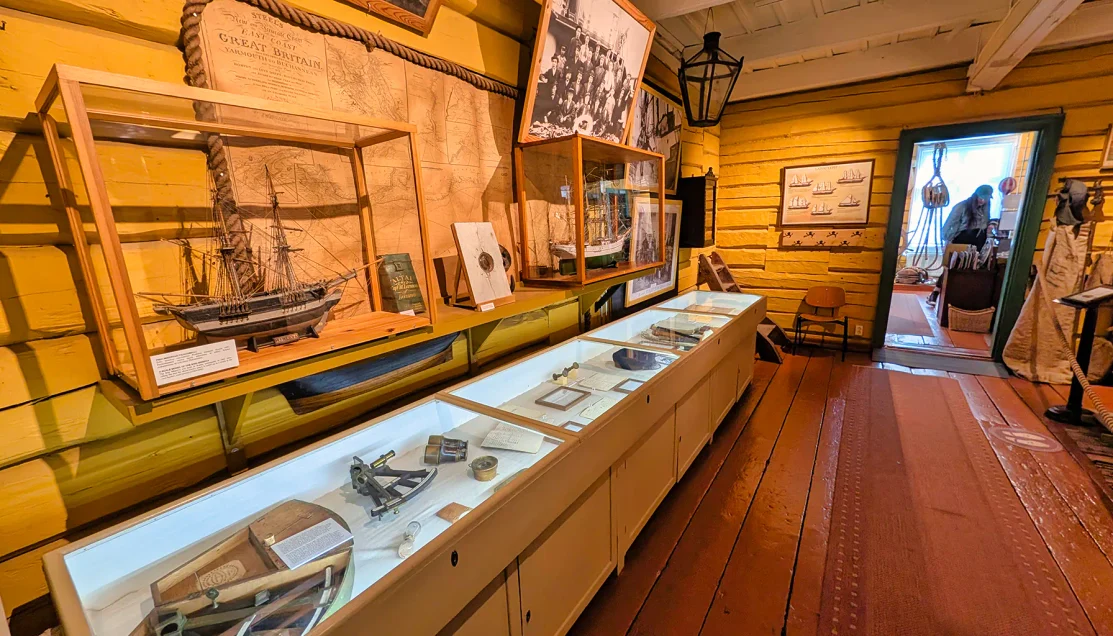
Ship models, navigational instruments, maps and other seafaring artifacts fill the timber-walled rooms of the Packhouse Museum.
The most striking room, however, was not maritime at all. The Church Hall contains an extraordinary collection of surviving wooden sculptures carved by Mikael Balt for Raahe’s old wooden church during the second half of the 17th century. Angels, apostles, evangelists and other brightly painted figures crowd the walls and display cases, their vivid colors and Baroque ornamentation standing in sharp contrast to the restrained interior of Holy Trinity Church we had just visited.
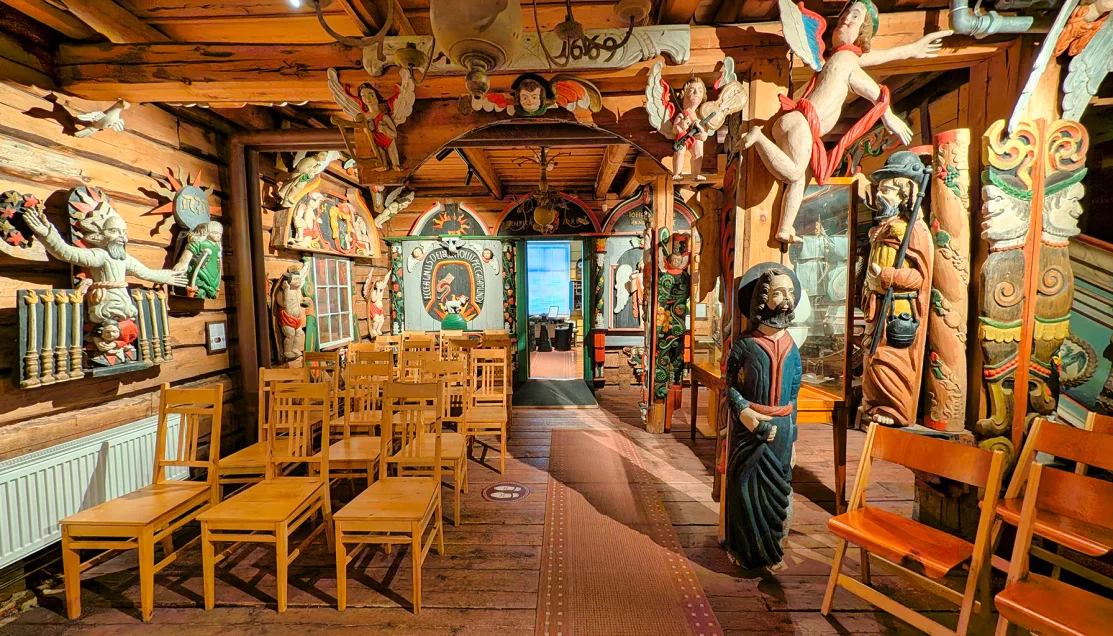
The surviving 17th-century wooden sculptures from Raahe’s former church are preserved together in the Packhouse Museum’s Church Hall.
Their survival was largely accidental. The sculptures had been removed from the church during a 19th-century renovation. When the old church burned in 1908, the stored carvings escaped the destruction. Our guide had introduced that story inside Holy Trinity Church; here we were standing among the objects themselves.
Elsewhere in the museum, models of sailing ships returned the story to Raahe’s maritime past. Seafaring and shipbuilding were central to the town’s economy, and by the 1860s Raahe had become Finland’s largest ship-owning town. Despite a population of only about 2,500, its residents owned some 60 large sailing ships.
After about half an hour inside, we boarded the coach for the short transfer back toward the center of Old Raahe. The bus let us out in front of Holy Trinity Church, and from there we walked only a few paces downhill to the Trade House of Lang for the scheduled refreshment stop.
⑤ Trade House of Lang
⚲ Kirkkokatu 19, Raahe, Finland
⧗ ~40 minutes
We had passed the Trade House of Lang earlier during the walking tour, when our guide pointed out the yellow and blue buildings associated with one of Raahe’s historic merchant families. This time we went inside for coffee and a pastry.
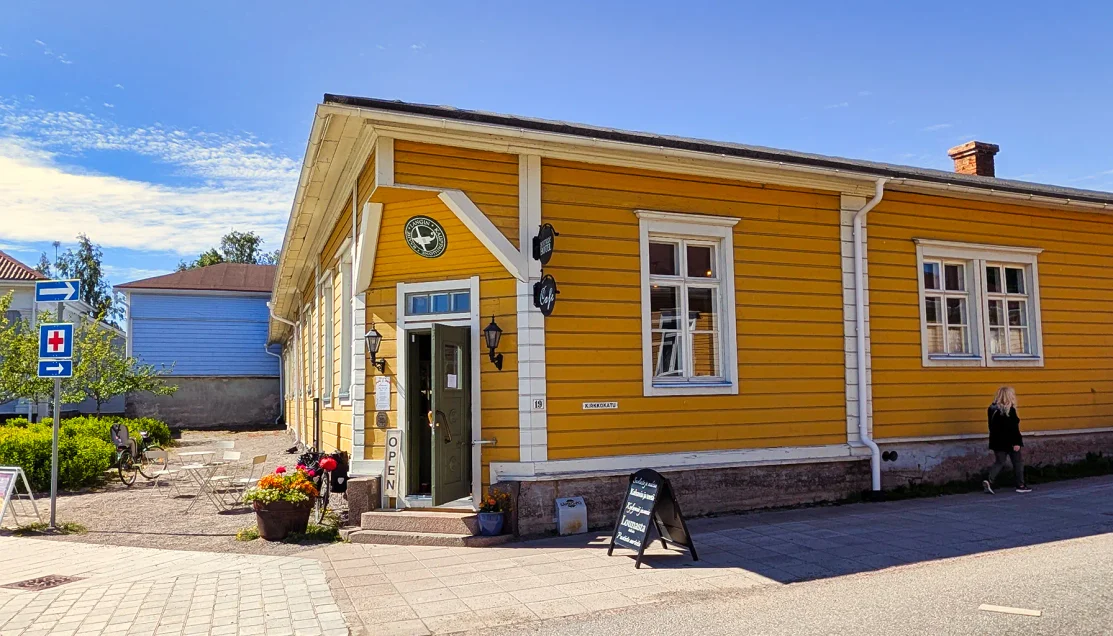
The yellow wooden building at Kirkkokatu 19 forms part of the historic Trade House of Lang complex in Old Raahe.
We were served coffee or tea with a raspberry-topped cake. After several hours of walking and museum visits, the stop provided a longer seated break before the final museum of the afternoon.
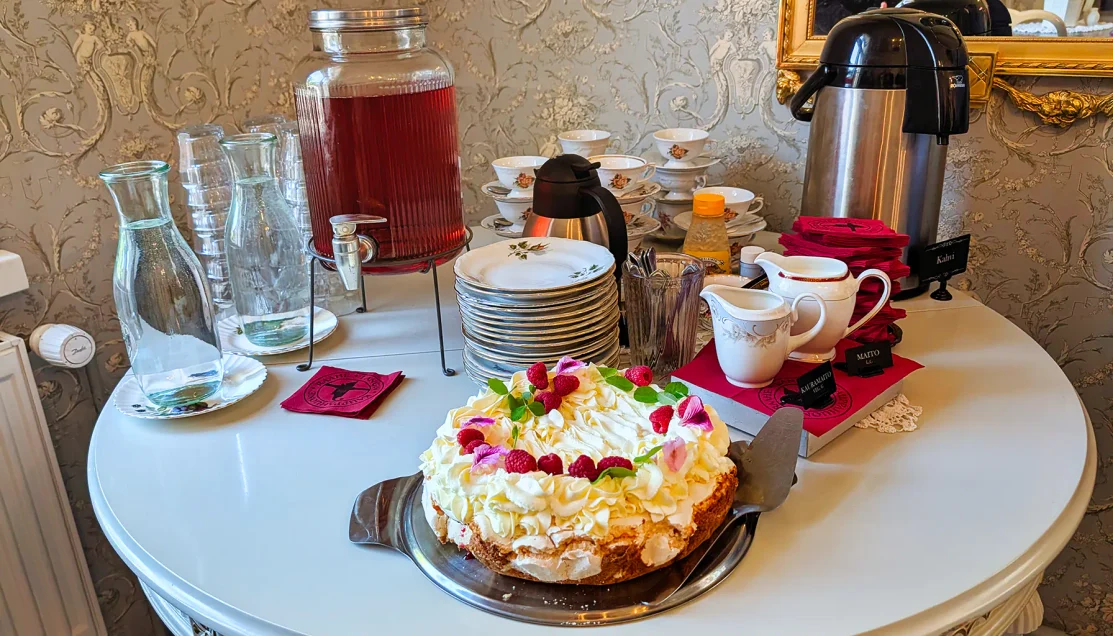
Coffee or tea was served with raspberry-topped cake during the tour’s seated refreshment break.
Our visit also coincided with the opening of the Magic of Light exhibition in the Stone Warehouse in the Trade House courtyard. Himmeli artist Tuija Rajamäki was present to explain the Finnish tradition of making himmeli, geometric hanging ornaments traditionally constructed from straw.
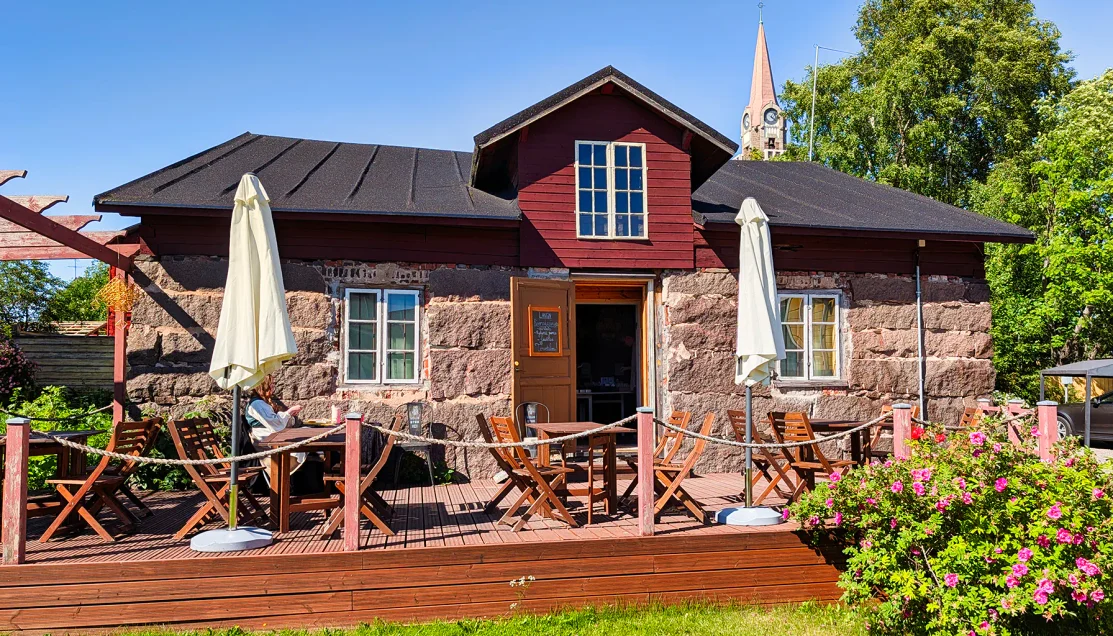
The historic stone-and-timber warehouse in the Trade House courtyard housed the Magic of Light himmeli exhibition during our visit.
The exhibition filled the old warehouse with intricate suspended forms made from rye straw and marram grass. Traditionally associated with Christmas, himmeli also carried older associations with the harvest: it was believed that the larger the ornament, the better the coming grain harvest would be. The Finnish name derives from the Swedish himmel, meaning sky or heaven.
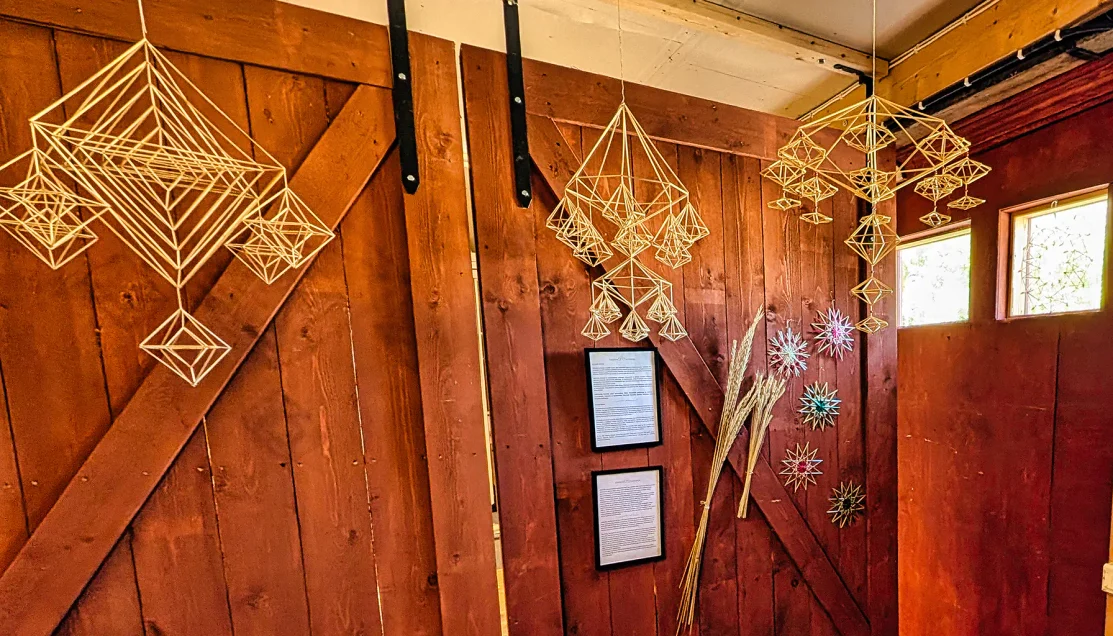
Geometric himmeli made from natural grasses hang inside the Stone Warehouse, illustrating the traditional Finnish craft featured in Tuija Rajamäki’s exhibition.
Tables had been set out with the natural materials used to construct the ornaments, and the opening-day program included an opportunity to make a small cube from beachgrass. What had initially been scheduled as a coffee stop therefore also provided a look at a traditional Finnish craft being interpreted inside one of the Trade House’s historic outbuildings.
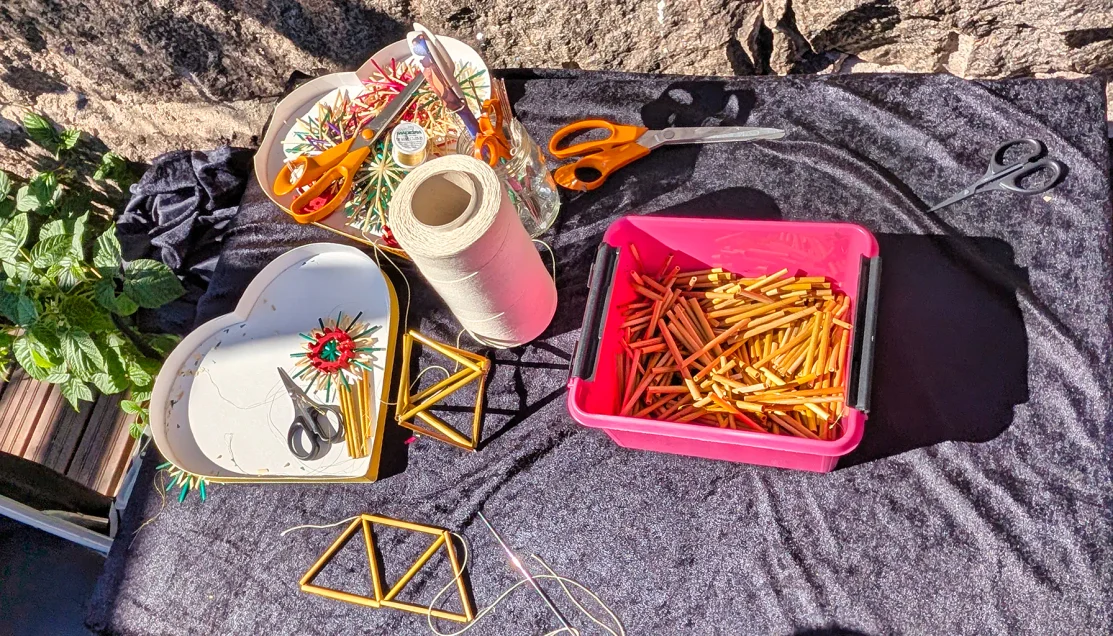
Cut lengths of natural grass, thread, scissors and partially assembled geometric forms show the materials and process used to construct a himmeli ornament.
After leaving the Trade House, we boarded the coach for the short transfer to the final museum.
⑥ Crown Granary Museum
⚲ Merikatu 10, Raahe, Finland
⧗ ~50 minutes
The Crown Granary Museum occupies a large brick building completed in 1852 as a state grain store. Grain collected through taxation was once held here, and the building continued in that role until 1910. It subsequently served as a military storage facility before eventually being converted for museum use. The Crown Granary opened to the public in 2012 as the newest location within Raahe Museum.
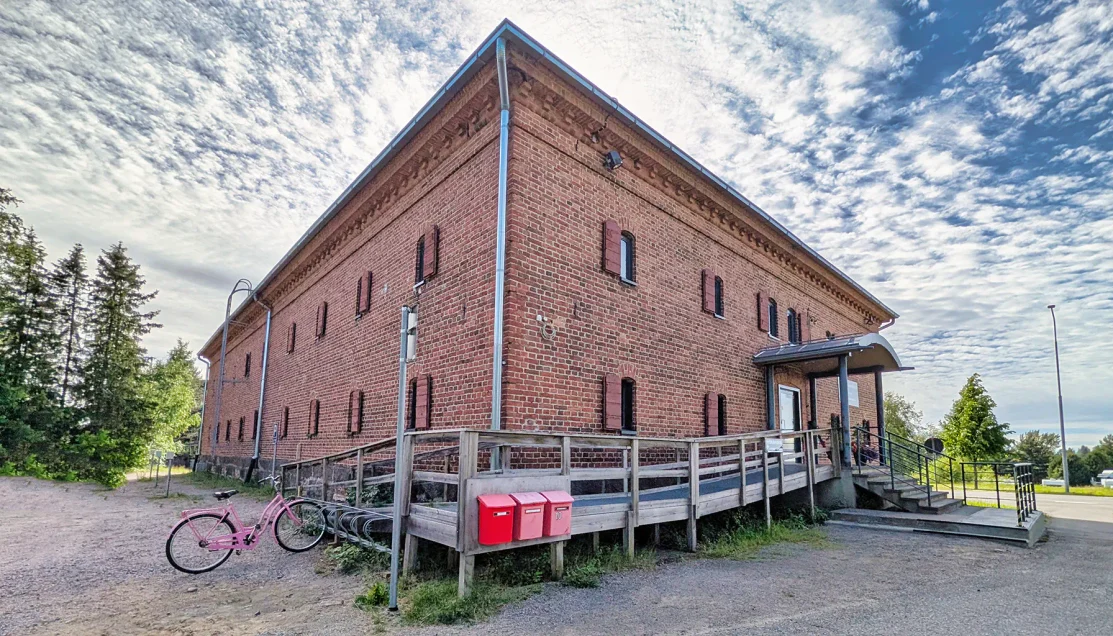
The substantial brick granary was completed in 1852 as a state storehouse for grain collected through taxation.
A museum curator met us inside and explained that, unlike the more specialized Packhouse, the Crown Granary traces Raahe’s story across a much broader sweep of history, from prehistory through the development of the town, wars, maritime commerce and eventually industrialization.
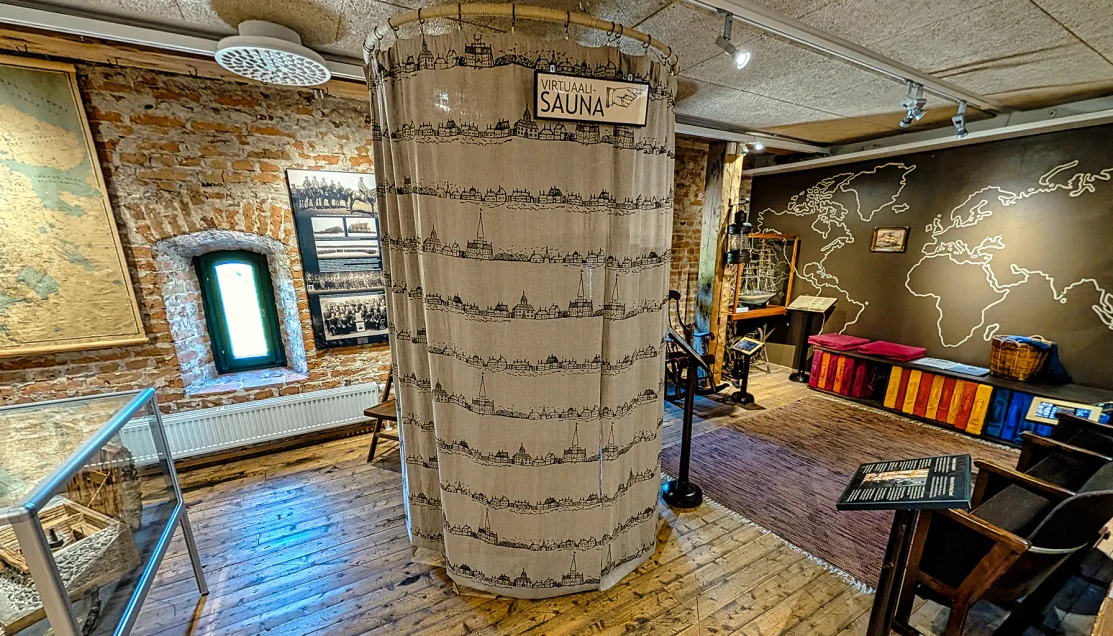
Exposed brick walls from the former grain store provide the setting for the museum’s modern multimedia and interactive exhibits.
One of the displays that held my attention longest was a small two-seat viewing area showing old film footage from Raahe. Sitting there watching people from the area going about their lives decades earlier gave the museum’s history a much more immediate quality. Rather than encountering the past only through objects in cases, for a few minutes we were watching the people themselves moving through the town and landscape we had spent the afternoon exploring.
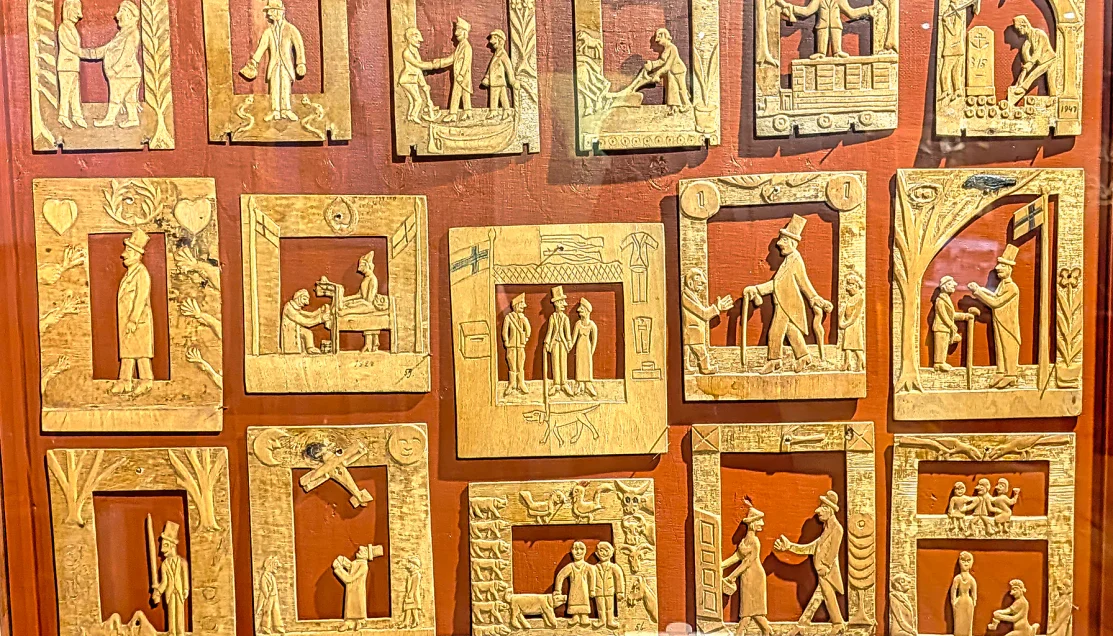
Raahe folk artist Samuli Sarkkila carved scenes of local people, occupations and everyday life, creating a distinctive wooden chronicle of the town and its inhabitants.
There were also deliberately hands-on displays. Visitors could operate pulleys, handle reproductions, try the weight of an old diving helmet and interact with exhibits rather than simply viewing everything through glass. That made this museum noticeably different from the Packhouse.
The Old Gentleman
Standing upright inside a glass case was the Old Gentleman of Raahe, an extraordinary 18th-century cowskin diving suit with a rounded hood, reinforced seams and openings for the diver’s hands.
It is the world’s oldest surviving diving suit and the best-known object in the Raahe Museum collection.
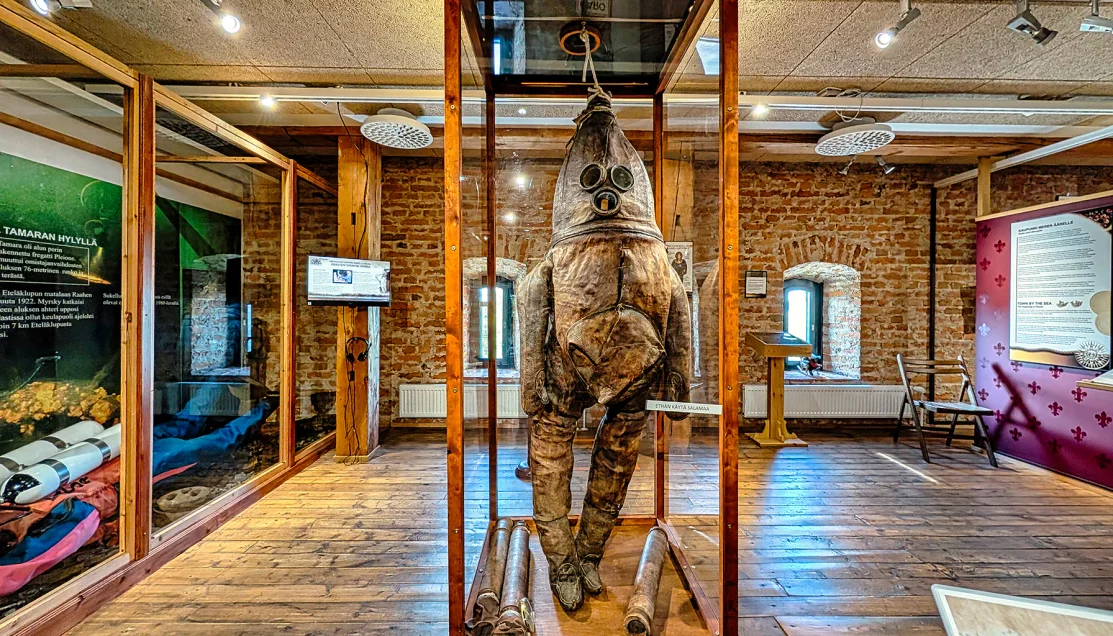
The 18th-century leather diving suit is considered the world’s oldest surviving diving suit and the best-known object in the Raahe Museum collection.
Its appearance is striking precisely because it bears so little resemblance to modern diving equipment. The leather body, broad shoulders and hood make it look almost improvised, yet it represents an early attempt to allow a person to work beneath the surface while remaining enclosed from the surrounding water.
We continued through the remaining exhibits before regrouping outside. From there, we boarded the coach for the drive back to Oulu.
Return to Port
The return drive retraced the route north from Raahe toward Oulu, bringing the excursion back to the pier after roughly five and a half hours away from the ship. There were no further sightseeing stops, and the coach continued directly to the port, where we rejoined the ship.
☑ Who Is This Tour Best For?
- Travelers interested in historic towns: Much of the excursion is spent on foot in Old Raahe, where the preserved wooden streets, courtyards, square and church form the core of the experience.
- Maritime-history travelers: Raahe’s seafaring past runs through the Packhouse Museum, historic merchant district and Crown Granary Museum, culminating with the Old Gentleman diving suit.
- Travelers who value guided interpretation: The Old Pharmacy, Holy Trinity Church and Crown Granary Museum included separate narration that added context to the buildings and collections.
- Travelers comfortable with sustained walking and standing: Oceania lists approximately three hours of walking, and the excursion combines historic streets with repeated museum and building visits.
- Travelers who enjoy smaller local museums and cultural details: The pharmacy collection, Mikael Balt’s historic church sculptures and the historic Trade House setting provide a more locally focused experience than a panoramic sightseeing tour.
⊞ Tour Summary
- Tour Name: Explore Raahe
- Port: Oulu, Finland
- Total Duration: Approximately 5½ hours
- Primary Focus: Old Raahe, maritime history, historic architecture and local museums
- Main Stops: Old Raahe, Old Pharmacy, Holy Trinity Church, Packhouse Museum, Trade House of Lang and Crown Granary Museum
- Refreshment Included: Coffee or tea with pastry at the Trade House of Lang
▣ Activity Summary
- Walking: Approximately three hours according to Oceania, concentrated primarily in Old Raahe and during the museum and church visits.
- Terrain: Historic town streets and indoor museum spaces, with paved and cobbled surfaces and repeated entry into historic buildings.
- Accessibility: The Packhouse Museum is not wheelchair accessible. Oceania cautions travelers with mobility concerns to evaluate their personal ability and stamina.
- Pacing: Guided walking and standing are broken up by short coach transfers and a seated refreshment stop at the Trade House of Lang.
- Weather Exposure: A meaningful portion of the excursion takes place outdoors while walking through Old Raahe.

Related Northern Europe Travel: Explore more Northern European cruise ports and shore excursions in our complete regional guide.
→ Northern Europe Cruises & Shore Excursions Guide
© OceansAfoot