✘ Luleå, Sweden • June 25, 2026
⌖ From Modern Luleå to the Old Church Town
Tour Route: Luleå → Gammelstad Church Town → Hägnan Open-Air Museum → Gammelstad Church Town → Luleå
Our excursion began with a panoramic drive through Luleå, giving us an introduction to the modern city before continuing to Gammelstad. Near the harbor, our guide pointed out the large icebreakers that keep shipping moving through the frozen winter months. From there, the coach continued through a city shaped by the railway, iron-ore trade and steel industry.
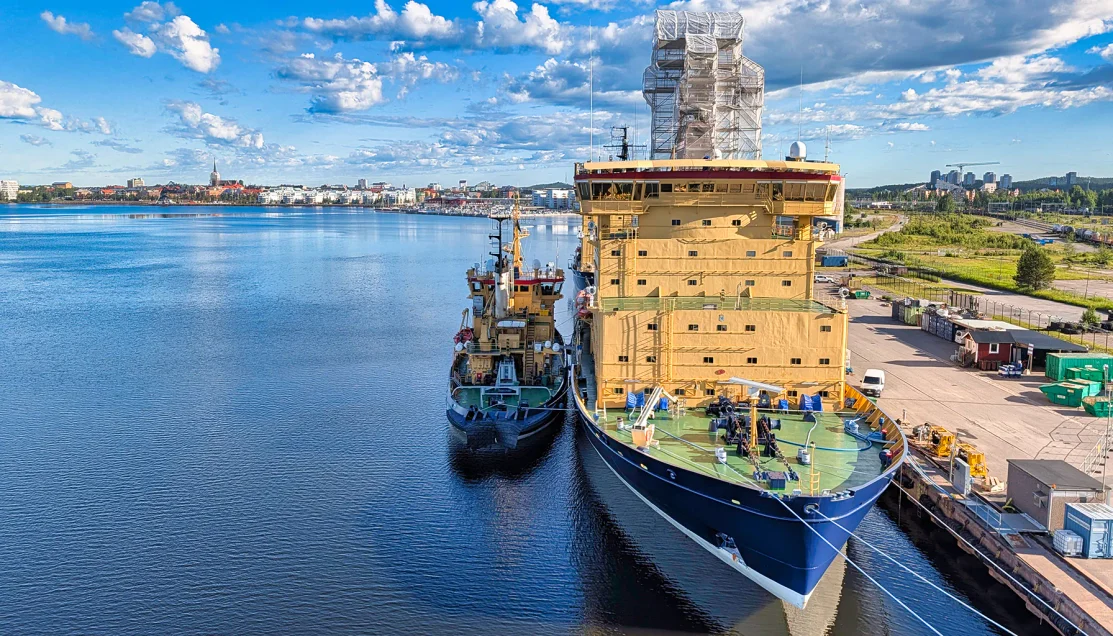
The Swedish icebreaker Atle sits at its Luleå berth, where the head-on view reveals the broad hull designed for working through the northern Baltic’s winter ice.
The route carried us past the South Harbour and through the city center, with the cathedral district, County Governor’s residence, North Harbour and Kulturens Hus among the landmarks along the way. Commentary ranged from Luleå’s industrial development to life in the far north, including the surrounding archipelago and the ice roads that form across parts of it during winter.
As we left the modern city behind, our guide shifted his commentary to Gammelstad and the earlier history of Luleå. After roughly half an hour on the coach, the stone tower and steep roof of Nederluleå Church appeared through the window. We left the bus near the Visitor Center and continued on foot into the church town.
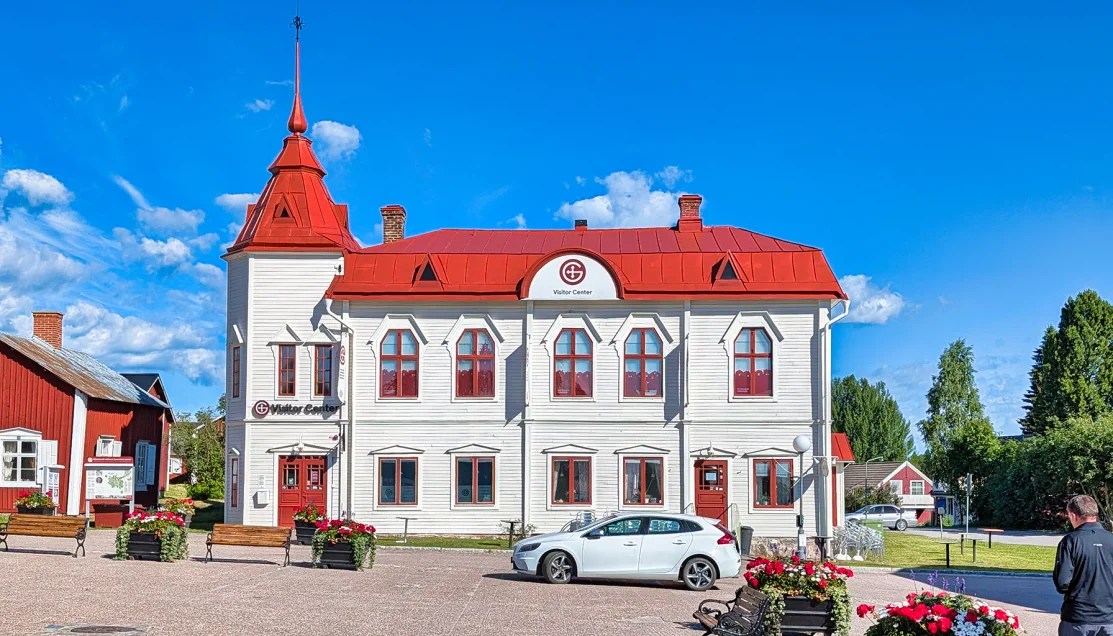
The low red buildings around the Visitor Center offered our first glimpse of the traditional wooden architecture that characterizes the church town.
① Gammelstad Church Town
⚲ Gammelstad Church Town, Luleå, Sweden
⧗ ~1 hour 10 minutes
From the Visitor Center, we followed our guide toward Nederluleå Church, the large stone church at the center of the settlement. He had been born in Gammelstad, and as we gathered outside the church he began explaining why hundreds of small wooden cottages had developed around it.
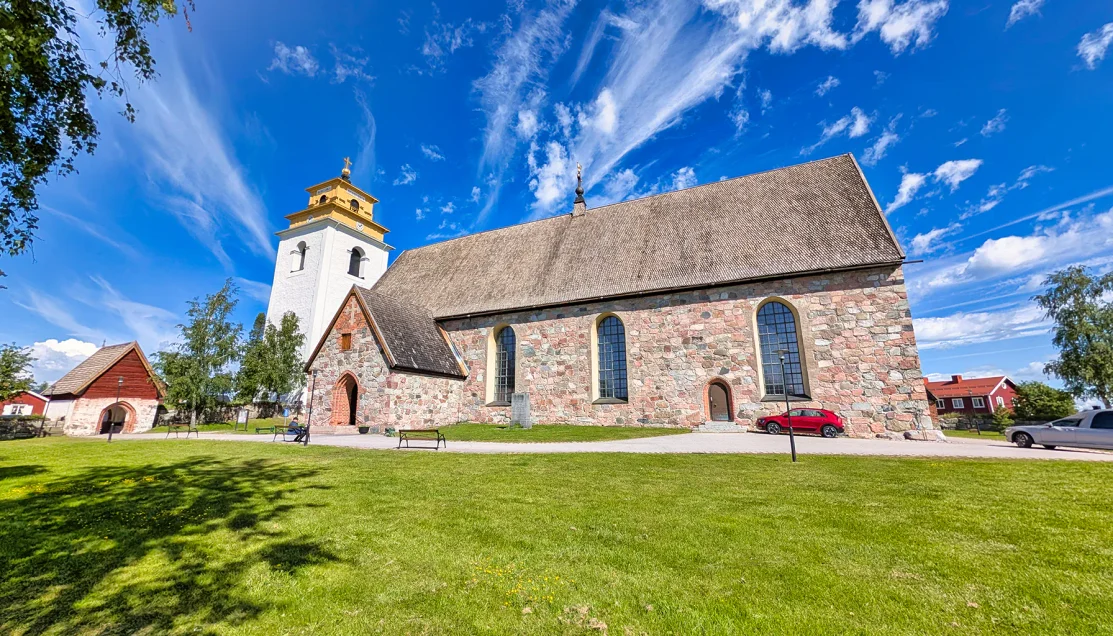
The late-medieval stone church stands at the center of Gammelstad Church Town, surrounded by the settlement that developed to accommodate parishioners traveling long distances for services and other gatherings.
As he described the enormous parish the church once served, the reason for the cottages began to make sense. Some parishioners faced journeys of eight to ten hours to reach Gammelstad, where families gathered not only for church services but also for markets, court proceedings and parish meetings. For those traveling the greatest distances, returning home the same day was not always practical. Beginning in the 16th century, the church cottages gave them somewhere to stay.
We left the church behind for the moment and followed the guide into the surrounding lanes. Once among the 404 surviving church cottages, divided into about 552 individual rooms, their density became much more apparent. The lanes narrowed into grassy passages barely separating one red timber building from the next.
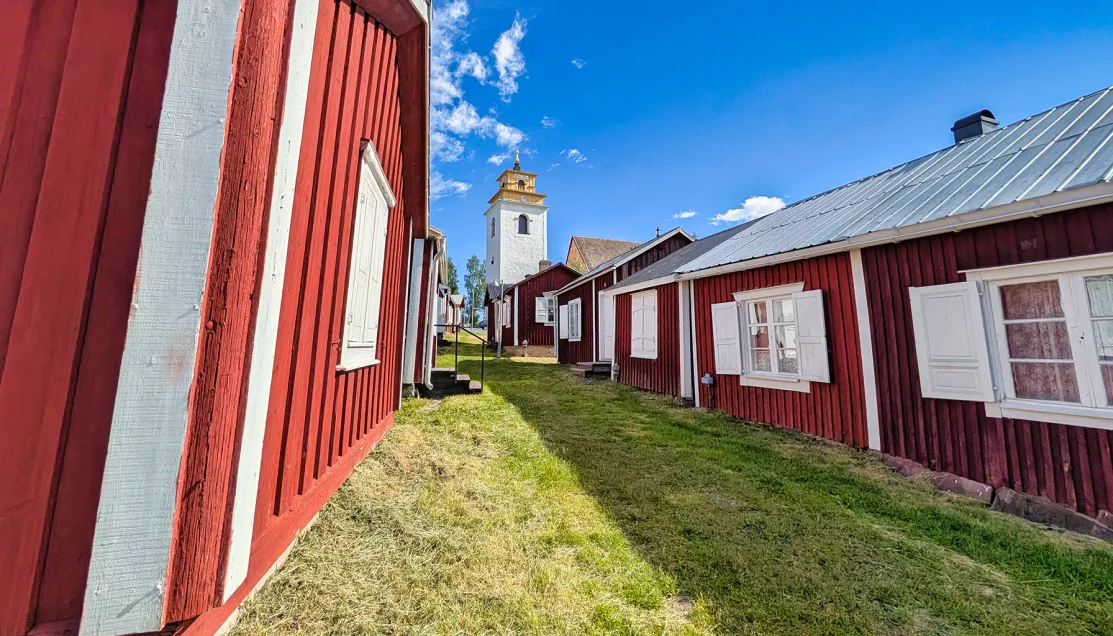
With Nederluleå Church still visible beyond the cottages, this remarkably intact settlement preserves what UNESCO considers the best-preserved example of the church-town tradition once found across northern Scandinavia.
Our guide then took us inside one of the preserved church cottages, where the compact interior made the arrangement much easier to understand. An enclosed bed occupied one side of the room, while a small stove, table, chairs and storage furniture filled much of the remaining space. As we looked around, he explained that cottages could be shared by two families and pointed out how basic the accommodations remained. Electricity has since brought some modern conveniences, but there is still no running water or toilets.
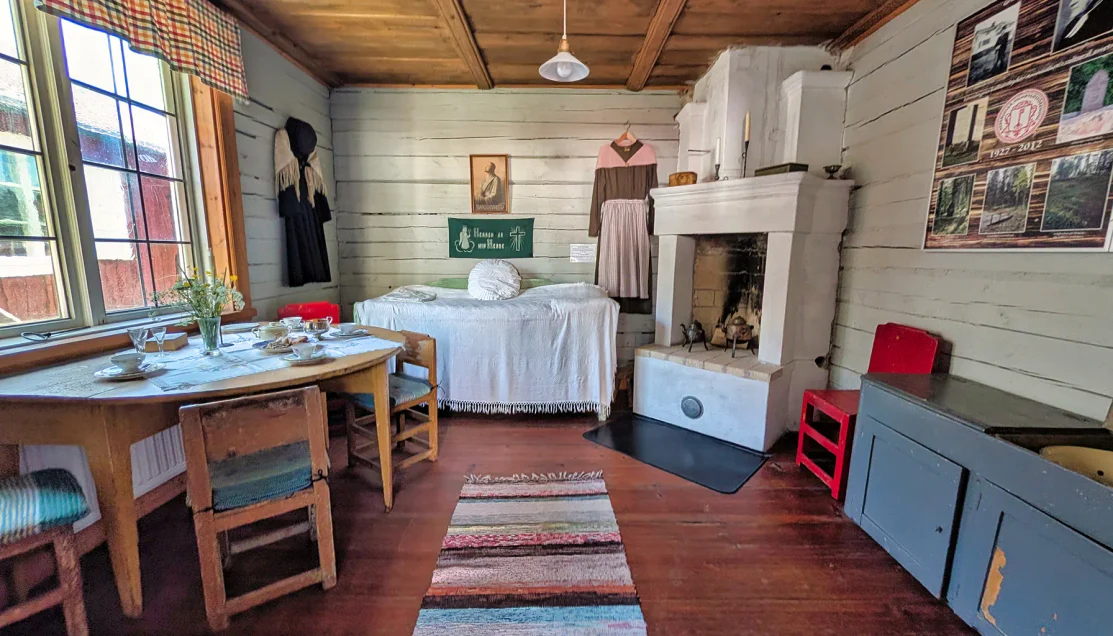
The compact interior combines sleeping, dining, storage and heating within a single room, showing the simple living arrangements used by families staying in the church town.
The cottages were not simply places to sleep. Church weekends also created one of the few regular opportunities for young people scattered across the large parish to meet. Our guide described an old courtship custom in which young women gathered inside the cottages while young men approached the windows and knocked to ask if they could come in. If welcomed, they could join them inside for coffee and conversation, giving young people an opportunity to socialize and potentially meet a future partner.
After leaving the cottage, we continued through the lanes until reaching the Captain’s House, where coffee, tea and small squares of cake topped with whipped cream had been set out on long tables for an optional break.
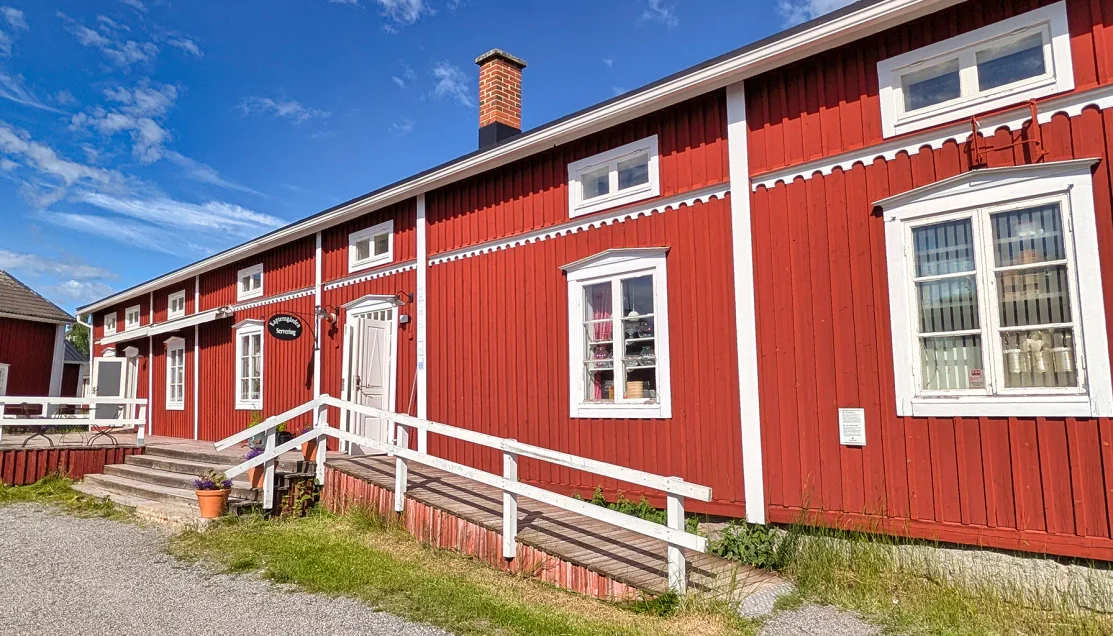
The unusually long red-painted building is actually three houses joined together, reflecting a very different scale from the compact church cottages nearby.
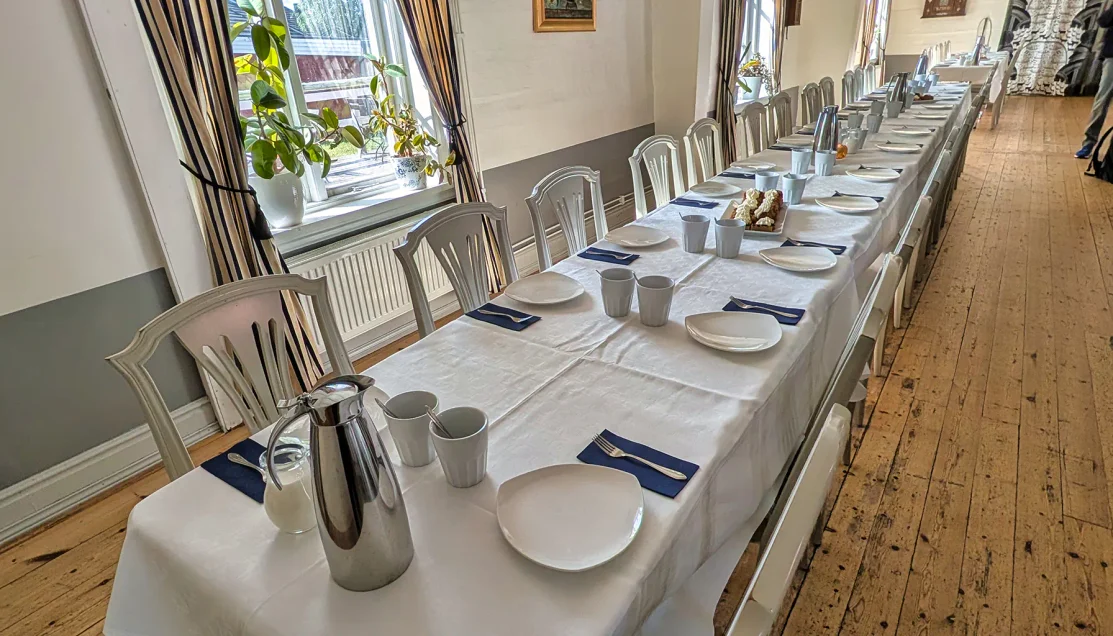
The simple timber interior provided a traditional setting for the optional refreshment stop.
The Captain’s House also revealed another side of Gammelstad. Unlike the small church cottages used by visiting parishioners, it stood within the town district east of the church, where larger permanent residences developed. Although the building cannot be dated precisely, the property has its origins in the homes of Gammelstad’s 17th-century burghers.
After the break, we were given some free time to explore independently, and the lanes revealed more of this side of Gammelstad. Among the small red church cottages were several much larger properties, including the Mayor’s House.
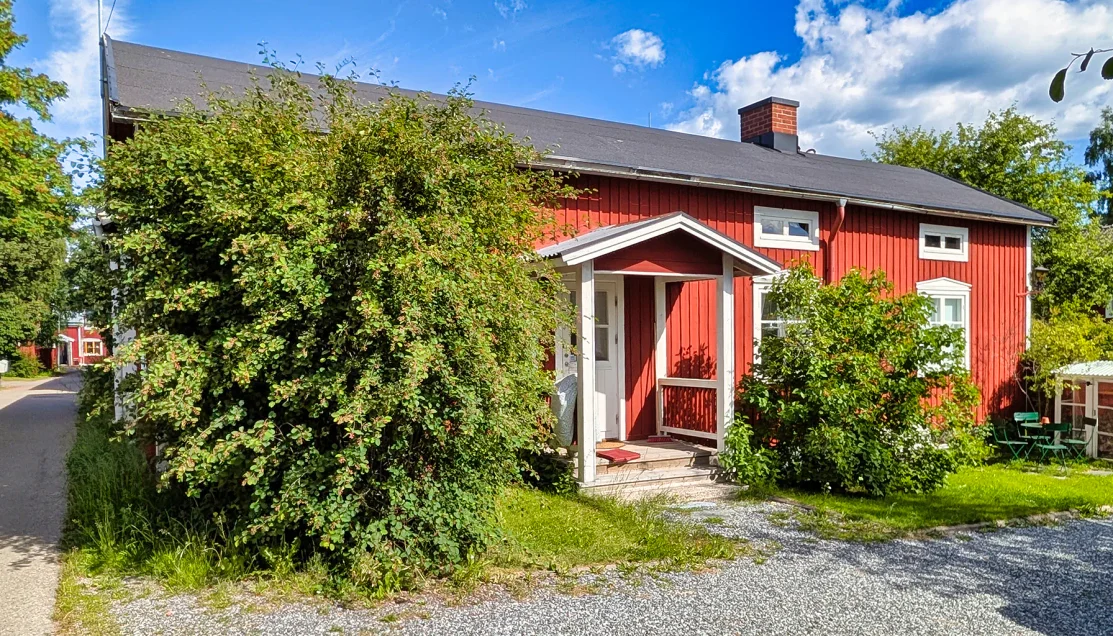
The larger residence and surrounding property contrast with the compact church cottages packed along the nearby lanes.
An interpretive sign identified its main building as one of Gammelstad’s oldest, dating to no later than the early 1700s. Unlike most houses in the church town, which stood directly along the road, this residence was set farther back within the property. The name came from two former owners who served as mayors of Luleå around 1800, but the property also functioned as a working farm, with horses, cows and sheep.
A short distance away stood the Old Guest House, built in the late 18th century and extensively remodeled in the mid-1800s. Its yellow, oil-painted wooden exterior immediately distinguished it from the smaller red-painted buildings around it. The more expensive finish reflected the higher status of the prosperous sawmill owner who once lived here. Over the years, the building served several roles within the community, including a doctor’s surgery, junior school training college, tax inspector’s office and inn. Today it is privately owned.
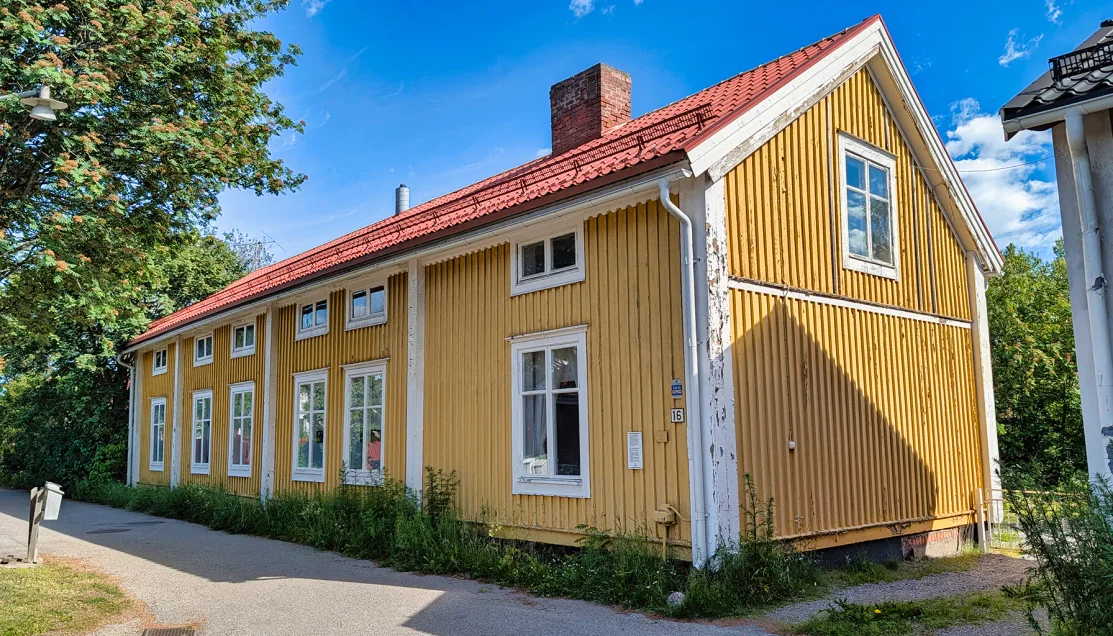
Its yellow-painted facade makes the larger residence immediately recognizable among Gammelstad’s predominantly red wooden buildings.
Further along, we came across several of the surviving church stables, adding another piece to the story our guide had begun outside the church. Parishioners making those long journeys to Gammelstad needed somewhere for their horses as well as somewhere for themselves. An 1817 map recorded about 500 church cottages and 350 stables. Once buses began providing a more practical way of reaching Gammelstad during the 20th century, the stables steadily disappeared. Only six remain today.
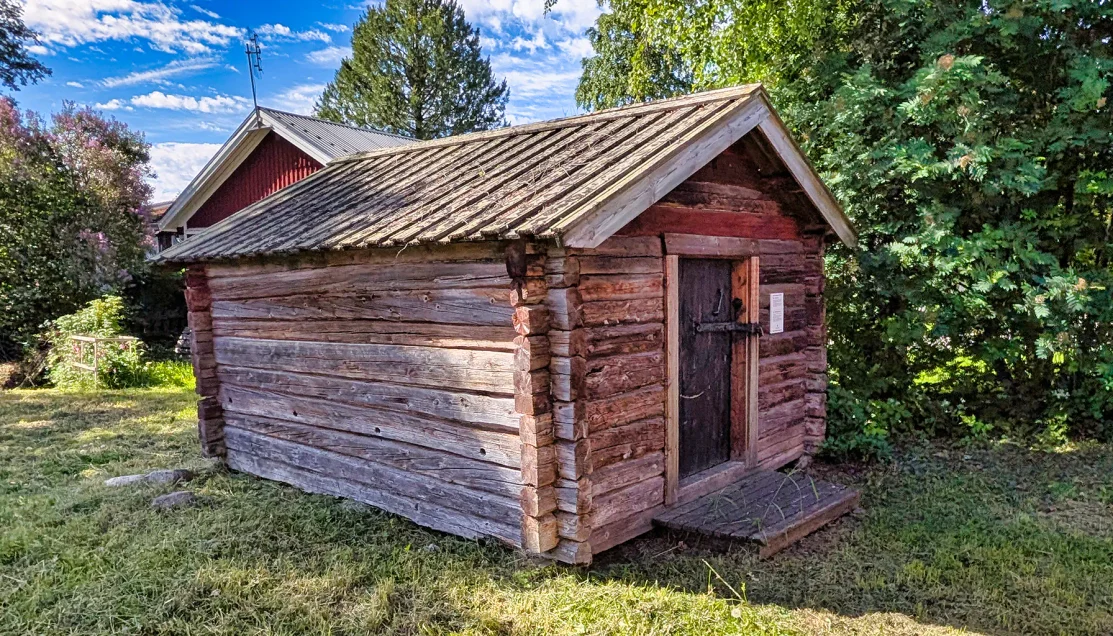
One of only six church stables remaining in Gammelstad, these simple log buildings once sheltered the horses of parishioners staying in the church cottages.
Near the outer edge of the settlement, an interpretive panel marked the site of Gammelstad’s oldest harbor. Looking around, it was difficult to imagine water reaching this far inland, but during the 14th century the shoreline extended to this area. Post-glacial land uplift gradually changed the landscape, forcing the usable shoreline progressively eastward as the land continued to rise.
That changing shoreline ultimately helps explain the separation between Gammelstad and present-day Luleå. The town had been formally established around the church in 1621, but its harbor continued to grow shallower. In 1649, Luleå relocated about ten kilometers closer to the coast, while the church and surrounding settlement remained behind.
From the former waterfront, our independent walk continued directly into Hägnan Open-Air Museum. The transition was historically appropriate as well as geographic: Hägnan now occupies part of the area where Gammelstad’s harbor once stood.
② Hägnan Open-Air Museum
⚲ Hägnan Open-Air Museum, Gammelstad, Luleå, Sweden
⧗ ~30 minutes
Hägnan was not a scheduled stop on the Oceania excursion, but its location beside Gammelstad gave us an opportunity to use part of our free time to explore the museum on our own.
As we followed the path into Hägnan, the tightly packed cottages and narrow passages of Gammelstad gave way to open grassy grounds, split-rail fences and farm buildings spaced around larger yards. Hägnan brings together historic buildings from across the region to illustrate rural life in Norrbotten’s coastal countryside from the 1700s through the 1900s.
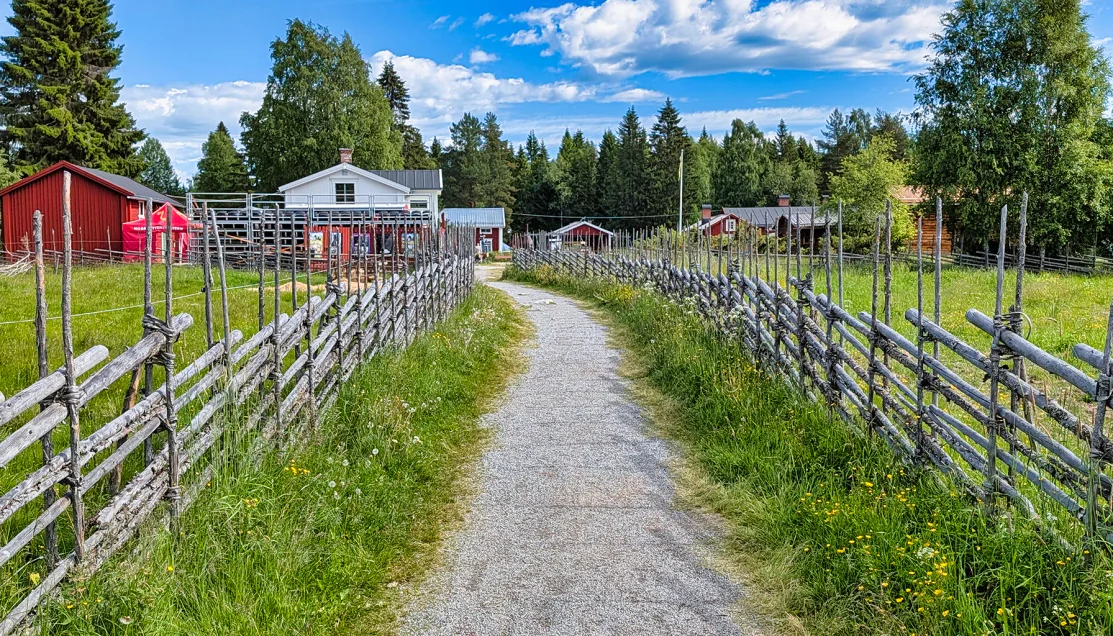
Hägnan preserves historic buildings from across the region within an open-air setting representing rural life in Norrbotten.
Following the fenced path into the museum, we emerged into a small clearing surrounded by historic buildings and objects. A green Rikstelefon telephone kiosk and an early fuel pump stood near Hägnans Lanthandel, the old-fashioned country store. On the opposite side of the clearing was a traditional single cottage, one of the building types used to illustrate everyday rural life in the region.
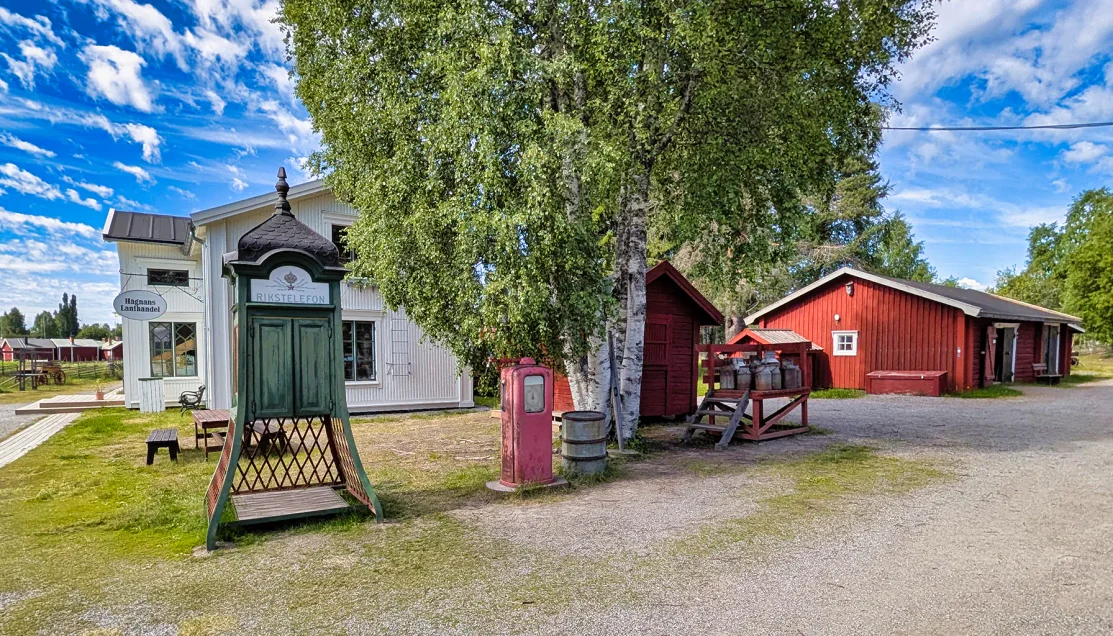
Hägnans Lanthandel, a green Rikstelefon kiosk and an early fuel pump stood together near the entrance to the open-air museum.
Continuing along the path brought us past Alviksgården, now home to Café Fägnan. Its long red facade, blue doors and enclosed outdoor seating area stood beside the open central grounds, where the museum began to feel less like a collection of individual buildings and more like a reconstructed rural settlement.

The open central grounds placed Café Fägnan and the surrounding historic buildings within the broader museum landscape.
Ahead stood the imposing two-story gateway shed from Niemisel, with the lower loft storehouse nearby.
The gateway shed was particularly distinctive. Its central passage once formed the entrance into an enclosed farmyard, while other parts of the building were used for storage. During summer, the people of the farm could also use the structure as sleeping quarters when conditions inside the main farmhouse became crowded. Buildings of this type became increasingly uncommon after enclosed farmyards fell out of fashion during the 18th century.
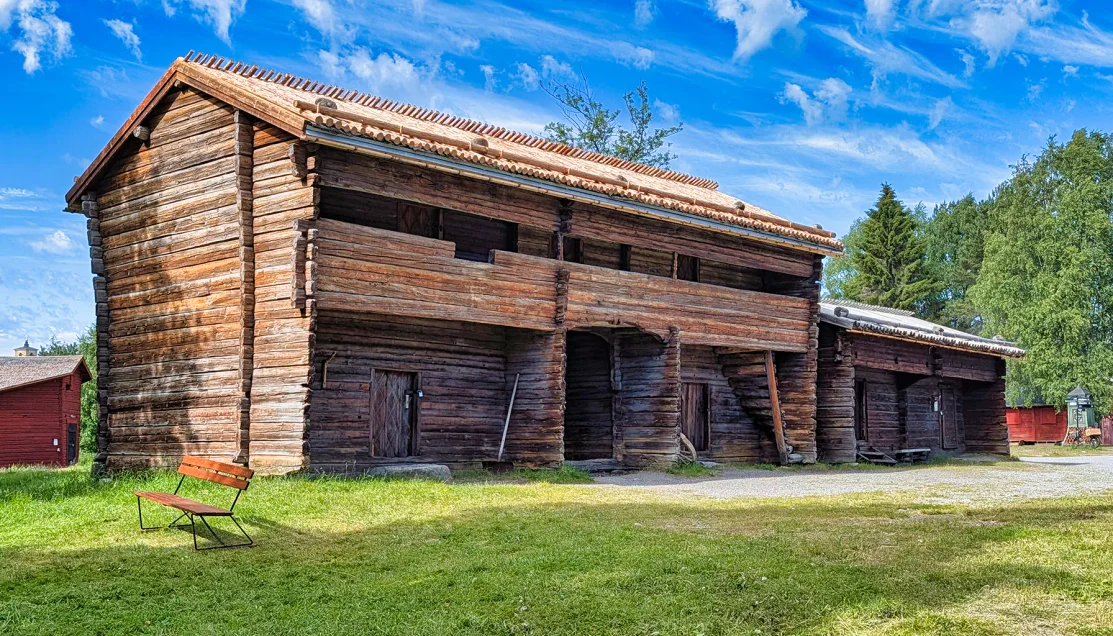
Once used as the entrance to an enclosed farmyard, this two-story log gateway shed represents a building type now rarely preserved in Norrbotten.
Continuing past the gateway shed brought us to the nearby loft storehouse. We walked through its broad central passage and emerged into the farm environment beyond.
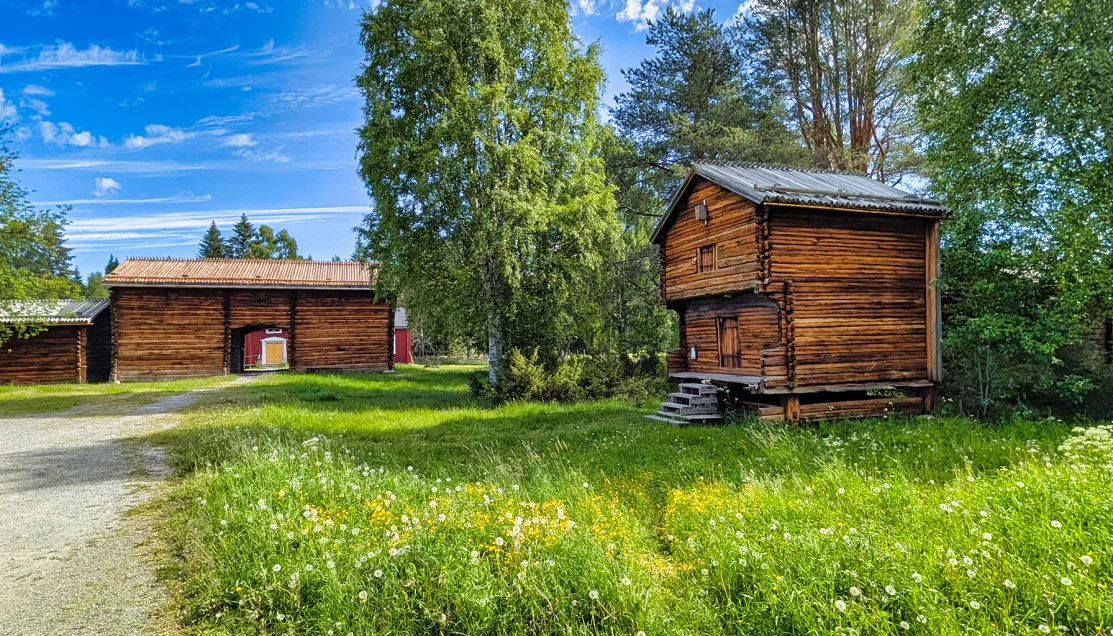
The loft storehouse and its broad central passage stand at left, while the smaller raised storehouse from 1836 occupies the foreground at right.
On the other side, we stopped to look at the smaller raised storehouse dating from 1836. Its compact lower level supported a noticeably projecting upper story, creating a form quite different from the longer timber buildings around it.
Beyond the storehouse, we came to the museum’s yellow-painted dance floor, representing another aspect of village life. Buildings such as this provided gathering places for rural communities, adding a social dimension to the farmhouses, storehouses and agricultural structures preserved elsewhere on the grounds. Continuing farther into Hägnan, the buildings became more widely scattered and the landscape opened into pasture, where horses and other farm animals stood behind traditional fencing.
With a set time to meet our guide back at Nederluleå Church, we could only make a relatively quick pass through Hägnan rather than stop to examine the museum in detail. After reaching the farm area, we turned back toward Gammelstad.

Traditional fencing and scattered farm buildings lined the path as we began making our way back toward Gammelstad.
Leaving the open grounds of Hägnan, we retraced our route through the red cottages, with the tower of Nederluleå Church gradually coming back into view above them. We made it back in time to rejoin our guide.
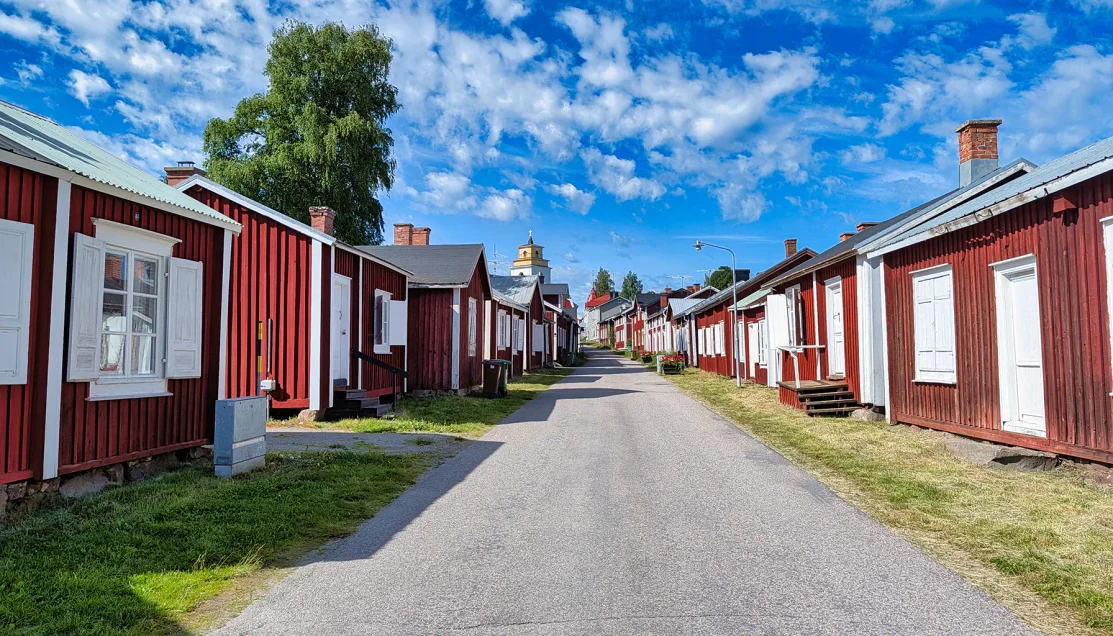
Rows of traditional red church cottages line one of Gammelstad’s lanes, with the tower of Nederluleå Church rising above the settlement.
Nederluleå Church
A funeral temporarily delayed our planned visit inside the church. Once the service had concluded and the church reopened to visitors, we entered through the weapons porch, where the guide explained that visitors historically left their weapons before proceeding inside.
Beyond the porch, the restrained exterior gave way to a much more elaborate interior. The scale of the building was immediately apparent. Nederluleå Church was built during the 15th century and inaugurated in 1492, making it the largest late-medieval stone church in northern Sweden. The guide also drew our attention to its thick stone walls and explained that some of the original windows were later enlarged to admit more daylight.
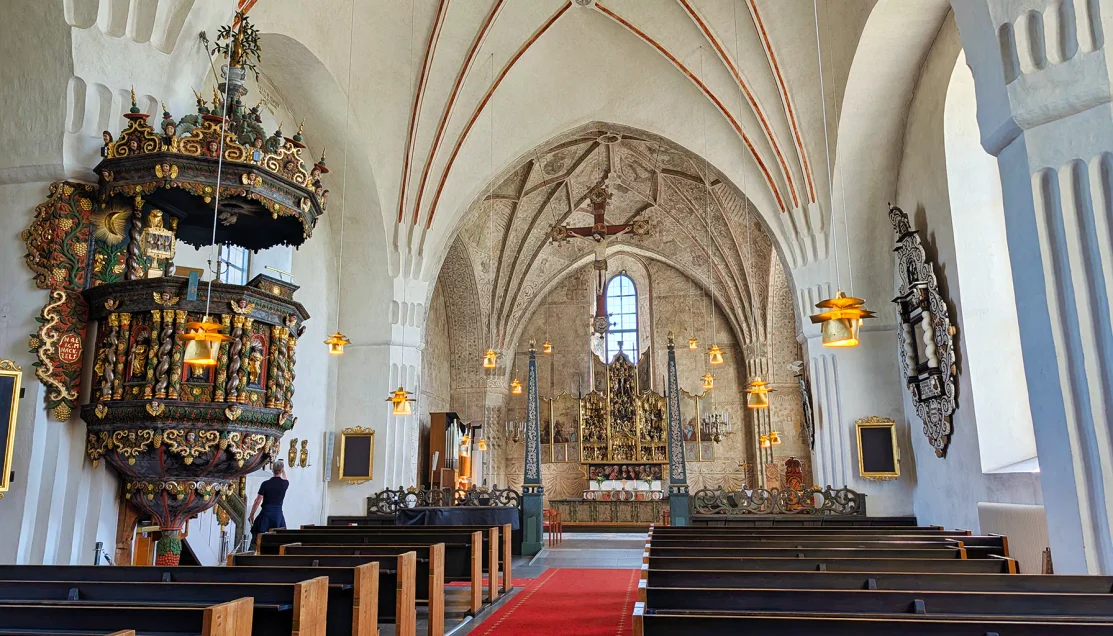
The long central aisle reveals the scale of the late-medieval stone church, leading through the whitewashed nave toward the richly decorated chancel.
Looking upward revealed much of what gave the interior its distinctive character: paintings spread across the brick vaults and portions of the walls. The guide explained that they were added after the church was completed, filling otherwise undecorated surfaces with biblical figures and scenes. Following the Reformation, some were covered as the church changed from Catholic to Lutheran worship, but they were later uncovered and restored.
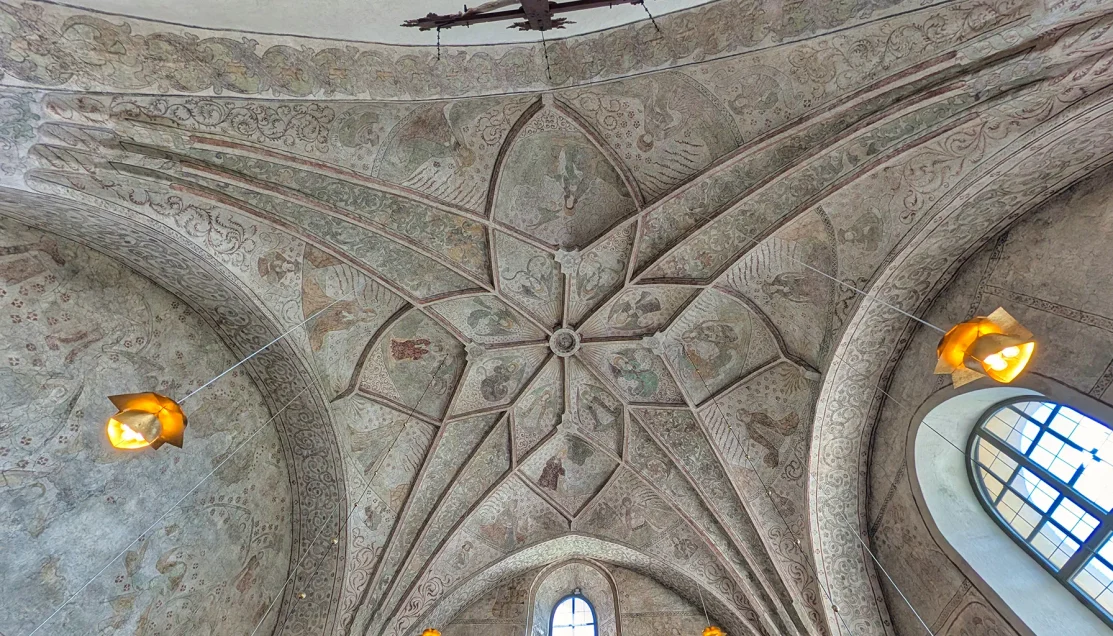
Biblical figures and decorative patterns spread across the brick vaults, preserving much of the painted interior that was later uncovered and restored.
Moving toward the chancel brought us closer to the large carved altarpiece we had seen from the nave. Its densely arranged biblical figures and gilded details stood out sharply against the pale walls and faded medieval paintings surrounding it.
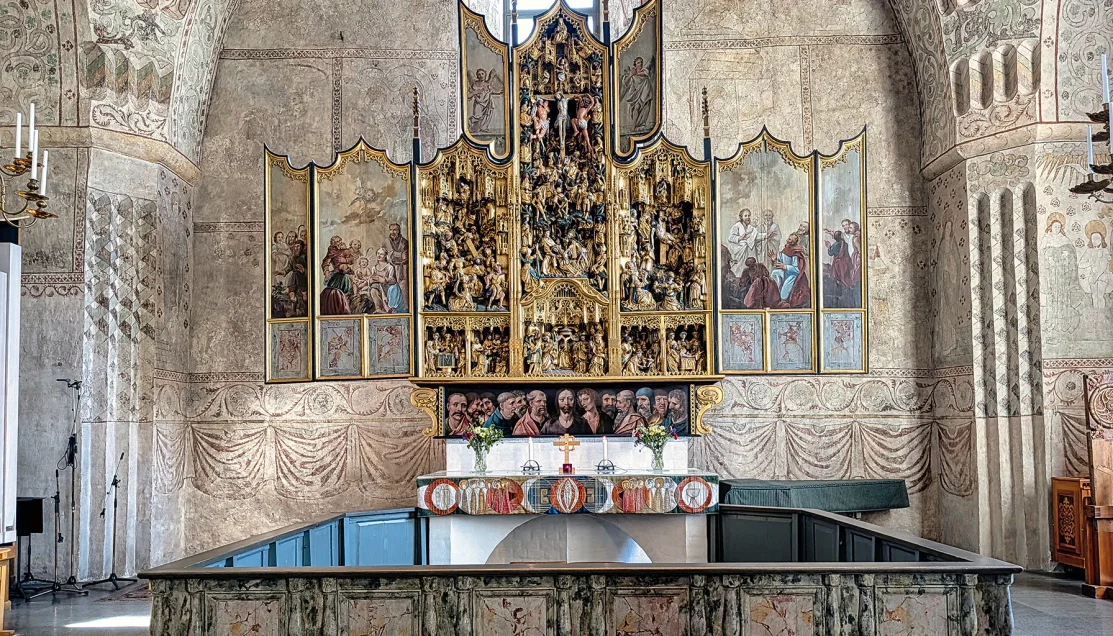
Multiple tiers of carved figures fill the gilded altarpiece, with individual biblical scenes arranged across its elaborate framework.
Nearby, a suspended crucifix hung above the nave, while the elaborately carved pulpit projected from the wall beside the chancel. Its dense carving, painted figures and gilded ornament made it one of the most visually elaborate features of the interior.

The richly painted and gilded pulpit combines carved figures, twisted columns, floral ornament, and a decorated staircase beneath its elaborate sounding board.
Turning back toward the entrance brought the organ loft into view. The organ contains approximately 4,200 pipes and 55 stops, from the large façade pipes visible across the loft to much smaller pipes hidden within the instrument.
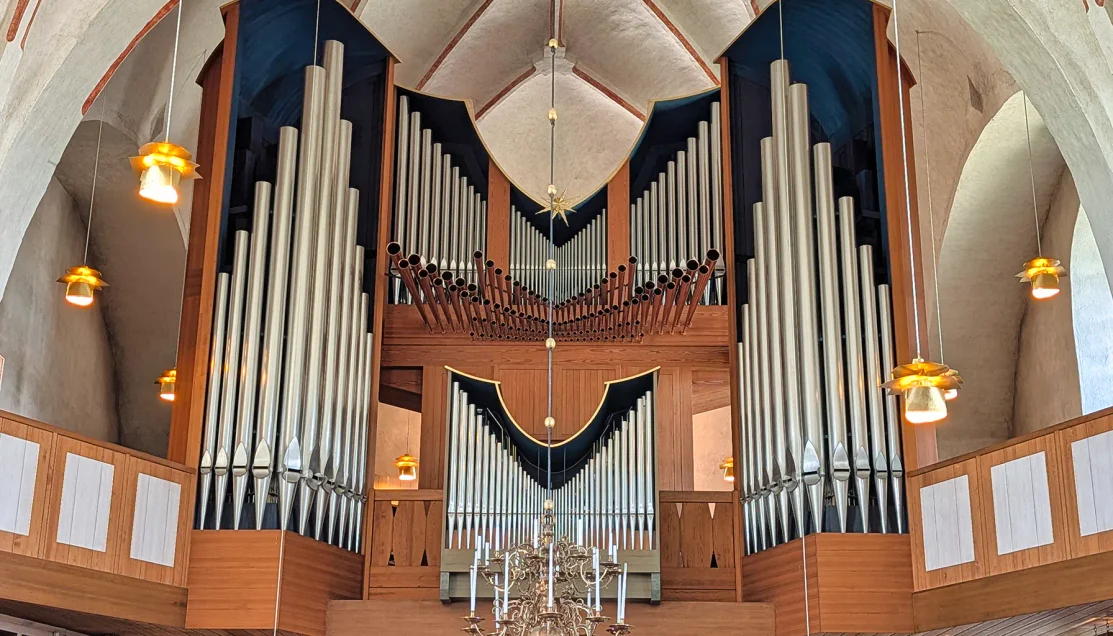
Ranks of silver façade pipes rise around the central loft, their symmetrical arrangement filling much of the western end of the church.
From this end of the nave, the different elements of the interior could be seen together, from the painted vaults overhead to the carved furnishings and medieval decoration encountered along the way.
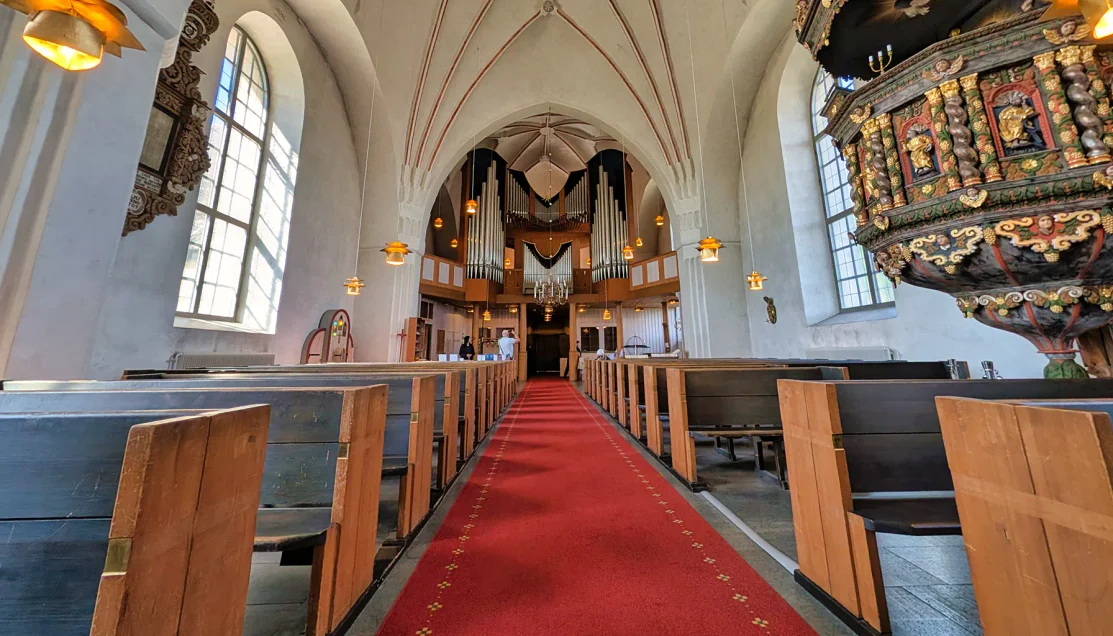
The long red aisle leads toward the entrance, with the organ loft filling the western end beneath the vaulted ceiling.
After spending time inside, we returned through the churchyard and back toward the coach. With the scheduled Gammelstad visit complete, we boarded for the drive back toward Luleå.
Return to Luleå
Leaving Gammelstad, the coach headed back toward Luleå, but the return route included one final look at the modern city. Our guide directed our attention toward Porsön and the large Meta data center, still referring to it by its original Facebook name. Rather than simply passing it at a distance, the coach made a short detour around the front of the complex.
As we looped past the complex, our guide explained why a facility of this scale had been built in Luleå, pointing to the cool climate and access to reliable electricity. From the coach, however, relatively little of the operation itself was visible. Long, low buildings stood behind the controlled perimeter, with the guide also pointing out the security surrounding the site.
From Porsön, we continued through Luleå and back toward the harbor. The industrial waterfront came into view again as we approached the port, and soon we were back alongside Insignia, where the excursion came to an end.
☑ Who Is This Tour Best For?
- Travelers interested in cultural history – Gammelstad preserves an unusual northern Scandinavian church-town tradition, with the medieval parish church surrounded by hundreds of cottages once used by worshippers traveling long distances.
- Travelers who enjoy guided visits with independent exploration – The excursion combines guide interpretation and a church-cottage interior visit with time to explore Gammelstad independently.
- Travelers interested in historic architecture and everyday life – The experience ranges from the substantial stone church to compact wooden church cottages, permanent residences, former stables and other buildings associated with the settlement.
- Travelers comfortable with walking on mixed surfaces – Most walking is concentrated in Gammelstad and includes streets, pedestrian lanes, grassy passages and some uneven surfaces between buildings.
⊞ Tour Summary
- Tour Name: Luleå City Tour & UNESCO-Listed Gammelstad
- Port: Luleå, Sweden
- Ship: Oceania Insignia
- Total Duration: ~3½ hours
- Primary Focus: Panoramic Luleå sightseeing and historic Gammelstad Church Town
- Main Stop: Gammelstad Church Town, including a church cottage and Nederluleå Church
- Independent Addition: Hägnan Open-Air Museum during free time
- Refreshment Included: Coffee and small squares of cake topped with whipped cream
- Drive-By Highlights: Luleå waterfront, industrial and civic districts; Meta data center
▣ Activity Summary
- Walking: Moderate walking concentrated in Gammelstad, with additional walking for those choosing to explore farther during independent time.
- Terrain: Primarily streets and pedestrian lanes, with some grassy and uneven passages between the church cottages.
- Pacing: Panoramic coach sightseeing through Luleå followed by guided exploration in Gammelstad, independent free time, and a scheduled interior visit to Nederluleå Church.
- Free Time: Time was provided for independent exploration within Gammelstad. During our visit, we used part of that period to explore neighboring Hägnan Open-Air Museum independently.

Related Northern Europe Travel: Explore more Northern European cruise ports and shore excursions in our complete regional guide.
→ Northern Europe Cruises & Shore Excursions Guide
© OceansAfoot