Berlin, Germany • July 23, 2010
About This Experience
This semi-independent day trip provided cruise guests with a direct rail connection from Warnemünde to Berlin aboard a scheduled Deutsche Bahn train. Escorted to the station by a cruise representative, participants had several hours of free time to explore the German capital. Designed for those comfortable with extended walking and self-navigation.
Arriving by Rail into the Heart of Germany
We departed early in the morning for the Berlin Transfer by Train excursion, a cruise line-arranged transfer designed to give guests an independent day in Germany’s capital. The train ride from Warnemünde to Berlin lasted approximately 2.5 hours, passing through the rural landscapes of Mecklenburg-Vorpommern and Brandenburg before reaching Berlin Hauptbahnhof, the city’s central transportation hub.
During the ride, we were seated in a shared six-person compartment with three French women who, while cordial, politely maintained the appearance of not speaking English for the entire journey. The train ride was otherwise smooth and efficient, and we passed the time watching the countryside roll by.
This excursion included a guide only for the rail portion. Upon arrival, all participants were given a return time and a rendezvous point at Berlin Hauptbahnhof. A coach was scheduled to transport the group from the station to Potsdamer Platz, where the self-guided day would officially begin.
Normally, that’s when exploration would begin. But in an effort to get ahead—a decision that quickly backfired—we exited the train early at Berlin-Lichtenberg, mistakenly believing it was closer to our destination. Instead, we found ourselves stranded on the outskirts of the city, far from the coach transfer and completely detached from the group.

🛤️ Stop 1: Berlin-Lichtenberg Station (Unplanned Detour)
📍 Location: Weitlingstraße 22, Berlin, Germany
⏳ Time Spent: 1 hour
Upon arrival at Berlin-Lichtenberg—our unintended stop—we left the station to regroup and assess our options. Before continuing, we made a quick visit to a nearby retail shop. Unfortunately, during this brief outing, Leslee accidentally misplaced her glasses, leaving me to take over all navigation duties for the rest of the day.
Realizing our mistake and the importance of getting back on track, we returned to Berlin-Lichtenberg station and purchased local train tickets to reach our originally intended destination: Berlin Hauptbahnhof. This additional leg of travel cost us both time and convenience, further compounding the setback caused by our premature exit from the main transfer.

🚦 Navigation Error: We exited early at Lichtenberg Station, missing the group coach transfer into central Berlin.
🚉 Stop 2: Berlin Hauptbahnhof
📍 Location: Europaplatz 1, Berlin, Germany
⏳ Time Spent: 20 minutes
🏙️ Urban Note: The station spans multiple levels and connects long-distance, regional, and S-Bahn lines.
Following the delay caused by our unexpected detour, it took an additional 20 minutes by regional train to reach Berlin Hauptbahnhof—the intended arrival point for our independent exploration. The station, an architectural centerpiece of modern Berlin, spans multiple levels and serves as the city’s main transportation hub, linking long-distance, regional, and S-Bahn lines. We arrived later than planned, but finally ready to begin our day ashore.
🏛️ Stop 3: Checkpoint Charlie
📍 Location: Friedrichstraße 43-45, Berlin, Germany
⏳ Time Spent: 20 minutes
Our first destination was Checkpoint Charlie, once the most well-known border crossing point between East and West Berlin during the Cold War. Operated by the U.S. military, it served as a controlled gateway through the Berlin Wall and became a powerful symbol of the divided city.
Today, the original guardhouse and signage have been replaced with replicas for tourists, and we were surprised to find that no actual sections of the Berlin Wall remain standing at the site itself. While the area retains its historical significance, it functions primarily as a photo opportunity and a symbolic marker rather than a preserved heritage site.

🕵️ Cold War Symbolism: Once the best-known border crossing during Berlin’s division, now a symbolic photo spot with replica signage.
🏛️ Stop 4: Berlin Wall Memorial & Documentation Center
📍 Location: Bernauer Straße 111, Berlin, Germany
⏳ Time Spent: 1 hour 20 minutes
🛍️ Shopping Tip: The visitor center includes a well-curated gift shop with historical maps and Cold War books.
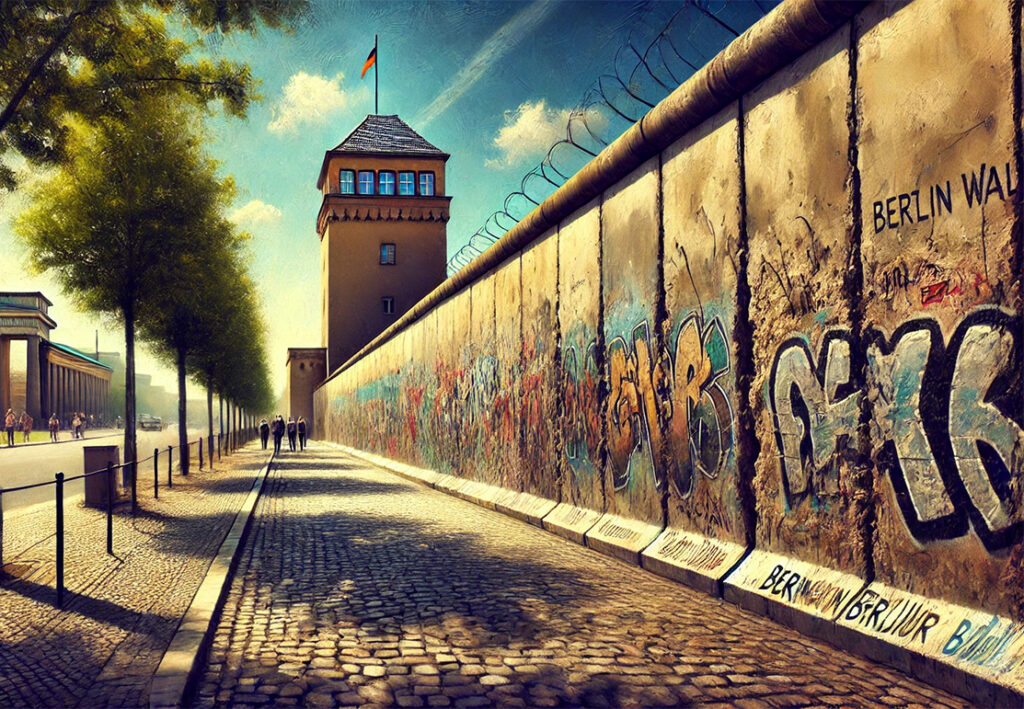
We got directions and walked about 15 minutes to the Berlin Wall Memorial, located on Bernauer Straße in the Mitte district. Unlike the commercialized atmosphere at Checkpoint Charlie, this site preserves one of the most historically authentic segments of the Berlin Wall. A surviving guard tower, foundation walls, and a stretch of the former “death strip” provide a sobering visual of the border’s physical and psychological impact. Interpretive panels explain key events and personal stories from Berlin’s division and reunification.

📝 Note: We did not visit the Marienfelde Refugee Transit Camp, which is located in southern Berlin and operated separately.
Continuing our walk along the street, we noticed that the former path of the Berlin Wall was subtly marked by a double row of cobblestones embedded into the pavement. These stones trace the Wall’s original course and serve as a quiet but powerful reminder of the city’s once-divided status. At one point, we were able to straddle the line—standing with one foot in East Berlin and the other in the West.
❤️ Favorite Moment: Standing on the line that once separated East and West Berlin, we quite literally walked across history.


Just beyond the outdoor section, we entered a series of indoor exhibits, part of the Berlin Wall Memorial’s documentation center. These buildings offered insight into life on either side of the divide and the measures taken to prevent escape. The displays deepened our understanding of the emotional and political consequences of the Wall’s presence in daily life.
🚇 Berlin U-Bahn Transition
After visiting the Berlin Wall Memorial, we boarded the Berlin U-Bahn to continue our exploration. The city’s underground transit system revealed noticeable contrasts between lines and stations—likely remnants of the city’s Cold War-era division. Some stations in East Berlin had once been sealed off as “ghost stations”, where trains passed through without stopping.
We traveled due south to the Mehringdamm district in Kreuzberg, a neighborhood known for its bohemian character and eclectic architecture. Our goal was to find a series of patio-style displays and open-air exhibits believed to be tucked among local courtyards.

🛤️ Stop 5: Mehringdamm District
📍 Location: Mehringdamm, Berlin, Germany
⏳ Time Spent: 1.5 hours
Despite our research, we were unable to locate the specific patio garden displays featured on our map. We wandered the Kreuzberg neighborhood for nearly an hour and a half, but no signage or visible entries matched the descriptions. The elusive garden exhibits remained undiscovered.

🍰 Stop 6: Steineckes Heidebrot Backstube Bakery
📍 Location: Mehringdamm 57, Berlin, Germany
⏳ Time Spent: Approximately 30 minutes
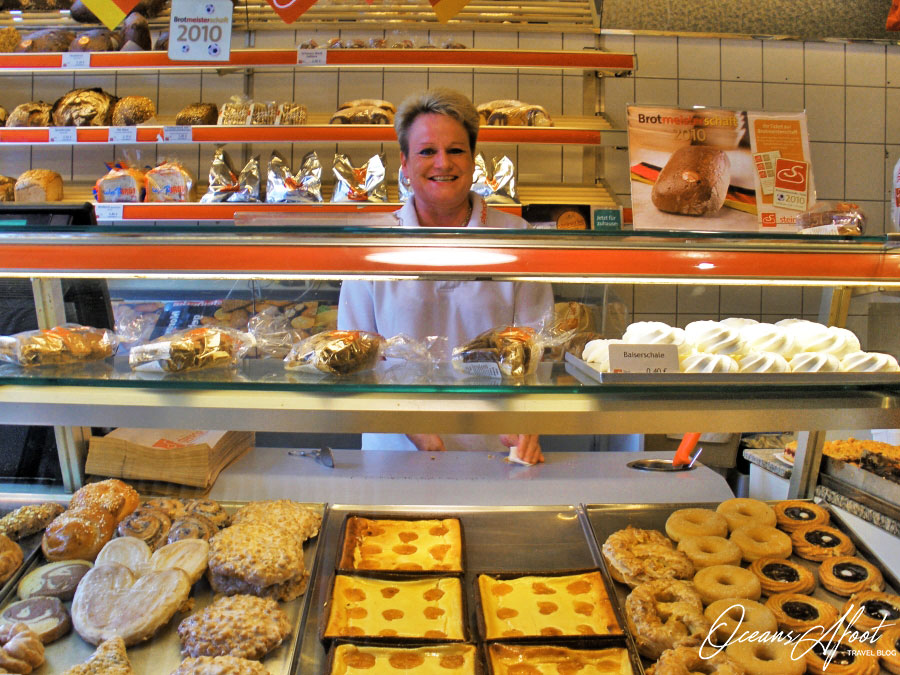
🍽️ Snack Stop: Steinecke’s offered flaky strudels, buttery croissants, and fruit-filled pastries.
Eventually, we abandoned the garden search and stopped at Steinecke’s Heidebrot Backstube, a neighborhood bakery specializing in traditional German baked goods. It was the perfect spot to rest and recharge before heading back to central Berlin.

Tired from several hours of walking and still puzzled by the elusive garden display, we made our way back toward central Berlin. Along the way, we couldn’t help but notice the abundance of graffiti covering walls, underpasses, and even historical buildings—a visual reminder of the city’s ongoing transformation and expressive street culture.


🚶 Wandering Through Central Berlin
After returning to central Berlin, we resumed our walking tour of the city. Despite studying maps and planning a route, we quickly discovered that Berlin’s major attractions were deceptively far apart. Much like the illusion on the Las Vegas Strip, where everything appears walkable but is actually separated by long distances, Berlin’s landmarks required more time and energy to reach than expected.
In an effort to conserve time—and our legs—we decided to hire a young man offering bike taxi services. Our goal was to reach the Reichstag Building, one of Berlin’s most iconic government structures. Unfortunately, just as we began the ride, the driver’s girlfriend appeared on the scene. After a brief exchange in German, he turned to us, offered a heartfelt apology, and promptly abandoned the job to attend to his personal matters—leaving us once again on foot, stranded mid-journey with only our increasingly tired legs to rely on.
🏛️ Stop 7: Reichstag Building & Lawn
📍 Location: Platz der Republik 1, Berlin, Germany
⏳ Time Spent: 30 minutes
We eventually made it to the Reichstag Building, the historic seat of the German Parliament (Bundestag) and one of Berlin’s most recognized landmarks. Completed in 1894 and famously crowned with a modern glass dome after German reunification, the Reichstag blends imperial architecture with contemporary symbolism.
Like many others, we took a moment to rest on the expansive lawn in front of the building, enjoying a brief pause in the heart of Berlin’s government district. The green space around Platz der Republik offered a peaceful spot to take in the building’s grandeur from a distance.

🏛️ Historical Note: Completed in 1894, the Reichstag was restored after reunification with a new glass dome symbolizing government transparency.
As the afternoon wore on, it became clear that it was time to make our way back to Berlin Hauptbahnhof—the designated rendezvous point for our return train journey to the port of Warnemünde.
🚉 Stop 8: Berlin Hauptbahnhof
📍 Location: Berlin Hauptbahnhof (exact platform unknown)
⏳ Time Spent: 20 minutes
📌 Transit Tip: Navigating this multi-level station was confusing without clear signage or English guidance.
We arrived at Berlin Hauptbahnhof with time to spare, but immediately ran into a new challenge: finding the correct platform for our return train to Warnemünde. As we had not stayed with the original group earlier in the day, we missed any guidance the onboard escort may have provided, and now faced a maze of tracks, platforms, and signage in German.
With dozens of departures and minimal English-language information posted, it was easy to feel overwhelmed. Fortunately, we found a currency exchange kiosk inside the station, and the attendant spoke English well enough to point us in the right direction. Thanks to that quick assistance, we located the correct platform just in time and made our way back to the train.

🧭 Takeaway Lessons
This final scramble taught us a valuable lesson: when visiting a country where you don’t speak the language and navigation can be tricky, a fully guided tour may offer more peace of mind. In a city like Berlin—where many streets and station names can sound deceptively similar—it’s easy to get turned around. In hindsight, sticking with the group might have saved us time, energy, and a few moments of panic.
✅ Who Is This Tour Best For?
✅ Adventurous travelers comfortable with unstructured time
✅ Those familiar with European train systems
✅ Guests who enjoy Cold War history and urban exploration
⚠️ Not ideal for first-time visitors without a strong sense of direction
📰 Tour Name: Berlin Transfer by Train
🕒 Total Duration: Approximately 6.5 hours
🚉 Main Stops: Berlin-Lichtenberg (accidental), Hauptbahnhof, Checkpoint Charlie, Berlin Wall Memorial, Mehringdamm, Reichstag
📸 Drive-By Highlights: None
📝 Notes: This was mainly a self-guided experience. Expect a lot of walking and possible confusion without a guide.

Excursion & Photography Notice: All descriptions and photographs on OceansAfoot reflect individual travel experiences and are shared for documentary and informational purposes. Content is based on personal participation, public settings, and traveler observation, and does not represent official positions of cruise lines, tour operators, or featured institutions.
Related Baltic Travel: Explore more Baltic cruise ports and shore excursions in our complete regional guide.
→ Baltic Cruises & Shore Excursions Guide
© OceansAfoot